
Replacing failed floors in Becontree terraces
Terraced houses make up 42% of homes in Barking and Dagenham, and the Becontree estate's cottage-style terraces are the borough's main renovation job. Floors in many of these houses are uneven or were laid without a proper damp proof membrane.
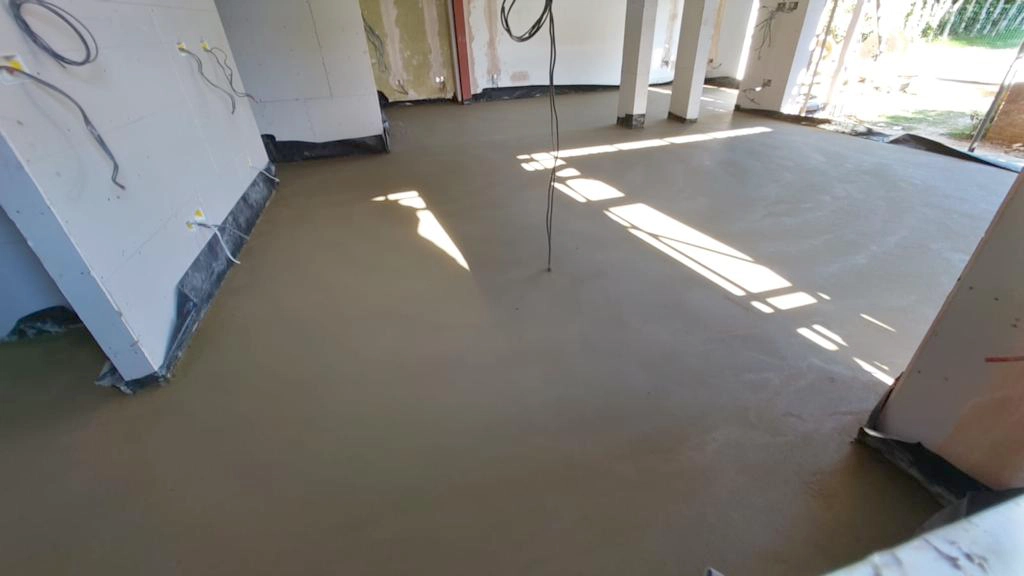
Usually the old slab is broken out completely and built back up. First a membrane goes down to keep damp out, then insulation, then a floating cement screed around 65mm thick for a house. Those lower layers can be supplied and fitted under our insulation and membrane work. The finished level has to meet the doors, the hallway and any new extension, so we check heights before pricing, and a photo of each doorway threshold helps.
Sand and cement suits a dug-out floor split into small rooms with several doorways. The mix is made up in batches, so the floor can be laid room by room without a pump lorry parked outside all day, and each batch can be adjusted where the depth varies across the old floor.
It also works where the floor must carry weight early or where a cement substrate is required by the finish. Where the old floor is sound and only uneven, a new screed may be unnecessary, and levelling compound for Becontree floors can be the answer.
How each depth is arrived at is set out in our guide to screed depths.
Wet rooms, garages and bonded screeds in Dagenham and Barking
In a walk-in shower or wet room, the screed is laid to a fall so water runs off to the drain. That is hand work, and it must be cement based, because calcium sulphate screed is not suitable where a floor may get wet. So even when the rest of an extension is poured with a flowing screed, the shower or utility area is often laid in sand and cement.
Garage conversions follow a similar pattern to a dug-out floor. That slab tends to sit below the house floor, with no insulation and the odd stain. The new screed has to sit on insulation and meet the adjoining room at the same level.
If the concrete underneath is sound and headroom is short, a bonded screed only 25 to 40mm thick can go straight onto it. On 2026 UK figures, a bonded screed costs from £12 up to £18 per m², against £18 to £25 per m² for a floating one.
It is slower drying than a pumped floor. Drying runs at roughly a millimetre a day until 40mm, and slows beyond that. For a project in Redbridge, see sand and cement screed in Redbridge.
Sand and Cement Screed prices in Barking and Dagenham
Sand and cement screed: £18 to £25 per m² supplied and laid (MyJobQuote, August 2026), so £450 to £630 for 25 m². MyJobQuote does not say whether these figures include VAT. See our floor screeding cost guide or screed calculator.
Who lays your sand and cement screed in Barking and Dagenham
K & B Screeding’s own team, led by director Donatas Bardisevicius. Founded 2019, company 12298780.
See what customers say in our Google reviews and on our testimonials page.
Sand and Cement Screed from Slough to Barking and Dagenham
Barking and Dagenham is about 33.1 miles east of our Slough base as the crow flies, with postcodes including IG11, RM9, RM8 and RM6. The nearest towns to it are Redbridge (3.5 miles), Newham (4 miles), Havering (4.2 miles) and Chigwell (5.3 miles).
More on sand & cement screed, part of our screeding services.
