
Rebuilding old floors in Gidea Park and Emerson Park
Early garden suburbs came to Havering with the railways, at Upminster, Emerson Park and Gidea Park. Gidea Park started life in 1910 and 1911 as an exhibition of 159 houses by more than 100 architects, and that variety carries through to the floors. Two neighbouring houses can have different floor levels and different sub-floors. A hand-laid screed adapts to that, room by room.
Only 5% of the borough's homes date from before 1919, so truly old floors are the exception here. Far more of Havering's houses come from between the wars and the years after 1945. Once a ground floor in one of those has cracked or its damp protection has given up, the answer is normally to dig it out, put down insulation and a membrane, and lay a fresh sand and cement topping.
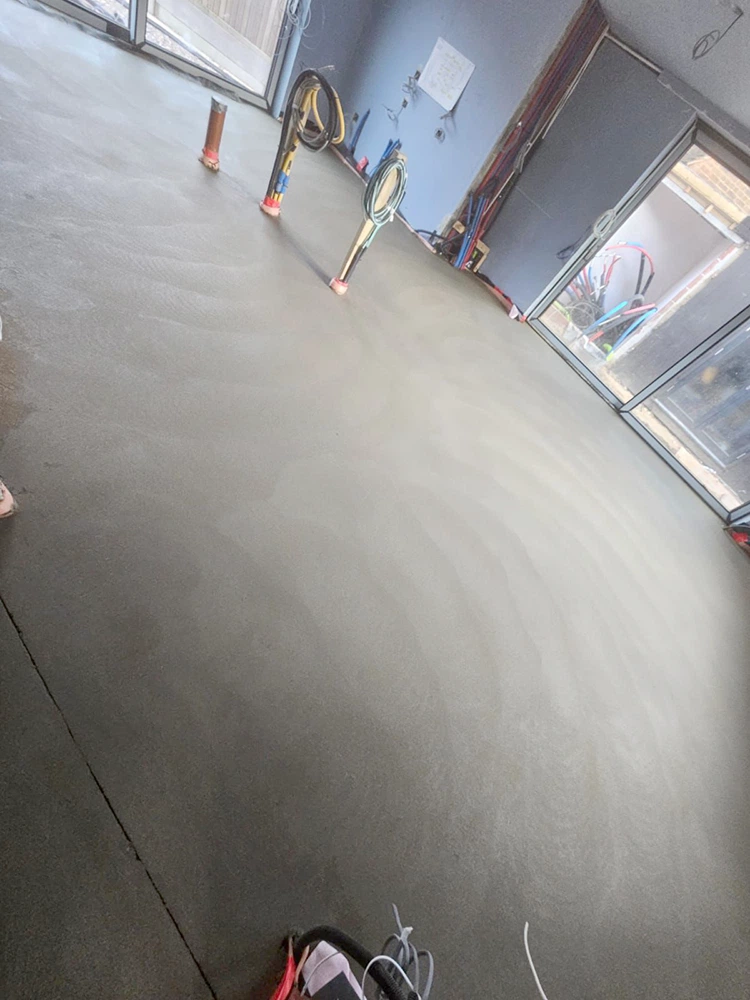
The depth is set by the base it goes over. Over insulation, a house floor floats at 65mm, rising to 75mm in commercial space. A bonded screed, stuck straight to a sound slab, runs from 25 to 40mm and suits places where height is tight. Each is compacted and trowelled, or power floated on larger areas, to a flat finish.
Mixing fibres in helps a floor resist cracking and adds roughly £1 to £3 per m²; whether your Gidea Park or Emerson Park floor needs them is covered under screed with added fibres. Without fibres, current published pricing puts sand and cement between £18 and £25 per m².
Wet rooms, garages and Harold Hill terraces
A few rooms rule out anything but cement. Walk-in showers and wet rooms are laid with a gentle fall to the drain, a shape that is far easier to form with a trowel than with a mix that flows flat, and cement tolerates water in a way calcium sulphate does not.
Converted garages come up a lot as well. The old slab usually slopes and sits below the house, so it gets insulation and a membrane, then enough screed on top to bring it up to the hall floor. Each layer, from old slab to finished topping, is covered in our garage conversion floor guide.
In Havering, 24% of homes are terraced, and Harold Hill's brick terraces, built from 1948 to 1958, are typical of the borough's post-war stock. Where the only way to the back of a terrace is through the house, a site mix can be barrowed through in manageable loads, with no pump parked on the street.
The catch with a hand-laid mix is drying time. A 65mm floor loses its moisture at roughly one day per millimetre for the first 40mm, then more slowly, so it stays wet far longer than a thin pumped floor. If the kitchen fitter is booked, a quick drying additive can pull that in. For homes over the Essex side, there is also a Brentwood sand and cement page.
Sand and Cement Screed prices in Havering
Sand and cement screed: £18 to £25 per m² supplied and laid (MyJobQuote, August 2026), so £450 to £630 for 25 m². MyJobQuote does not say whether these figures include VAT. See our floor screeding cost guide or screed calculator.
Who lays your sand and cement screed in Havering
K & B Screeding’s own team, led by director Donatas Bardisevicius. Founded 2019, company 12298780.
See what customers say in our Google reviews and on our testimonials page.
Sand and Cement Screed from Slough to Havering
Havering is about 37.1 miles east of our Slough base as the crow flies, with postcodes including RM11, RM1, RM13 and RM5. The nearest towns to it are Barking and Dagenham (4.2 miles), Brentwood (5.4 miles), Redbridge (6.4 miles) and Chigwell (6.9 miles).
More on sand & cement screed, part of our screeding services.