
Heated ground floors in Hornchurch and Elm Park semis
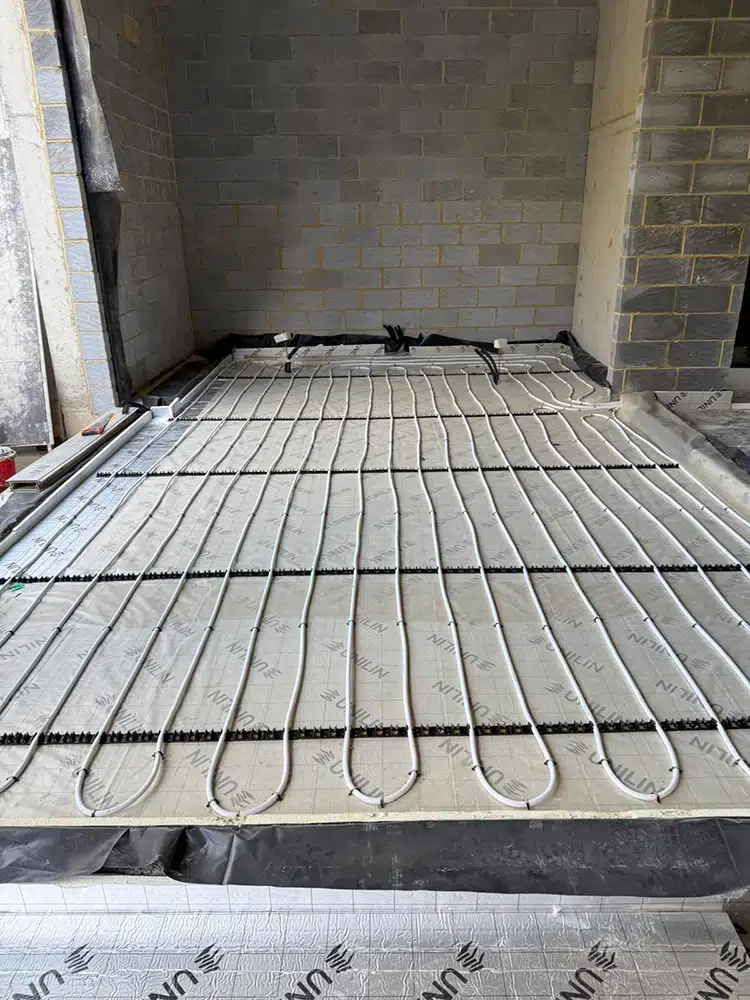
Over a third of Havering's homes, 36%, went up in the inter-war years from 1919 to 1944. The semis of Hornchurch and Elm Park are typical of that stock, and a common project is a whole ground floor upgrade: the old concrete floor comes out, insulation and a membrane go down, the heating pipes are clipped on top, and a new screed buries them.
The screed does the real work. It spreads the heat from the pipes across the floor, so it has to surround each pipe completely, with no air pockets, and be deep enough over them to carry the flooring without cracking. With a pumped mix, at least 25mm has to sit over the pipes, which puts the whole layer at around 45 to 50mm. A hand-laid mix asks for around 45mm over the pipes alone, so the build-up beneath your new Hornchurch floor gets that much thicker.
In an older house, that depth decides the choice. If digging down is limited, a liquid screed over the pipes keeps the finished floor at the height of the doors and thresholds. Where the floor is being rebuilt from scratch with plenty of depth, either type works.
Liquid screed is often preferred because it flows under and around the pipes and warms up faster once the system runs. The pumped liquid screed page covers access and pump set-up, and our insulation and membranes service covers the layers underneath.
Commissioning the heating in a Havering home
The heating is part of drying the floor, but it has to be switched on at the right time and turned up slowly. Calcium sulphate floors can normally have low heat put through them from around day 7. Sand and cement is slower, and the floor circuit stays off until a minimum of 21 days have passed.
After that, the flow temperature creeps up a little each day, sits at its working level for a spell, then comes back down before any covering is laid. Rushing it can crack the screed or leave it drying unevenly. You get that programme on paper from us, so whoever runs the boiler in your house and the engineer are working from the same plan.
Detached homes make up 11% of Havering's housing, and bigger ground floors bring zoning into play. Joints are placed where heating zones meet or across doorways, so each zone can expand without cracking its neighbour. Those positions are agreed with the heating engineer before the pour.
A heated garden room or extension in Romford works the same way, just across less floor. Nearby, we also lay heated floor screed in Redbridge, and our screed thickness guide sets out the full depths.
Underfloor Heating Screed prices in Havering
Liquid screed over underfloor heating: £20 to £35 per m² supplied and laid (trade2base, June 2026), so £700 to £1,230 for 35 m². trade2base gives these figures excluding VAT. See our floor screeding cost guide or screed calculator.
Who lays your underfloor heating screed in Havering
K & B Screeding’s own team, led by director Donatas Bardisevicius. Founded 2019, company 12298780.
See what customers say in our Google reviews and on our testimonials page.
Underfloor Heating Screed from Slough to Havering
Havering is about 37.1 miles east of our Slough base as the crow flies, with postcodes including RM11, RM1, RM13 and RM5. The nearest towns to it are Barking and Dagenham (4.2 miles), Brentwood (5.4 miles), Redbridge (6.4 miles) and Chigwell (6.9 miles).
More on underfloor heating screed, part of our screeding services.
