
Heated extensions on Chigwell's post-war houses
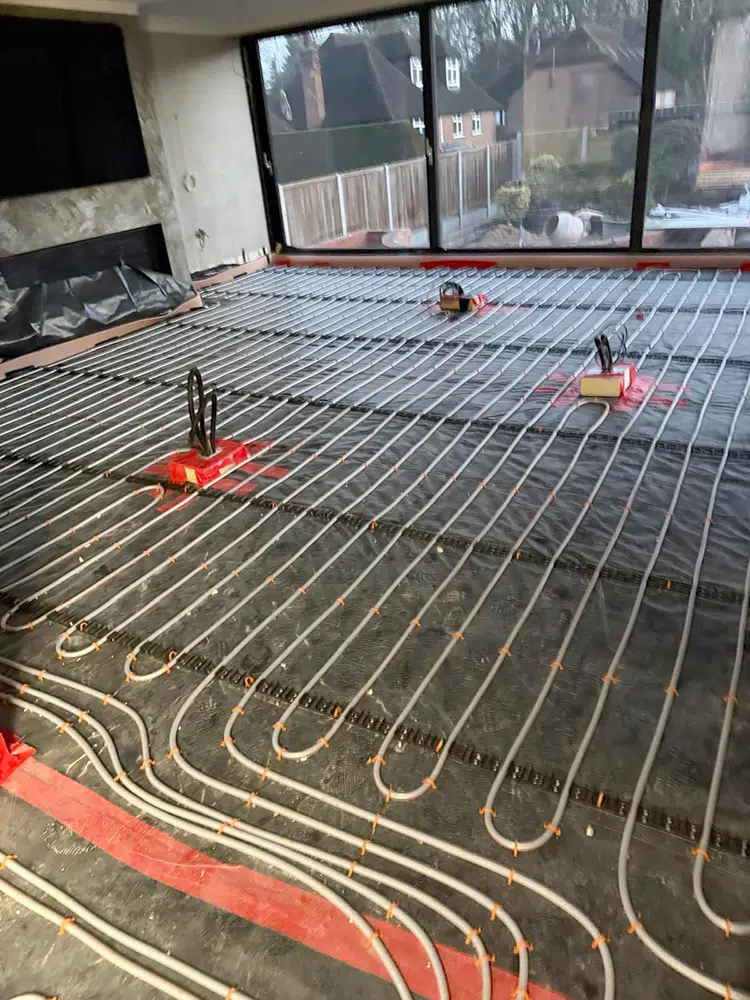
On a mid-century Chigwell house the usual plan is simple: the house gains a large rear extension, the old dividing walls come out, and wet heating is laid across the new space and sometimes into the original rooms too. The screed on top does two jobs. It spreads the heat evenly and gives a strong, flat base for tiles, LVT or engineered wood.
Full encapsulation is essential, because any air gap around a pipe is a cold spot and a weak point. A pumped liquid screed around the pipes flows under and between them, and needs at least 25mm of cover above the pipe, giving a total of about 45 to 50mm. A traditional sand and cement screed needs about 45mm of cover, so the whole floor is deeper and heavier.
The tricky part is the join. Where the new heated floor runs into an original 1950s or 1960s slab without pipes, the two areas have to finish at the same level. Sometimes the old floor is dug down; sometimes the new build-up is adjusted to suit. Deciding that before the insulation is bought saves a lot of trouble later.
Council tax bands point to larger homes too: 53% of Chigwell's homes are in bands F to H. On a bigger house the heated area is substantial, which makes the depth and the drying plan worth getting right.
Switching on the heating under a new Chigwell floor
K & B does not install underfloor heating pipes. Your heating engineer lays and clips the circuits and pressure tests them, and the circuits are normally kept under pressure during the pour, so any damage would show at once.
Commissioning then follows the material. On a calcium sulphate screed, the first gentle warmth can usually go in at around day 7. A sand and cement screed needs at least 21 days first. In both cases the water temperature is raised gradually over several days, held, then brought back down, and the floor is checked before any covering goes on. This controlled heat-up also helps dry the screed. Skipping it, or turning the system straight to full temperature, is a common reason for cracks and for tiles that debond in the first winter. Keep a simple log of the dates and water temperatures used, and pass it to the flooring fitter so they know the floor has been brought up to heat properly.
For older Chigwell houses where the whole ground floor is being retrofitted, floor height is often the limit. Thinner liquid systems help, and the flow screed specification page covers faster drying products for reduced depths. Nearby, the same service is available in Loughton homes with underfloor heating.
Underfloor Heating Screed prices in Chigwell
Liquid screed over underfloor heating: £20 to £35 per m² supplied and laid (trade2base, June 2026), so £700 to £1,230 for 35 m². trade2base gives these figures excluding VAT. See our floor screeding cost guide or screed calculator.
Who lays your underfloor heating screed in Chigwell
K & B Screeding’s own team, led by director Donatas Bardisevicius. Founded 2019, company 12298780.
See what customers say in our Google reviews and on our testimonials page.
Underfloor Heating Screed from Slough to Chigwell
As the crow flies, our yard in Slough is about 31.6 miles from Chigwell, which lies to the east-north-east. Postcodes here include IG7, and Redbridge (2.4 miles), Loughton (2.5 miles), Waltham Forest (3.9 miles) and Waltham Abbey (5.3 miles) are close by.
More on underfloor heating screed, part of our screeding services.