
Heated extensions on the Debden estate
The Debden estate was built by the London County Council around Jessel Green between 1947 and 1952. Its former council houses are regularly extended and remodelled, and underfloor heating is often run through the whole open-plan room that results. Semis make up 31% of Loughton's homes, and an extended semi faces the same question of floor height.
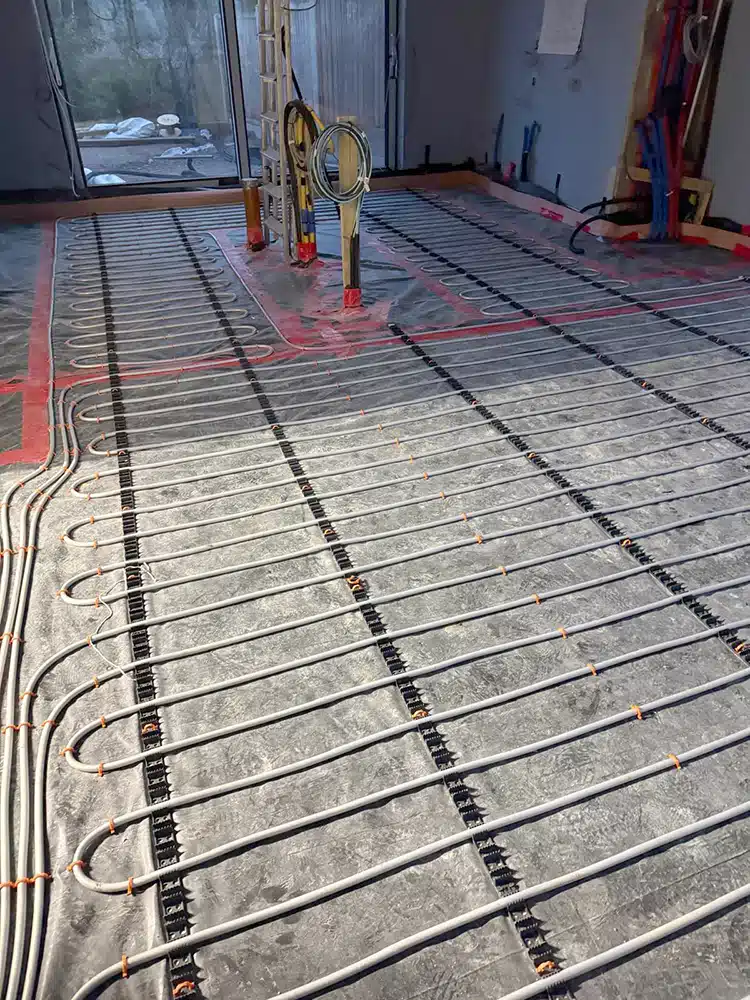
The challenge is height. The warm new floor must end flush with the old one, so insulation, pipework and enough screed on top all have to squeeze into that depth. Using liquid, the pipes want 25mm or more on top, and a Debden extension floor then normally totals 45 to 50mm. The traditional mix wants about 45mm of depth over that pipework, which makes the whole floor thicker.
In the extension, the builder can dig to suit. In the original part of the house, adding heating means taking up the old floor to make room, or accepting a raised floor with changes at the doors. Tell us the existing floor level and what the plan is for the old kitchen when you ask for a price.
Any air trapped round the pipes leaves cold patches, so the screed has to enclose them fully. A pumped liquid screed that flows round the pipes does this by its nature, while sand and cement relies on careful compaction. What sits underneath counts as well, and we can lay the insulation and membrane for you.
Bringing a Loughton heated floor into use
The heating must not be switched straight to full to dry the floor. A new screed needs a slow start, raising the water temperature gradually over several days, or it can crack or curl.
When that can begin depends on the screed. For calcium sulphate, that point usually comes roughly a week in. The traditional mix must be left three weeks, 21 days, before any heat. The warm-up timetable itself comes from the screed maker or your heating engineer, and we leave written notes with you when the pour is done.
Terraced houses, 27% of Loughton's homes, raise the same questions on a smaller scale, and where there is no side access the pump hose has to travel through the house.
Before tiles, LVT or engineered wood go on, the screed needs the flatness they call for and a moisture reading within the maker's limit. Our guide to screed drying times explains why the heating helps but cannot be rushed. For a house in Epping, our Epping underfloor heating screed page covers the same work.
Underfloor Heating Screed prices in Loughton
Liquid screed over underfloor heating: £20 to £35 per m² supplied and laid (trade2base, June 2026), so £700 to £1,230 for 35 m². trade2base gives these figures excluding VAT. See our floor screeding cost guide or screed calculator.
Who lays your underfloor heating screed in Loughton
K & B Screeding’s own team, led by director Donatas Bardisevicius. Founded 2019, company 12298780.
See what customers say in our Google reviews and on our testimonials page.
Underfloor Heating Screed from Slough to Loughton
As the crow flies, our yard in Slough is about 31.8 miles from Loughton, which lies to the east-north-east. Postcodes here include IG10, and Chigwell (2.5 miles), Waltham Abbey (3 miles), Epping (3.5 miles) and Waltham Cross (4.8 miles) are close by.
More on underfloor heating screed, part of our screeding services.