
Heated floors in Epping extensions and older houses
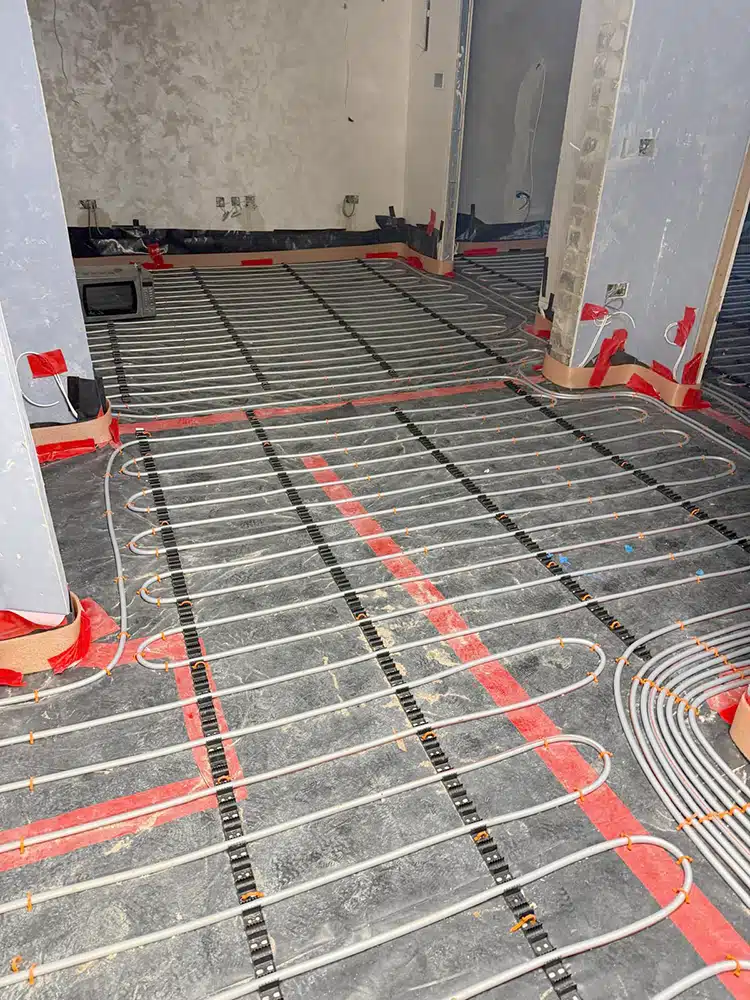
Whether an older Epping house can take underfloor heating comes down mainly to height. Insulation goes down first with the pipes on top, then enough screed over them to spread the warmth and stop cracks. A liquid screed needs at least 25mm of cover over the pipes, giving a total of 45 to 50mm in most cases. Hand-laid sand and cement needs about 45mm of cover on its own, so the finished floor ends up deeper.
That is why liquid is common in retrofits. In a post-war semi towards Ivy Chimneys or Coopersale, where a heated rear extension has to meet the existing kitchen level, those saved millimetres can decide whether the floor lines up without a step. How the pump gets in is explained under pumped liquid screed in Epping.
The period cottages behind the High Street are harder. Their old solid floors usually have to be dug out anyway to add a membrane and insulation, and the depth of that dig sets how much insulation, pipe and screed will fit. We look at the thresholds, the doors and the external ground level before recommending a build-up.
A garden room is the same problem in miniature. In every case, insulation, membrane and edge strip need checking before we pour, and if they are missing we can supply and fit them as part of our insulation and membranes work.
Once laid, the screed encapsulates the pipes with no air pockets, which is what lets the system warm up quickly and evenly.
South Epping new homes and switching the heating on
South Epping is allocated for at least 450 new homes in the adopted Local Plan, and new houses of that kind are likely to use screed over underfloor heating. On a new plot the drawings normally fix the insulation, pipe layout and screed depth, and we pour to that specification.
The stage that is easiest to get wrong comes after the pour: the heat-up. Under calcium sulphate, the heating can normally come on from around day 7, and that helps the drying along. With sand and cement, keep it off for 21 days or more. Either way, commissioning is gradual: the flow temperature goes up a little at a time over several days, is held there, then comes down again before any flooring is laid. Turning the heating straight up to full risks cracking the floor.
The schedule is something we write out and leave with you. Why it works that way is covered in our screed drying times guide.
The same service in Harlow is covered on our underfloor heating screed in Harlow page.
Underfloor Heating Screed prices in Epping
Liquid screed over underfloor heating: £20 to £35 per m² supplied and laid (trade2base, June 2026), so £700 to £1,230 for 35 m². trade2base gives these figures excluding VAT. See our floor screeding cost guide or screed calculator.
Who lays your underfloor heating screed in Epping
K & B Screeding’s own team, led by director Donatas Bardisevicius. Founded 2019, company 12298780.
See what customers say in our Google reviews and on our testimonials page.
Underfloor Heating Screed from Slough to Epping
As the crow flies, our yard in Slough is about 34.5 miles from Epping, which lies to the east-north-east. Postcodes here include CM16, and Loughton (3.5 miles), Waltham Abbey (4.1 miles), Harlow (4.9 miles) and Chigwell (5.6 miles) are close by.
More on underfloor heating screed, part of our screeding services.
