
Heating under screed at Waltham Abbey North and beyond
Plans for Waltham Abbey North allow for at least 740 homes, with Lea Valley Nursery at Crooked Mile and sites west of Galley Hill Road among the land included. New houses of that kind are usually built from the slab up with insulation, a membrane, pipes and a flowing screed. Homes built since 2015 make up only 5% of the town so far, so this will be a change in scale for the area.
Existing housing gets heating in two ways. Semi-detached houses account for 26% of homes, and a rear extension on one can have the system built in from scratch. A kitchen refit on a 1960s or 1970s estate house, where the old screed is being broken out anyway, can take insulation and pipes before the new screed goes down.
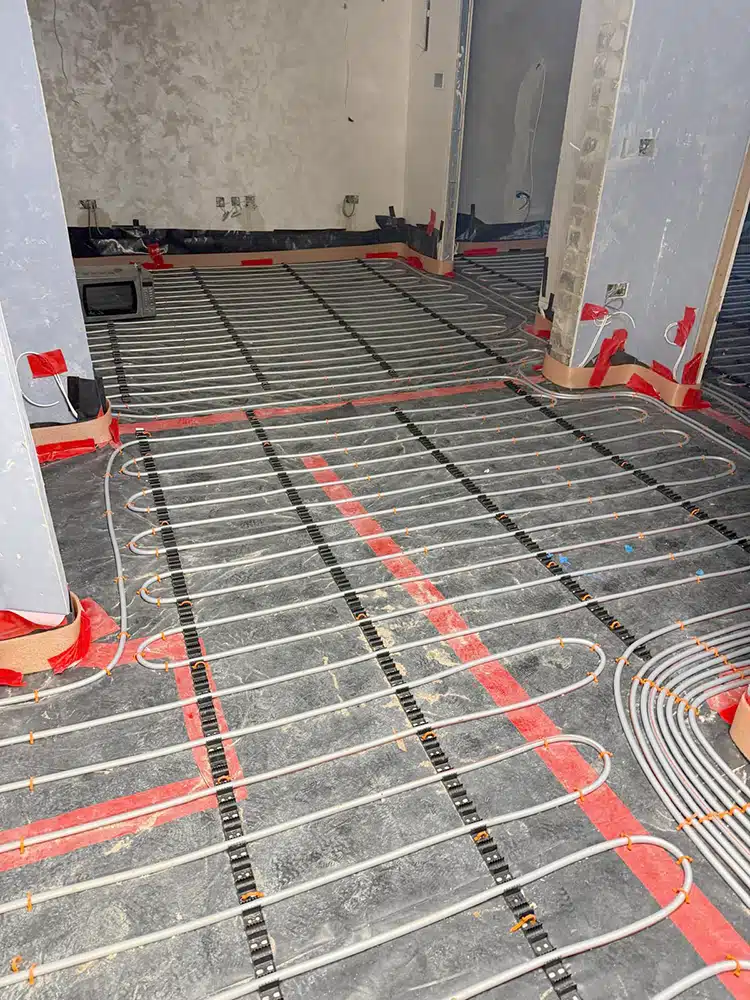
Pipe cover is the key figure. A liquid layer only has to clear the pipes by 25mm, giving a total depth in the region of 45 to 50mm. Sand and cement put down by trowel wants nearer 45mm above them, raising the level further. Where a refit must meet an existing floor level, liquid usually fits better, and because it flows fully around the pipes it leaves no air pockets and warms up faster.
By the time we arrive, your heating engineer should have the pipes down and tested under pressure. We inspect the edge strip, the membrane and the insulation ourselves before pouring. The screed thickness guide gives the full build-ups.
Commissioning heated floors in Waltham Abbey homes
The heating is not switched on the day after the pour. On calcium sulphate, gentle heat is usually fine after around 7 days. Sand and cement is left cold for 21 days minimum. From then on, start with cool water, lift the temperature a step at a time across several days, and keep it steady for a while before flooring goes on.
Rushing that stage is how heated screeds crack. A sudden jump to full temperature dries the top faster than the base, and the stress shows as cracks or curled edges, sometimes only after the covering is laid. The heating engineer sets the steps for the system, and we give written guidance on what the screed needs so both trades work from the same plan.
Flooring then follows a moisture test. For tiles, LVT or engineered wood, the finish maker's limit applies, and a properly commissioned heated floor gets there sooner. If the screed specified is calcium sulphate, read the anhydrite flow screed notes for Waltham Abbey. For a bathroom on the same floor, traditional screed for wet rooms is the safer base.
Underfloor Heating Screed prices in Waltham Abbey
Liquid screed over underfloor heating: £20 to £35 per m² supplied and laid (trade2base, June 2026), so £700 to £1,230 for 35 m². trade2base gives these figures excluding VAT. See our floor screeding cost guide or screed calculator.
Who lays your underfloor heating screed in Waltham Abbey
K & B Screeding’s own team, led by director Donatas Bardisevicius. Founded 2019, company 12298780.
See what customers say in our Google reviews and on our testimonials page.
Underfloor Heating Screed from Slough to Waltham Abbey
Waltham Abbey is about 30.4 miles east-north-east of our Slough base as the crow flies, with postcodes including EN9. The nearest towns to it are Waltham Cross (2.1 miles), Cheshunt (2.8 miles), Loughton (3 miles) and Epping (4.1 miles).
More on underfloor heating screed, part of our screeding services.