
Fitting heated floors into existing Hoddesdon houses
Retrofitting underfloor heating on a ground floor is mostly a matter of millimetres. The finished floor has to meet existing thresholds, internal doors and the hallway, so the depth available for insulation, pipes and screed is set before anything is ordered. Digging out the old floor gives you that depth to work with; keeping it means a thin build-up.
This is where the screed type counts. With liquid screed the minimum over the pipes is 25mm, roughly 45 to 50mm overall, whereas sand and cement wants around 45mm above them. In a tight retrofit the thinner liquid build-up can be the difference between keeping and losing the insulation you want. Both sets of numbers are compared in our guide to screed depths.
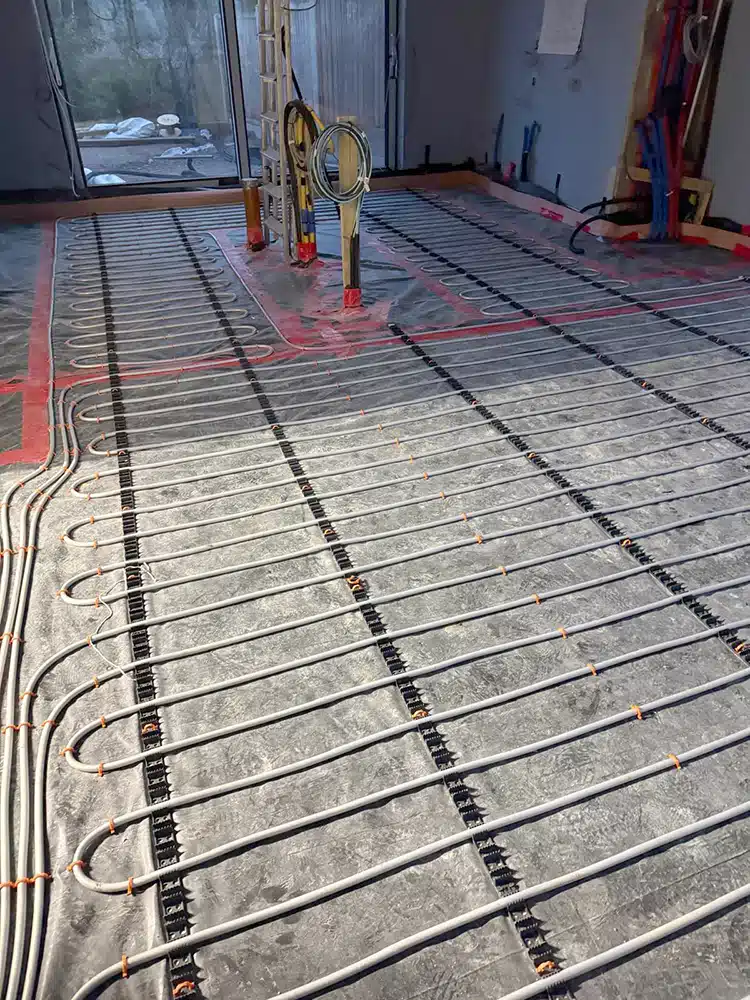
Encapsulation is the other point. Poured screed wraps itself around each pipe and leaves no voids, so heat spreads more evenly and the floor comes up to temperature quicker. A traditional screed has to be compacted carefully around the pipes to get the same result, and that takes skill rather than speed.
Pour day only goes ahead once your installer has clipped every loop and pressure tested the circuit, and once the perimeter strip, membrane and insulation boards have all been looked over. Where those layers are missing we can provide them; our insulation and membrane service explains what is involved.
Heat-up schedules for Hoddesdon extensions and garden rooms
A new heated extension or garden room is the easier case, because the floor depth is designed in from the start. Newer homes follow the same pattern: 5% of Hoddesdon's homes were built from 2015 onwards, and new houses may be planned with heating inside the ground floor screed.
Whatever the building, the screed cannot be dried by turning the heating up straight away. For calcium sulphate, the earliest the heating usually goes on is about day 7; for sand and cement, wait a minimum of 21 days. After that, commissioning should raise the flow temperature gradually, a few degrees at a time, and hold it before any flooring goes down. You get that programme on paper, so the heating engineer and the flooring fitter are both reading from one sheet.
On cost, our published 2026 figures for liquid screed laid over heating pipes run from £20 to £35 a square metre, with depth and floor area deciding where a job falls. For pumped access and flatness, see the liquid screed option, and for the neighbouring town, read about underfloor heating screed in Hertford.
Underfloor Heating Screed prices in Hoddesdon
Liquid screed over underfloor heating: £20 to £35 per m² supplied and laid (trade2base, June 2026), so £700 to £1,230 for 35 m². trade2base gives these figures excluding VAT. See our floor screeding cost guide or screed calculator.
Who lays your underfloor heating screed in Hoddesdon
K & B Screeding’s own team, led by director Donatas Bardisevicius. Founded 2019, company 12298780.
See what customers say in our Google reviews and on our testimonials page.
Underfloor Heating Screed from Slough to Hoddesdon
As the crow flies, our yard in Slough is about 31.4 miles from Hoddesdon, which lies to the east-north-east. Postcodes here include EN11, EN10 and CM19, and Hertford (3.8 miles), Ware (3.9 miles), Cheshunt (4.1 miles) and Harlow (4.7 miles) are close by.
More on underfloor heating screed, part of our screeding services.