
Reading an anhydrite specification for a Hoddesdon project
Calcium sulphate screeds are specified by grade under the European standard for screed materials, and the designation tells you a lot. In each code, C gives the compressive strength in N/mm2, with F giving flexural strength in the same unit. A Hoddesdon bedroom or similar lightly used domestic floor can take CA-C20-F4. For the bulk of homes, apartment blocks and office space, CA-C25-F5 is normal. Where a floor will be worked harder, the drawings should show CA-C30-F6. If a drawing says only "anhydrite screed", we ask the designer which grade they intend before pricing, because ordering the wrong grade cannot be fixed after the pour.
There are also alpha hemihydrate screeds, picked where a job needs quicker drying or a thinner pour. Their depths and drying times come from each manufacturer's data sheet, not from the general rules of thumb.
What makes the material useful on site is how little it shrinks. Bays can be big and joints few, which fits open plan flats and the full ground floor of a new build house. We plan the bay and joint layout before the pour, particularly where the screed runs through doorways or across separate heating zones.
Newer homes are part of this picture too. 13% of Hoddesdon's housing was built between 2000 and 2014, and a newer home is more likely to have a flowing screed over insulation in its specification. For a plain account of the material itself, read our guide with anhydrite screed explained.
Laitance, moisture and primers on Hoddesdon floors
While it cures, anhydrite screed throws up a thin, weak film on its surface, known as laitance. Once the floor has dried, that film has to be sanded away, because adhesive or levelling compound put over it may let go. We put this in writing on every pour.
Then comes the moisture check. Flooring manufacturers often allow less moisture in a calcium sulphate base, so a reading that passes for tiles over cement may fail on anhydrite. A hygrometer gives you the number, and if there are heating pipes in the floor they can normally be used to force dry it from about day 7. Primer comes last, and it has to be one rated for calcium sulphate, or the adhesive and compound will struggle to hold.
Anhydrite has no place in a room that could get wet, such as a ground floor shower room in one of these blocks, so there we swap to a flowing screed made with cement. For the pumping side of a job, and how the hose reaches an upper floor, see our Hoddesdon liquid screed service. Before a thin sheet finish goes down, levelling compound over anhydrite needs the same careful priming.
Anhydrite & Flow Screed prices in Hoddesdon
Liquid flowing screed (which includes anhydrite): £24 to £31 per m² supplied and laid (MyJobQuote, August 2026), so £960 to £1,240 for 40 m². MyJobQuote does not say whether these figures include VAT. See our floor screeding cost guide or screed calculator.
Who lays your anhydrite and flow screed in Hoddesdon
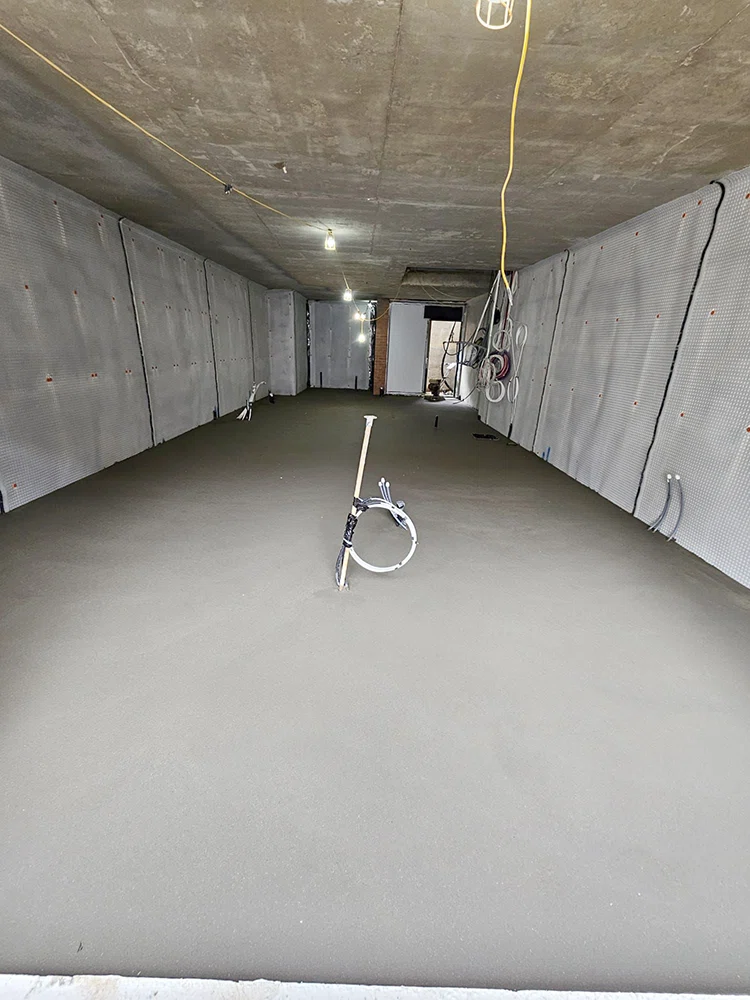
K & B Screeding’s own team, led by director Donatas Bardisevicius. Founded 2019, company 12298780.
See what customers say in our Google reviews and on our testimonials page.
Anhydrite & Flow Screed from Slough to Hoddesdon
As the crow flies, our yard in Slough is about 31.4 miles from Hoddesdon, which lies to the east-north-east. Postcodes here include EN11, EN10 and CM19, and Hertford (3.8 miles), Ware (3.9 miles), Cheshunt (4.1 miles) and Harlow (4.7 miles) are close by.
More on anhydrite screed, part of our screeding services.