
Calcium sulphate grades for Cheshunt apartments and plots
Grades are written in the code from the European screed standard. Read the numbers as strengths in N/mm2: the one after C is compressive, the one after F flexural. A house floor with light foot traffic needs only CA-C20-F4. Houses, apartments and offices in general are poured at CA-C25-F5. CA-C30-F6 is for heavier use, such as ground floor shops beneath flats or busy communal areas.
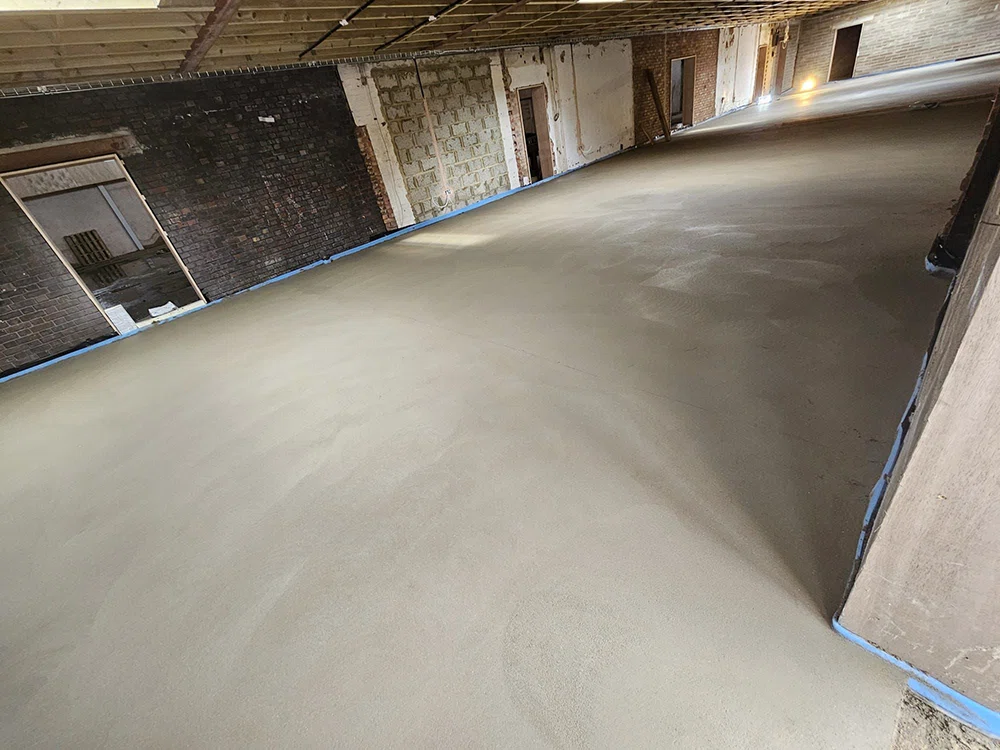
On a phased development, plot after plot is poured to the same specification, and the grade has to match the drawings every time. Calcium sulphate is chosen for this work because it shrinks very little as it dries, allowing large bays with few joints, and it keeps a consistent depth over insulation and acoustic layers. Only 5% of Cheshunt's homes were built since 2015, so recent building is still a small part of the town; the new schemes will change that.
Alpha hemihydrate products sit apart from these: they are chosen when faster drying or a thinner section is needed, and their own product sheet governs them in place of the general figures.
Our own team prepares the whole build-up, plans the bay and joint layout before the pour and hands over drying and laitance advice in writing. Background on the material is in our anhydrite screed guide, and if the design calls for a cement base instead, the liquid screed in Cheshunt page covers both types.
Finishing a Cheshunt anhydrite floor before flooring
Getting the screed poured is the first half of the work. What happens between the pour and the floor covering decides whether the finish stays down.
Start with the surface. Setting calcium sulphate leaves a weak skin, laitance, on top, and once the floor has dried enough it gets sanded off. Left on, it means the adhesive grips a layer that can break away. Vacuum the dust off afterwards.
Then test. Calcium sulphate often has a stricter moisture limit from flooring makers than cement does, so judge the reading against the figure for this material, not a general one. A hygrometer test is the standard method. On a new home, switching the underfloor heating on after about 7 days force dries the floor and speeds this stage up considerably.
After that the floor is primed with a primer compatible with calcium sulphate, and only then does adhesive or levelling compound go on.
From the outset, calcium sulphate is ruled out wherever water could reach the floor. Wet rooms and plant areas get a cement based flowing screed instead, and we offer that alternative where the specification needs it. For surface work on existing floors, see floor preparation.
Anhydrite & Flow Screed prices in Cheshunt
Liquid flowing screed (which includes anhydrite): £24 to £31 per m² supplied and laid (MyJobQuote, August 2026), so £960 to £1,240 for 40 m². MyJobQuote does not say whether these figures include VAT. See our floor screeding cost guide or screed calculator.
Who lays your anhydrite and flow screed in Cheshunt
K & B Screeding’s own team, led by director Donatas Bardisevicius. Founded 2019, company 12298780.
See what customers say in our Google reviews and on our testimonials page.
Anhydrite & Flow Screed from Slough to Cheshunt
On the map, Cheshunt sits east-north-east of Slough, about 28.5 miles from our base in a straight line (postcodes including EN8 and EN7), next to Waltham Cross (1.2 miles), Waltham Abbey (2.8 miles), Enfield (4.1 miles) and Hoddesdon (4.1 miles).
More on anhydrite screed, part of our screeding services.
