
Anhydrite grades for Potters Bar flats and new schemes
Every calcium sulphate screed has a designation, and the specification should state it. It reads CA first, then a C number for compressive strength and an F number for flexural strength, each given in N/mm2.
Lightly used rooms in a house can take CA-C20-F4. Ordinary homes, flats and offices mostly end up with CA-C25-F5. Floors that take more punishment get CA-C30-F6. When the drawings for a block of flats or a new plot name one of these, we pour to it. When they only say "anhydrite", we ask the designer which grade is intended before pricing.
Alpha hemihydrate products are chosen for a different reason. They dry faster or allow a thinner section, which can matter where floor-to-ceiling height is limited on apartment floors. Depth and drying for these come from each product's data sheet, not the general rules.
The material suits large floors. Calcium sulphate has low shrinkage, so it can go down in large bays with few joints, and open-plan flats can often be poured without joints inside the rooms. We plan the bay layout, any joints at doorways and the division between heating zones before the pour, and our own team prepares the full build-up beneath, from insulation to edge strip.
For a plain guide to how the material behaves, see anhydrite screed explained.
Sanding, testing and priming anhydrite in Potters Bar
Looking dry and being ready for flooring are two different things on calcium sulphate. Three checks come first.
Laitance: curing leaves a thin, weak skin across the top. When the screed has dried, that skin is sanded off, because adhesive or compound stuck to it can let go.
Moisture: the limit flooring makers set for calcium sulphate is often stricter than their cement figure. A hygrometer test tells you where the floor stands. Where pipes are in the floor, force drying can normally begin at roughly 7 days.
Primer: after sanding, the floor takes a primer compatible with calcium sulphate before any adhesive or compound goes down, so the next layer bonds properly.
One more rule matters on flats and houses alike. Bathrooms and other rooms that can get wet are kept clear of calcium sulphate and get a cement based flowing screed, or sand and cement, instead. For thin sheet finishes, see levelling anhydrite before vinyl, and for how the pump reaches the floor, see liquid screed for Potters Bar homes.
Anhydrite & Flow Screed prices in Potters Bar
Liquid flowing screed (which includes anhydrite): £24 to £31 per m² supplied and laid (MyJobQuote, August 2026), so £960 to £1,240 for 40 m². MyJobQuote does not say whether these figures include VAT. See our floor screeding cost guide or screed calculator.
Who lays your anhydrite and flow screed in Potters Bar
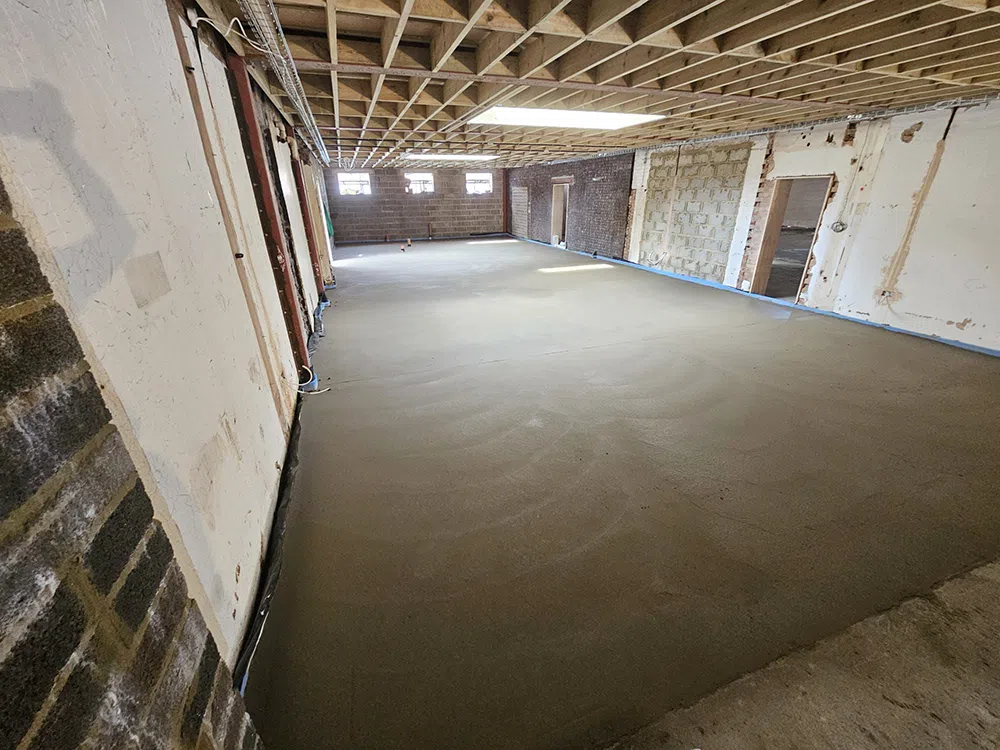
K & B Screeding’s own team, led by director Donatas Bardisevicius. Founded 2019, company 12298780.
See what customers say in our Google reviews and on our testimonials page.
Anhydrite & Flow Screed from Slough to Potters Bar
As the crow flies, our yard in Slough is about 22.5 miles from Potters Bar, which lies to the east-north-east. Postcodes here include EN6, and Borehamwood (4.1 miles), Hatfield (5 miles), Enfield (5.6 miles) and Barnet (5.7 miles) are close by.
More on anhydrite screed, part of our screeding services.
