
Choosing a calcium sulphate grade for Borehamwood apartments
The grade on a drawing is a short code with a precise meaning. Under the European screed standard, a grade code carries two strengths in N/mm2: the C figure is compressive and the F figure flexural. A lightly used domestic floor can go down at CA-C20-F4, while CA-C25-F5 is the usual specification for houses, flats and offices alike. Where use is heavier, such as a busy shared corridor in a block or commercial space on a ground floor, CA-C30-F6 is the grade.
Newer apartment schemes in Borehamwood, and refurbishments of older blocks, depend on the floor build-up to control sound between flats. Calcium sulphate suits that job. Because the material barely shrinks while drying, we can pour it in large bays with only a few joints, and it holds the same thickness across a resilient sound layer.
Alpha hemihydrate screeds are a different group of products. They come in where a floor must dry sooner or be thinner, say a refurbished Borehamwood flat that has to be handed back quickly, and their own product data sheet replaces the general figures.
Before the pour our own team prepares the full build-up, plans the bay and joint layout, and confirms the grade against the specification. On a new build site the floors go down plot by plot, so the pour sequence is agreed with the site manager. For background on the material, read our guide to anhydrite screed; for how the pump and hose are set up, see screed pumping.
Laitance, moisture and primers on Borehamwood flow screeds
As calcium sulphate sets, a thin and weak layer called laitance forms on top. No covering should be laid until that layer is removed. That skin is sanded off by us as soon as the floor is dry enough, and the dust is vacuumed up.
Moisture testing comes next, and it is where calcium sulphate differs most from cement. Many flooring manufacturers set a lower moisture ceiling for calcium sulphate than for cement, so a figure that would let a tiler start on a cement screed may still be a fail on a Borehamwood flat's anhydrite floor. A hygrometer test against the maker's figure is the reliable way to know. On a new build programme it helps a great deal that the underfloor heating can normally be used to force dry the screed from about 7 days.
Priming is the last step. Calcium sulphate needs a primer that is compatible with it before adhesives or levelling compounds go on, and the primer should be chosen with the flooring system in mind.
Last, keep it away from anywhere that could get wet. Shower floors, plant rooms or a ground floor with any risk of water getting in should have a cement based flowing screed instead, and the liquid screed page covers both types.
Anhydrite & Flow Screed prices in Borehamwood
Liquid flowing screed (which includes anhydrite): £24 to £31 per m² supplied and laid (MyJobQuote, August 2026), so £960 to £1,240 for 40 m². MyJobQuote does not say whether these figures include VAT. See our floor screeding cost guide or screed calculator.
Who lays your anhydrite and flow screed in Borehamwood
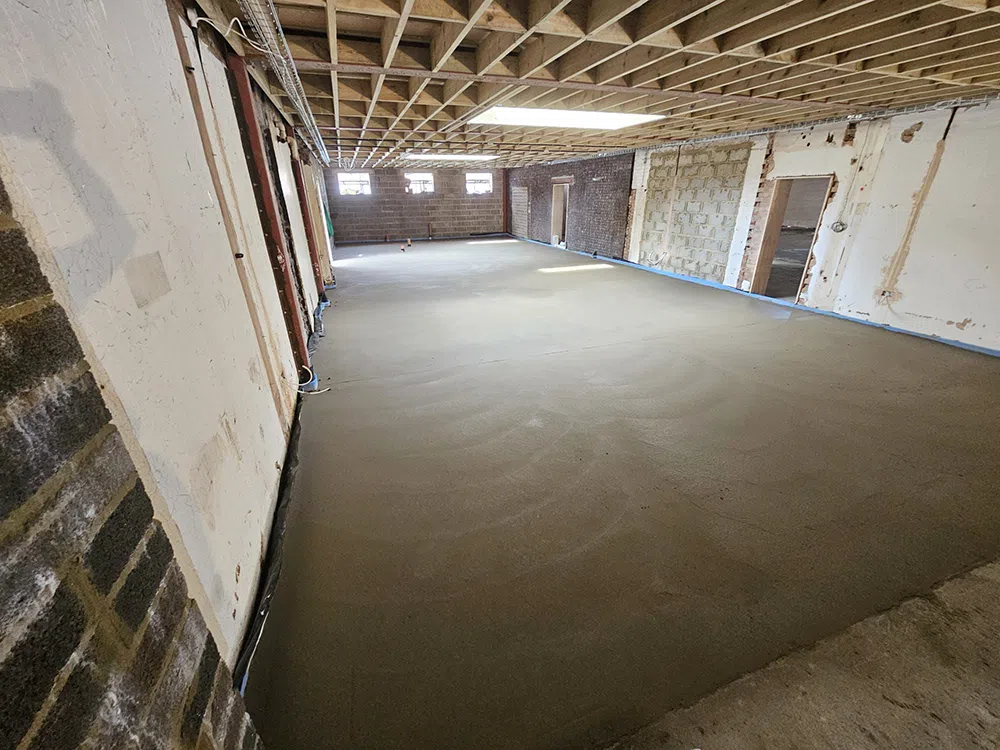
K & B Screeding’s own team, led by director Donatas Bardisevicius. Founded 2019, company 12298780.
See what customers say in our Google reviews and on our testimonials page.
Anhydrite & Flow Screed from Slough to Borehamwood
As the crow flies, our yard in Slough is about 18.4 miles from Borehamwood, which lies to the east-north-east. Postcodes here include WD6, and Potters Bar (4.1 miles), Bushey (4.2 miles), Barnet (4.4 miles) and Watford (5.4 miles) are close by.
More on anhydrite screed, part of our screeding services.