
Reading the screed specification on a Bushey project
The European screed standard gives each calcium sulphate grade a short code. Its C number gives compressive strength in N/mm2, and its F number gives flexural strength in the same units. Light domestic traffic is what CA-C20-F4 is designed for. The bulk of houses, flats and office floors take CA-C25-F5. Where a floor will take harder wear, the code moves up to CA-C30-F6.
Conversion and infill schemes can mix new-built floors with floors inside older buildings, and the specification may change from one part to another. Calcium sulphate works well on those jobs because it shrinks very little, so large bays can be poured with few joints, and it holds an even depth over insulation or acoustic layers.
Alpha hemihydrate is a different option again. It goes in where the floor must dry faster or be thinner, a converted Bushey floor with little height to spare being one example, and its own product sheet takes over from the general rules.
Our own team prepares the full build-up and plans the bay and joint layout before the pour, so the grade and depth on the drawings are what goes down. If a floor may get wet, the specification should call for a cement based flowing screed instead, and we offer that where calcium sulphate is not suitable. For background on the material, our anhydrite screed explained guide is a good start.
Before flooring goes on a Bushey anhydrite floor
Three steps stand between a poured calcium sulphate screed and the finished floor.
The first is laitance. As the screed sets, a weak surface skin forms, and it must be removed. Once the floor is dry enough, it is sanded to take the laitance off and then vacuumed, leaving a sound surface for adhesive.
The second is moisture. The acceptable moisture level for calcium sulphate is often lower in flooring manufacturers' data than it is for cement, so a number that would be acceptable on a cement screed can fail on this one. Test with a hygrometer and compare the result with your chosen flooring's own published limit. Where pipes run under the screed, the heating can normally be used from about 7 days to force dry it, which shortens this stage.
The third is priming. Any adhesive or compound goes on only after a primer suited to calcium sulphate.
Rooms where water could reach the floor are no place for it. Wet rooms, utility areas with floor drains and any floor with a water risk should use a cement based flowing screed or a hand-laid sand and cement screed instead. Our screed pumping page covers how the material reaches the room.
Anhydrite & Flow Screed prices in Bushey
Liquid flowing screed (which includes anhydrite): £24 to £31 per m² supplied and laid (MyJobQuote, August 2026), so £960 to £1,240 for 40 m². MyJobQuote does not say whether these figures include VAT. See our floor screeding cost guide or screed calculator.
Who lays your anhydrite and flow screed in Bushey
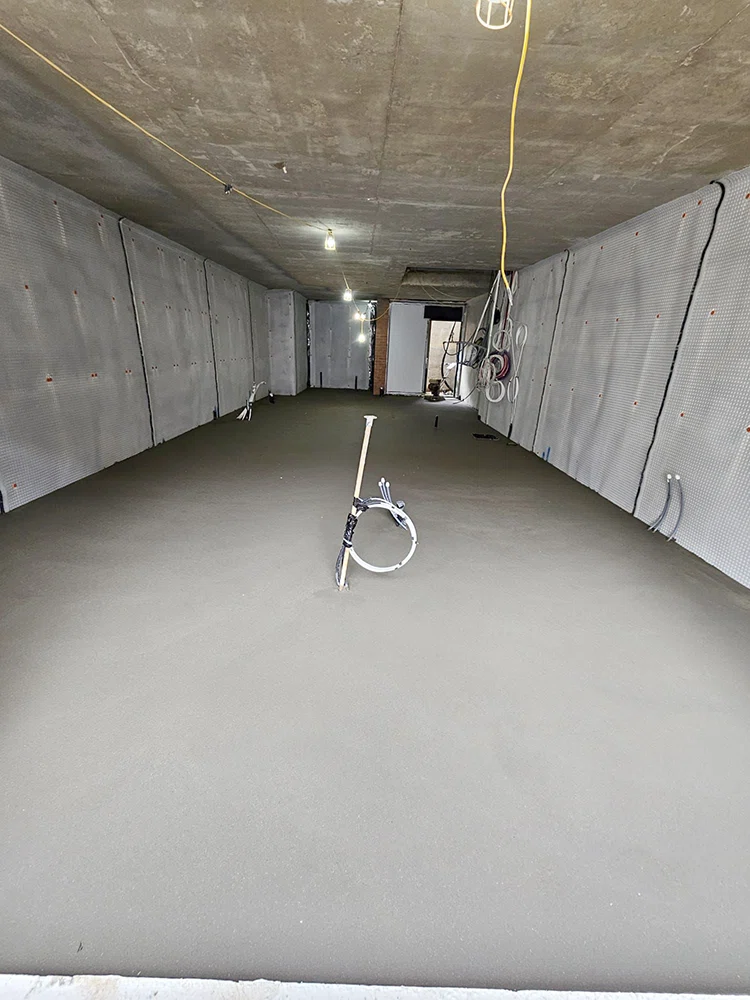
K & B Screeding’s own team, led by director Donatas Bardisevicius. Founded 2019, company 12298780.
See what customers say in our Google reviews and on our testimonials page.
Anhydrite & Flow Screed from Slough to Bushey
On the map, Bushey sits north-east of Slough, about 14.4 miles from our base in a straight line (postcodes including WD23 and WD7), next to Watford (1.5 miles), Harrow (3.8 miles), Borehamwood (4.2 miles) and Rickmansworth (4.5 miles).
More on anhydrite screed, part of our screeding services.
