
Where liquid screed fits Bushey conversions and extensions
Purpose-built flats account for 27% of Bushey's homes, and 20% of all homes here were built since 2000. Both groups suit a flowing screed: upper storeys are reached by hose rather than by hand, and a pumped floor over insulation is quick to bring to level.
Conversion schemes, such as the residential scheme on the former Royal Masonic School site, bring a different challenge. In any converted building, a new build-up has to fit under existing window sills and door heads. In a house, a flowing screed laid on insulation needs only about 35mm compared with about 65mm for sand and cement, so a converted Bushey building can put the depth it saves into more insulation.
Extensions are the third case. When a semi's kitchen is opened into a new rear extension, a pumped floor flows across the whole area in one pour, reaches SR1 or SR2 surface regularity readily, and needs far fewer joints because it shrinks so little. That is useful if the kitchen is getting large format tiles. If the old kitchen floor is taken up at the same time, the screed can run through both spaces so the room finishes on one level, with no step at the old back wall.
Which kind of liquid screed goes in, calcium sulphate or cement based, depends on the rooms involved. Grades and specification are set out on our Bushey calcium sulphate screed page. To compare costs and drying times, see our guide to liquid screed or sand and cement.
Pump access on Bushey streets and stairwells
Our pump and mixer are parked on the drive or in the road, and the screed reaches the room through a hose. With a detached house and its own driveway, setting up is easy. Where parking is tight, or the only route to the back of a semi is a narrow side passage, the hose route needs planning, so describe it when you ask for a price.
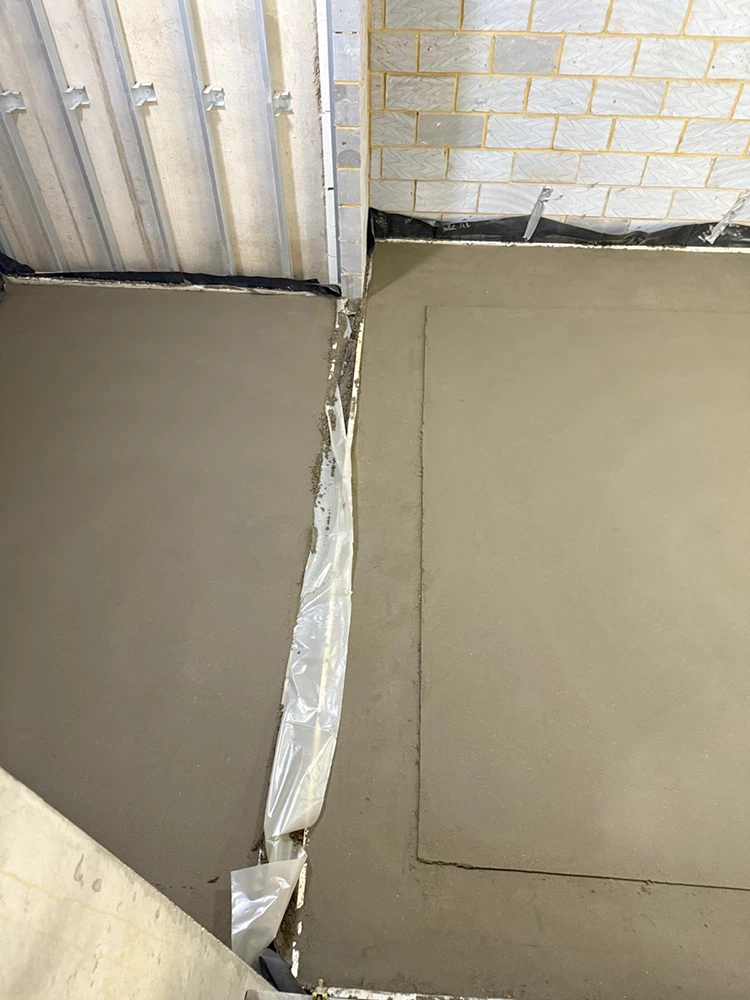
For flats, the hose usually runs up a communal stair. The managing agent will normally want to approve that, and stair treads, lift doors and frames are protected along the way. Upper floors also need the room sealed: edge strip on the walls, a taped membrane over the insulation and dams at every doorway, because a flowing screed will find any gap.
After 24 to 48 hours other trades can walk across a pumped floor and get on with their work, but the screed is still far from dry. Count roughly one drying day per millimetre as far as 40mm, and a slower rate after it, and a 50mm floor over heating is weeks away from taking most coverings. We work those sums through in a separate piece on how drying time is calculated. Published 2026 prices for liquid screed are £24 to £31 per m², and the pump comes with our crew rather than as a separate hire.
Liquid Screed prices in Bushey
Liquid screed: £24 to £31 per m² supplied and laid (MyJobQuote, August 2026), so £960 to £1,240 for 40 m². MyJobQuote does not say whether these figures include VAT. See our floor screeding cost guide or screed calculator.
Who lays your liquid screed in Bushey
K & B Screeding’s own team, led by director Donatas Bardisevicius. Founded 2019, company 12298780.
See what customers say in our Google reviews and on our testimonials page.
Liquid Screed from Slough to Bushey
On the map, Bushey sits north-east of Slough, about 14.4 miles from our base in a straight line (postcodes including WD23 and WD7), next to Watford (1.5 miles), Harrow (3.8 miles), Borehamwood (4.2 miles) and Rickmansworth (4.5 miles).
More on liquid screed, part of our screeding services.