
Harebreaks estate extensions and new Watford homes
A self-levelling screed shows its value on floors that are big, open or high.
New homes are the obvious fit. New-build houses and apartments are usually designed from the start with insulated floors to take a flowing screed, often with heating pipes laid first, so the pour is quick and the floor comes out flat.
Extensions are the other. Inter-war houses such as those on the Harebreaks estate are often extended at the back or side into one large kitchen and living space. Pour into that space and the screed spreads wall to wall on its own, comfortably meeting SR1 or SR2. Low shrinkage keeps the joint count down, so a single pour can carry on from the old kitchen into the new room without the breaks a hand-laid floor would need.
Matching an old floor level is where thickness counts. Laid floating in a home, a pumped screed can begin at about 35mm; sand and cement needs about 65mm. Commercial work takes a minimum of about 40mm. That shallower build-up can save digging deeper into the ground under an older house.
There are two families of liquid screed, calcium sulphate and cement based. Calcium sulphate is the common choice in dry living areas, while cement based versions go where a floor might get wet. Our page on anhydrite screed specifications explains the calcium sulphate grades, and the guide to choosing between liquid and traditional screed compares the two methods.
Pumping into Watford terraces and upper floors
The pump and mixer work from the street or driveway, with a hose running into the building. Anywhere from Garston and Leavesden Green to Oxhey, a house with off-road parking is simple to reach. Terraced roads with permit parking need a space held for the lorry on the day, so mention restrictions, narrow passages or shared access when you ask for a price. For flats, the route up the stairs needs to be clear and protected.
Inside, the room is prepared before the pour. That means edge strip on every wall, the insulation sheeted over with a membrane whose joints are all taped, and dams across the doorways. We check each of these on arrival, because a gap in the edge strip or an untaped membrane joint lets screed escape under the insulation.
People can walk on it lightly from 24 to 48 hours, which says nothing about whether it is dry. For most coverings a moisture test has the final say. Up to 40mm thick, think of a millimetre drying each day; deeper than that, the pace drops. Next door in Bushey? See pumped screed for Bushey.
Liquid Screed prices in Watford
Liquid screed: £24 to £31 per m² supplied and laid (MyJobQuote, August 2026), so £960 to £1,240 for 40 m². MyJobQuote does not say whether these figures include VAT. See our floor screeding cost guide or screed calculator.
Who lays your liquid screed in Watford
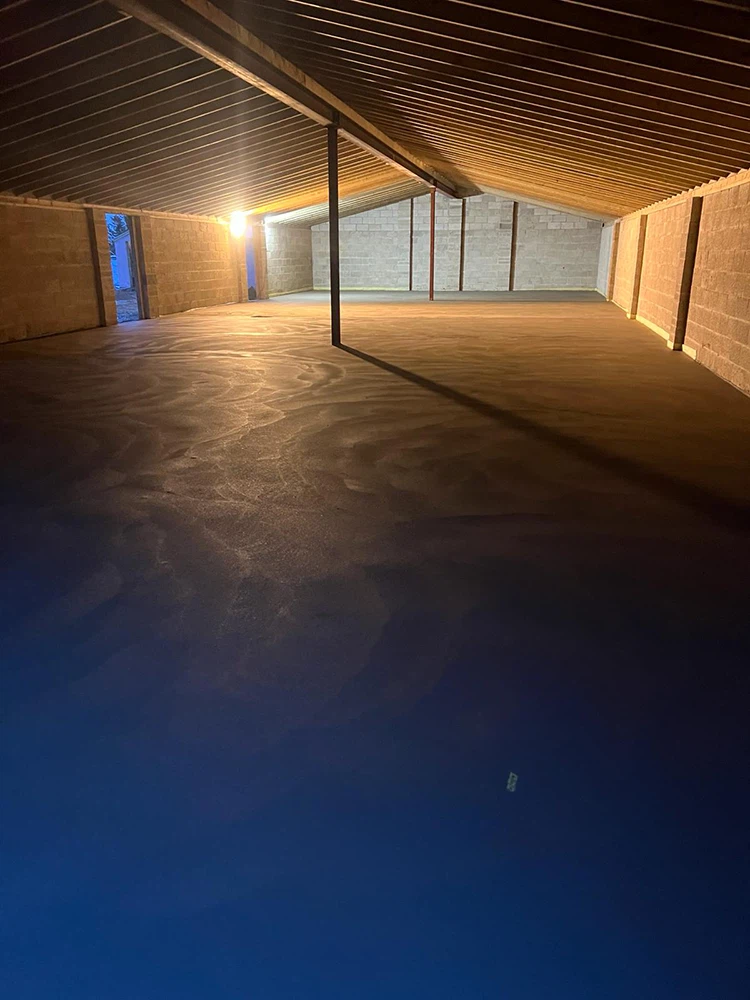
K & B Screeding’s own team, led by director Donatas Bardisevicius. Founded 2019, company 12298780.
See what customers say in our Google reviews and on our testimonials page.
Liquid Screed from Slough to Watford
Watford is about 13.7 miles north-east of our Slough base as the crow flies, with postcodes including WD17, WD19, WD25 and WD18. The nearest towns to it are Bushey (1.5 miles), Rickmansworth (3.4 miles), Harrow (5 miles) and Chorleywood (5.4 miles).
More on liquid screed, part of our screeding services.