
Latex over mixed bases in Watford conversions and terraces
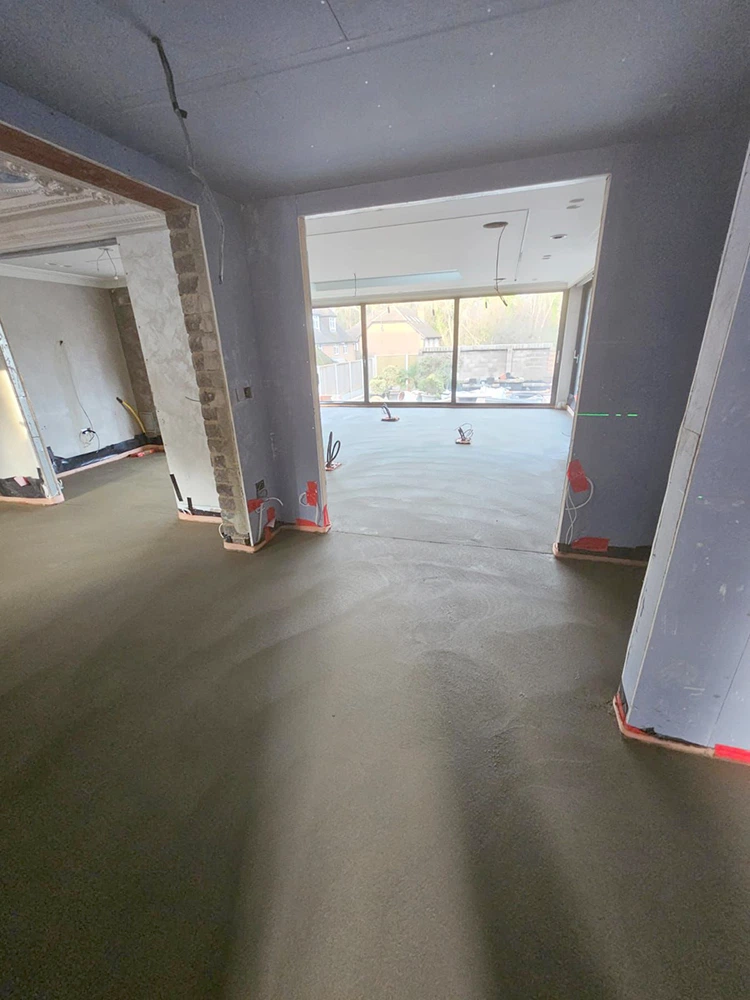
Latex screed earns its place on floors made of several materials at once. Turning an older house into flats, or refitting a kitchen in one, can leave a single room with old ceramic tiles at one end, a patch of new concrete where a wall came out and plywood over the original timber at the other. Each part needs its own preparation, then one continuous latex skim ties them together.
Preparation is where the real work lies. Quarry or ceramic tiles that are still stuck fast are cleaned and primed for a dense surface. Concrete is checked for soundness, and worn or dusty areas are primed so the latex does not lose its water too fast. Bare floorboards are never skimmed directly: they are fixed, then covered with flooring grade plywood screwed down at close spacing, and the latex goes over the ply. Old adhesive can stay only where it is hard, thin and compatible with the primer.
Some 27% of Watford homes were built between 1945 and 1972, and kitchens and bathrooms of that age can give up exactly this kind of patchwork once the old flooring is lifted.
The finished layer suits the thin coverings that show every flaw: sheet vinyl, LVT, lino, rubber and safety flooring, with carpet also lasting better on a smooth base. Where the job is about bringing a floor to SR1 or SR2 rather than smoothing awkward surfaces, our general floor levelling page is the one to read. If old coatings or ridges are in the way, grinding the slab back first gives the latex a clean surface.
Why latex cannot fix damp West Watford floors
In West Watford and Callowland, many Victorian and Edwardian terraces were built without a membrane beneath the ground floor. Those houses are the plainest example of where latex is the wrong tool. A thin compound over a floor with moisture coming up through it will not stop the damp, and the new flooring on top can lift or smell. The floor needs rebuilding with a membrane first, then latex only if the new surface calls for it.
Movement is the second limit. Timber floors that spring underfoot will crack a latex skim along the board lines, however well it is mixed. The cure lies in the structure: loose boards fixed, weak joists dealt with, then overboarding.
Level is the third. Latex smooths a floor; it does not straighten one. A room that falls by more than a few millimetres, or a concrete floor that has broken up, needs repair or a new screed first. Our concrete floor repair service handles cracked and damaged slabs.
Calcium sulphate screeds, common in new apartment floors, add one extra step: the laitance must be sanded off and the surface primed before latex goes on.
We cover the whole town, including Meriden, Woodside, Kingswood and The Rookery, and the service carries on next door as latex screed in Bushey.
How we price latex screed in Watford
A fixed written price within 24 hours, once we know the area and the base. See our floor screeding cost guide.
Who lays your latex screed in Watford
K & B Screeding’s own team, led by director Donatas Bardisevicius. Founded 2019, company 12298780.
See what customers say in our Google reviews and on our testimonials page.
Latex Screed from Slough to Watford
Watford is about 13.7 miles north-east of our Slough base as the crow flies, with postcodes including WD17, WD19, WD25 and WD18. The nearest towns to it are Bushey (1.5 miles), Rickmansworth (3.4 miles), Harrow (5 miles) and Chorleywood (5.4 miles).
More on latex screed, part of our screeding services.
