
Latex over overboarded timber in Fleetville terraces
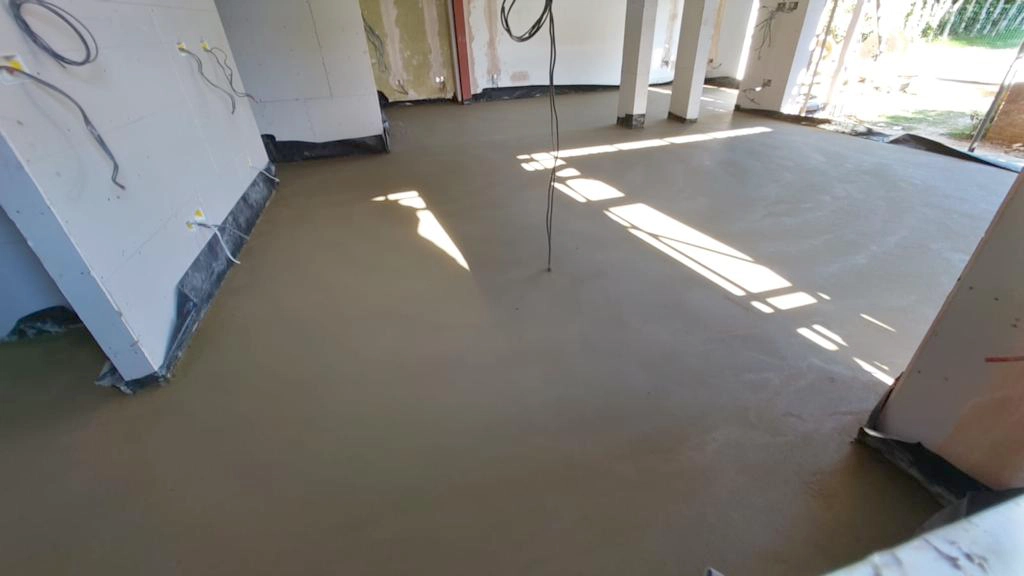
Latex screed takes its name from the liquid half of the pack. A cement based powder is mixed with a latex emulsion in place of water, and the result spreads like a thin compound but grips well and tolerates a little movement. It goes down a few millimetres thick, enough to bury screw heads, board joints and small hollows so that thin finishes do not show them.
Timber is the base where that counts. Fleetville's bay-fronted Victorian terraces, Camp View Road among them, are the obvious example: when a refit keeps the suspended timber floor instead of digging it out, the old boards stay in place. Latex must never be spread straight onto those boards. Floorboards shrink, cup and swell with the seasons, and a thin cement layer laid on them cracks along every joint. So the boards are screwed down first, flooring grade plywood is fixed over them at close centres, and only then is the plywood primed and latexed.
Before any of that, the floor has to be firm. If the boards bounce as you cross the room, the cause lies underneath: a weak joist, a notched span or decay near an outside wall. A coat of latex will not stiffen it. That needs a carpenter, or for the timber floor to come out and be replaced with a slab and screed, a route explained on our page about replacing a timber floor with a hand-laid screed.
Damp is the other check. A ground floor with no membrane can feed moisture into the plywood from below, so the void ventilation and any tide marks at skirting level are looked at before a price is given.
Tiles, concrete and old glue in St Albans semis
In St Albans, 17% of homes were built between 1919 and 1944, and the post-war semis add many more. Kitchens in houses of those ages were often finished with quarry or ceramic tiles laid on concrete. Breaking them out is noisy and slow, and it can tear lumps from the floor beneath. If they are still firmly bonded, they can stay. Every tile is tapped for hollow spots, pull any loose tiles, fill the gaps, scrub off grease and polish, then roll on a primer made for dense, non-absorbent surfaces before the latex goes over tiles and grout lines alike.
Bare concrete from the same era is often pitted, crazed or scarred where old units were fixed. A latex coat closes that up for sheet vinyl, lino, rubber or safety flooring, finishes that show every bump beneath them.
Old adhesive is a judgement call. A thin, hard residue that is bonded tight can sometimes be primed and covered. Anything soft, thick or flaking has to come off first, which is a job for concrete floor grinding in St Albans.
When a room is badly out of level rather than just rough, a few millimetres of latex is the wrong tool, and our floor levelling page covers deeper correction.
How we price latex screed in St Albans
A fixed written price within 24 hours, once we know the area and the base. See our floor screeding cost guide.
Who lays your latex screed in St Albans
K & B Screeding’s own team, led by director Donatas Bardisevicius. Founded 2019, company 12298780.
See what customers say in our Google reviews and on our testimonials page.
Latex Screed from Slough to St Albans
As the crow flies, our yard in Slough is about 20.1 miles from St Albans, which lies to the north-east. Postcodes here include AL3, AL4 and AL1, and Harpenden (4.5 miles), Hatfield (5.2 miles), Hemel Hempstead (5.7 miles) and Welwyn Garden City (6.7 miles) are close by.
More on latex screed, part of our screeding services.