
Rebuilding old floors in Fleetville's Victorian terraces
A Fleetville terrace on a street such as Camp View Road was built long before damp proof membranes. Its ground floor is often suspended timber over a void, or an early solid floor laid straight onto the ground. Either can fail: boards rot, solid floors crack or draw damp into the skirting, and new flooring on top will not last.
Fixing it properly means removing what is there, digging down far enough, then building back up in layers: compacted base, damp proof membrane, rigid insulation boards and finally a floating screed. Terraced houses make up 23% of the St Albans housing stock, and in houses of this kind the rooms are narrow, broken up by chimney breasts, and tied to thresholds and a staircase that cannot move. A hand-laid screed can be run to those fixed levels room by room, in small batches, with nothing parked outside but a mixer.
Depth is set by what sits beneath. With insulation underneath, a home's screed goes down at about 65mm; commercial premises would take about 75mm. Going thinner over insulation invites cracking. Why those depths apply, and when they change, is set out in our guide to screed depths.
Swapping a suspended timber floor for a solid one also changes the ventilation under neighbouring rooms, so it should be planned with your builder before any digging starts.
Wet rooms, garages and falls in St Albans homes
Water does not harm a cement screed the way it harms calcium sulphate. That makes it the base for walk-in showers and wet rooms, where the floor must fall towards a drain. We shape that slope into the screed as it is laid, so the tiler only has to follow it.
Garage conversions are another common use on suburban semis. Garage slabs normally sit a step down from the house, so we build them up with insulation and a membrane and finish the screed flush with the hallway. Our garage floor screed guide goes through it step by step.
Where the floor must take load early or carry heavier use, the mix can change. A fibre reinforced screed adds £1 to £3 per m² to the base rate, and quick drying additives help a tight programme.
The trade-off is time. A 65mm hand-laid floor dries far more slowly than a thin pumped one: about a day for each millimetre up to 40, then slower still. In cash terms, expect somewhere between £18 and £25 per m², the 2026 published band for this method. If the room is open and large, compare it with pumped liquid screed in St Albans before deciding.
Sand and Cement Screed prices in St Albans
Sand and cement screed: £18 to £25 per m² supplied and laid (MyJobQuote, August 2026), so £450 to £630 for 25 m². MyJobQuote does not say whether these figures include VAT. See our floor screeding cost guide or screed calculator.
Who lays your sand and cement screed in St Albans
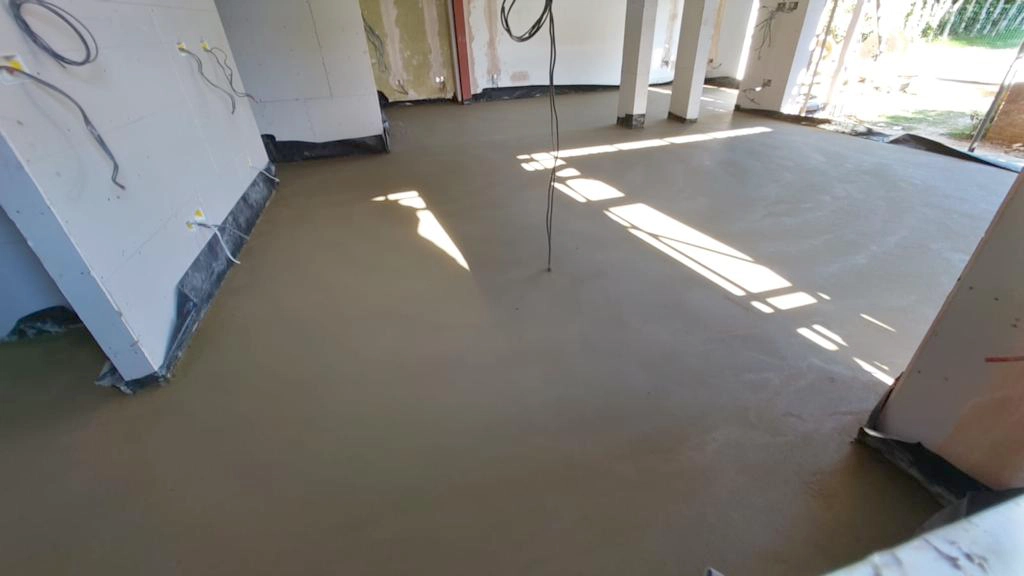
K & B Screeding’s own team, led by director Donatas Bardisevicius. Founded 2019, company 12298780.
See what customers say in our Google reviews and on our testimonials page.
Sand and Cement Screed from Slough to St Albans
As the crow flies, our yard in Slough is about 20.1 miles from St Albans, which lies to the north-east. Postcodes here include AL3, AL4 and AL1, and Harpenden (4.5 miles), Hatfield (5.2 miles), Hemel Hempstead (5.7 miles) and Welwyn Garden City (6.7 miles) are close by.
More on sand & cement screed, part of our screeding services.