
CA grades on St Albans apartment and new-build floors
Your engineer's drawing will show a code such as CA-C25-F5, taken from the European standard for screed materials; after the CA, the C figure gives squashing (compressive) strength and the F figure bending (flexural) strength, both in N/mm2. Three grades cover most buildings. A bedroom that sees little wear is fine on CA-C20-F4, the middle CA-C25-F5 covers typical homes, apartments and offices, and CA-C30-F6 is saved for floors that take a pounding.
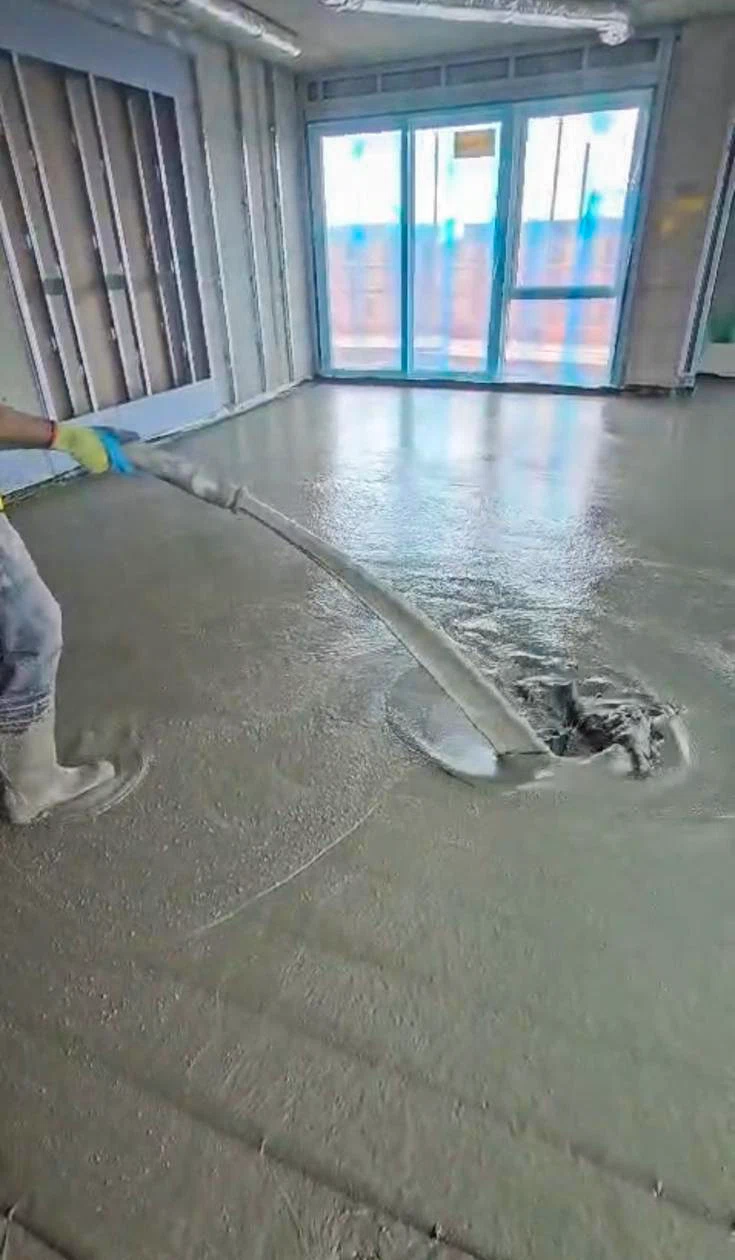
Whoever designed a St Albans block or new plot picks that number, and our pour follows it to the letter. Some specifications swap in an alpha hemihydrate product for a faster or thinner floor; its own data sheet then sets depth and drying, not the general figures.
Anhydrite barely shrinks as it cures. That lets wide bays go down with hardly any joints, a good fit for open-plan flats and broad ground floors. Any joints that are needed, at door thresholds or where one heating zone meets another, are marked out and agreed first.
With 16% of St Albans homes built since 2000, there is a steady share of newer stock designed around a flowing screed over insulation and heating. If you want to know more about gypsum based floors, our anhydrite explainer is the place to look. If the building is older and its base needs work first, our preparation of existing bases comes before anything is poured.
Laitance and moisture testing before St Albans floors go down
As it dries, anhydrite leaves a fragile surface film known as laitance. Adhesive laid onto it grips the skin rather than the screed, so tiles and LVT can let go months later. Once readings say the floor is ready, that crust gets abraded off by machine and a calcium sulphate primer is rolled on.
Moisture is the second check. Moisture is the second check, and the bar is often set lower for anhydrite than for cement, so a figure your tiler would happily accept on a cement floor might fail on this one. A hygrometer reading, not the date, tells us when it is ready. In heated flats and houses, the system can normally start drying the floor from around day 7.
There is one place this material does not belong, however well it is laid. Keep it out of walk-in showers, wet rooms and any utility space where a leaking washing machine could soak it; those want a cement based flowing mix or a traditional cement screed laid by hand. For the pumping side of the job and pump access, see liquid screed for St Albans homes.
Anhydrite & Flow Screed prices in St Albans
Liquid flowing screed (which includes anhydrite): £24 to £31 per m² supplied and laid (MyJobQuote, August 2026), so £960 to £1,240 for 40 m². MyJobQuote does not say whether these figures include VAT. See our floor screeding cost guide or screed calculator.
Who lays your anhydrite and flow screed in St Albans
K & B Screeding’s own team, led by director Donatas Bardisevicius. Founded 2019, company 12298780.
See what customers say in our Google reviews and on our testimonials page.
Anhydrite & Flow Screed from Slough to St Albans
As the crow flies, our yard in Slough is about 20.1 miles from St Albans, which lies to the north-east. Postcodes here include AL3, AL4 and AL1, and Harpenden (4.5 miles), Hatfield (5.2 miles), Hemel Hempstead (5.7 miles) and Welwyn Garden City (6.7 miles) are close by.
More on anhydrite screed, part of our screeding services.
