
Grades and products on Luton flat and plot drawings
Each calcium sulphate screed is labelled with a code from the European rules for screed materials. Read the C as compressive strength, and the F as flexural, both given in N/mm2. For Luton housing, three codes do nearly all the work. A lightly loaded floor in a Luton house can be specified as CA-C20-F4. Homes, apartments and offices generally sit at CA-C25-F5, and CA-C30-F6 is saved for floors that work harder.
On new apartment blocks and housing plots the engineer sets the grade, and we pour precisely what they specify. On a mixed scheme, with homes beside offices or industrial space, different buildings can carry different grades, so the drawings for each plot are checked before ordering.
Now and then a specification calls up an alpha hemihydrate product in place of a CA grade. Specifiers pick these when a quicker dry or a thinner layer is the priority, and we follow the maker's own sheet for depth and drying rather than the usual rules.
The practical advantage is low shrinkage. In a purpose-built Luton flat, the open living area can be filled in generous bays that need very few joints. Where a joint is unavoidable, typically at a doorway or the boundary between two heating zones, we mark it out and agree it with you before pouring. Our guide to calcium sulphate screeds goes deeper into how the material behaves.
Houses split into flats are a different job. There, floors usually need levelling and acoustic build-ups rather than a new flow screed, which our Luton floor levelling page covers.
Sanding, priming and testing Luton anhydrite floors
As it cures, anhydrite throws up a fragile film called laitance. If it stays, tile adhesive or levelling compound bonds to that weak skin instead of the screed beneath, so sanding it off is part of the job. We do that sanding when the screed has dried sufficiently, then apply a primer made to work with calcium sulphate so whatever goes on top holds fast.
Moisture is the other test. Calcium sulphate is judged more strictly on it, because many flooring makers set a tighter limit, so a figure that would pass on sand and cement can still mean waiting here. We measure with a hygrometer and work to the figure your flooring supplier gives, instead of guessing from the calendar.
In flats or plots with underfloor heating, the system can usually start force drying the screed from around day 7, which is useful when handover dates are close.
Anywhere likely to get wet is off limits for calcium sulphate. So a plant room, a wet room or a bathroom with a walk-in shower is poured with cement based flowing screed, or gets a hand-laid Luton sand and cement floor instead. For projects over towards Stevenage, see anhydrite flow screed in Stevenage.
Anhydrite & Flow Screed prices in Luton
Liquid flowing screed (which includes anhydrite): £24 to £31 per m² supplied and laid (MyJobQuote, August 2026), so £960 to £1,240 for 40 m². MyJobQuote does not say whether these figures include VAT. See our floor screeding cost guide or screed calculator.
Who lays your anhydrite and flow screed in Luton
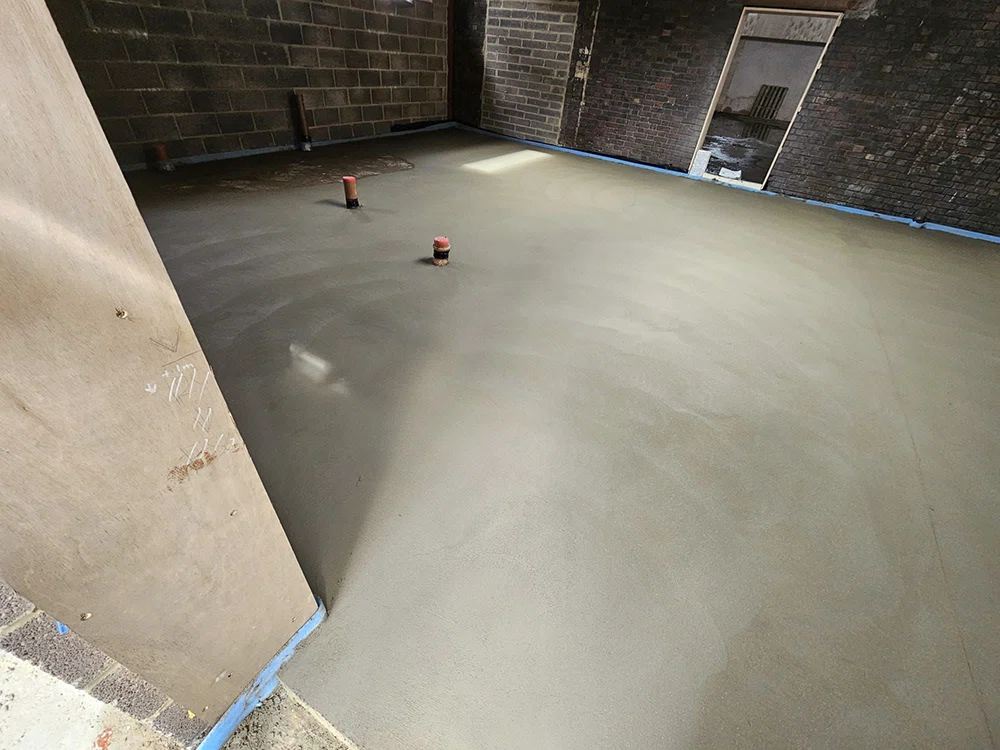
K & B Screeding’s own team, led by director Donatas Bardisevicius. Founded 2019, company 12298780.
See what customers say in our Google reviews and on our testimonials page.
Anhydrite & Flow Screed from Slough to Luton
As the crow flies, our yard in Slough is about 25.9 miles from Luton, which lies to the north-north-east. Postcodes here include LU1, LU3, LU4 and LU2, and Dunstable (4.6 miles), Houghton Regis (4.7 miles), Harpenden (5.1 miles) and Hitchin (7.6 miles) are close by.
More on anhydrite screed, part of our screeding services.
