
Anhydrite grades for new SG1 town centre homes
Those codes come from the European screed standard: after CA, the C figure is crush (compressive) strength and the F figure is bend (flexural) strength, each in N/mm2. Three grades cover most buildings. Spare rooms and other quiet domestic spaces can use the lowest, CA-C20-F4. Flats like those in the SG1 blocks, family houses and offices normally sit in the middle at CA-C25-F5. Where trolleys, crowds or stored goods mean harder wear, CA-C30-F6 is the step up.
On a scheme such as SG1, the structural engineer fixes the grade and we pour it as written. Now and then a designer picks an alpha hemihydrate product instead, to dry faster or fit a thinner layer where height is short. In that case its own data sheet governs depth, drying and warm-up, and we follow it over any rule of thumb.
The reason calcium sulphate suits apartment floors is its low shrinkage. Broad bays can go down with barely a joint, whether over insulation or heating loops. Any joints that are required, at doorways or between heating zones, are drawn up ahead of time.
With 20% of Stevenage homes in purpose-built blocks, the same grades matter when an existing flat is refurbished and its floor replaced, and the refurbishment specification should say which one is wanted. Our plain guide to anhydrite explains the material from scratch.
Sanding and testing anhydrite before Stevenage flooring
The pump going quiet is only half the job. Drying anhydrite grows a flimsy top crust called laitance, and glue or compound will not hold to it properly, so once the floor is dry we machine it off and roll on a primer meant for calcium sulphate. Skipping that stage is a known cause of tiles and LVT lifting.
Moisture limits are the second trap. Flooring brands frequently set a tighter moisture figure for anhydrite than for cement, which means a hygrometer result that would pass on a cement floor might still be too damp here. In a heated SG1 flat, the system can normally speed drying from about day 7.
Calcium sulphate should stay out of areas that may get wet. Shower floors, wet rooms and plant rooms that might leak get a cement based flowing mix or a traditional floor tamped by hand instead. On a new SG1 flat that can mean two materials side by side: anhydrite through the living space and cement under the shower tray. If the finished surface needs extra flatness for sheet flooring, see our floor levelling page for Stevenage.
Anhydrite & Flow Screed prices in Stevenage
Liquid flowing screed (which includes anhydrite): £24 to £31 per m² supplied and laid (MyJobQuote, August 2026), so £960 to £1,240 for 40 m². MyJobQuote does not say whether these figures include VAT. See our floor screeding cost guide or screed calculator.
Who lays your anhydrite and flow screed in Stevenage
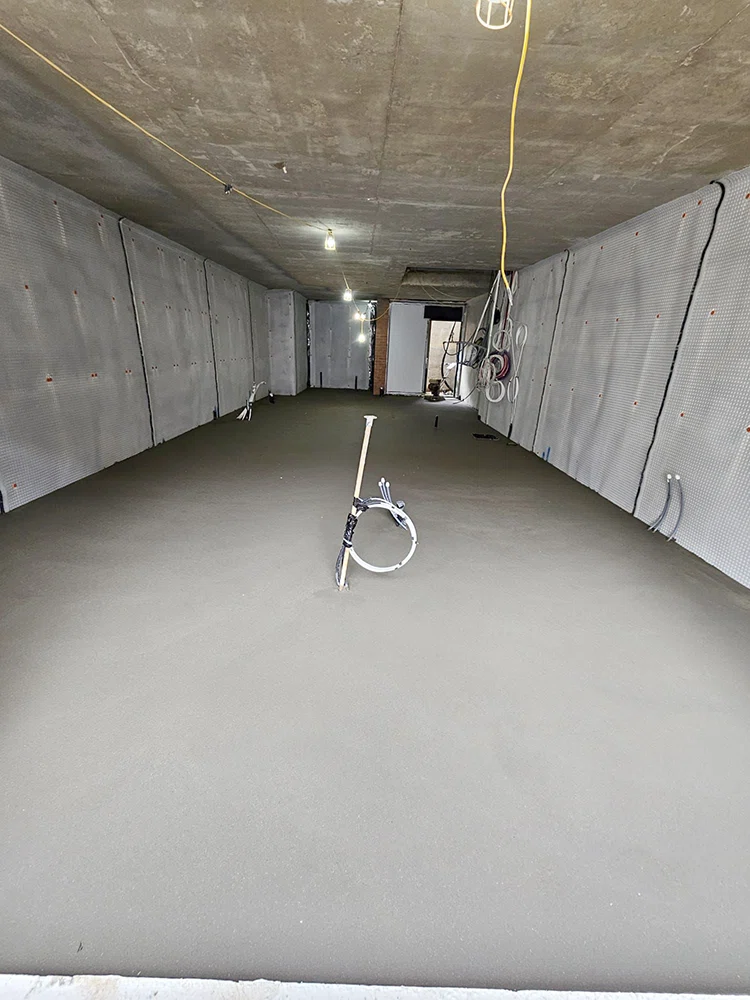
K & B Screeding’s own team, led by director Donatas Bardisevicius. Founded 2019, company 12298780.
See what customers say in our Google reviews and on our testimonials page.
Anhydrite & Flow Screed from Slough to Stevenage
Stevenage is about 31.9 miles north-east of our Slough base as the crow flies, with postcodes including SG1 and SG2. The nearest towns to it are Hitchin (4.7 miles), Letchworth (5.3 miles), Baldock (6.1 miles) and Welwyn Garden City (6.8 miles).
More on anhydrite screed, part of our screeding services.
