
Accurate floors for Gunnels Wood Industrial Area buildings
Gunnels Wood Industrial Area runs between the East Coast main line and the A1 and is the town's main employment zone. It holds MBDA and one of GSK's two global R&D hubs, alongside production and warehouse buildings. Floors in buildings like these are refitted as uses change, and the new finish is often less forgiving than the old one.
BS 8204 judges a floor by laying a 2m straightedge across it: gaps no bigger than 3mm make it SR1, up to 5mm SR2, up to 10mm SR3. SR1 is the class many thin sheet finishes demand, so safety vinyl in a laboratory or a production area usually needs a compound over the existing slab to meet it.
Preparation comes first. Old adhesive, coatings and contamination are removed, often by concrete floor grinding, and the base is primed with the product that suits it. Concrete slabs, cement screeds and anhydrite screeds all call for their own primer, and mixing them up costs adhesion. The compound then goes down, typically from about 2mm to around 10mm.
Heavier floors in warehouse and production space may need more than compound. Where a slab is cracked, dusting or breaking up, levelling over it only hides the fault, and deep pours of compound can crack and debond. Those floors need repair or a new wearing screed, and a high strength floor screed is often the right base there.
Levelling Stevenage terrace floors after old tiles come up
Across the new town neighbourhoods, a floor refit often starts with lifting old floor tiles. What lies underneath is an original screed that may be patchy, marked with old adhesive and out of level, and neither LVT nor large-format tiles will lie flat on it.
If that screed is firm and well bonded, a levelling compound is the efficient fix. The surface is cleaned and primed, then compound is poured to bring the room within tolerance in a few millimetres. It dries quickly, so flooring can follow soon after.
The same approach joins an extension to the original house. Where a new extension or garage conversion meets the old floor, the two rarely line up perfectly, and compound can blend them into one surface so the finish runs through without a threshold strip.
If the old screed is loose or crumbling, compound is the wrong answer, and a relaid screed is needed first; our sand and cement screed page for Stevenage covers that. We do not sand wooden floors or give DIY product advice.
How we price floor levelling in Stevenage
A fixed written price within 24 hours, once we know the area and the base. See our floor screeding cost guide.
Who levels your floor in Stevenage
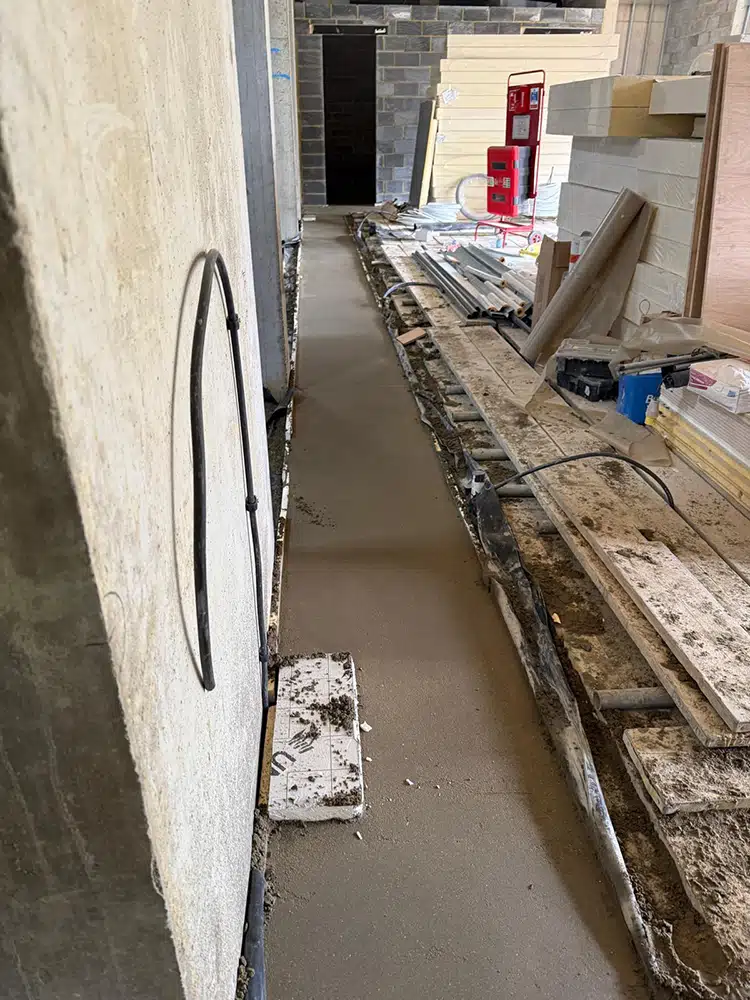
K & B Screeding’s own team, led by director Donatas Bardisevicius. Founded 2019, company 12298780.
See what customers say in our Google reviews and on our testimonials page.
Floor Levelling from Slough to Stevenage
Stevenage is about 31.9 miles north-east of our Slough base as the crow flies, with postcodes including SG1 and SG2. The nearest towns to it are Hitchin (4.7 miles), Letchworth (5.3 miles), Baldock (6.1 miles) and Welwyn Garden City (6.8 miles).
More on floor levelling, part of our screeding services. Not sure whether you need a thin compound or a full flowing screed? See self levelling screed explained.
