
Specifying anhydrite grades for Hitchin flats and plots
This material is graded by how strong it is. Read CA-C25-F5 as two numbers: 25 is compressive strength and 5 is flexural strength, each in N/mm2 under the European screed standard.
Three grades cover most work. At the light end is CA-C20-F4, for domestic rooms that see little traffic; at the heavy end is CA-C30-F6; and between them CA-C25-F5 suits the majority of houses, flats and offices. If the specification names a grade, the screed must meet it. If it names none, we suggest one to match how the floor will be used.
Where quicker drying or a shallower depth counts, alpha hemihydrate products come in. They follow their own product data sheets rather than the general rules, so we work to the manufacturer's figures on those jobs.
Of Hitchin's homes, 11% were built between 2000 and 2014, and newer plots and blocks of flats are where these grades tend to be written into the drawings. It barely shrinks, so wide bays need only a few joints; before pouring we mark out the bays so the joints sit at doorways and the edges of heating zones.
There is one hard limit. Calcium sulphate has no place in a wet room, a plant room or anywhere else that could see water. Those floors take cement based flowing screed. If the question is simply how a pumped floor goes in, see our liquid screed page for Hitchin.
Laitance and moisture checks on Hitchin anhydrite floors
Anhydrite grows a thin, weak top layer as it dries, and that layer is called laitance. Adhesives do not grip it reliably. When the screed has dried far enough, that layer is sanded away, the dust cleared up and a primer made to suit calcium sulphate goes on. Skip this and tiles or vinyl may start to come away months down the line.
Moisture is the second check. The moisture limit many flooring makers set for calcium sulphate is lower than the one for cement, which means a reading that passes on cement may fail here. A hygrometer tells you the real figure. From about 7 days, the floor can usually be force dried using the underfloor heating, which shortens the wait.
We hand over drying and laitance advice in writing, so the flooring contractor starts with the facts: the pour date, the grade, the heating schedule and when sanding was done. On a block of flats, it is worth keeping that record floor by floor. Our anhydrite screed explainer covers the material in more depth, and where old primers or adhesive need removing, see floor preparation. We offer the same service in Luton.
Anhydrite & Flow Screed prices in Hitchin
Liquid flowing screed (which includes anhydrite): £24 to £31 per m² supplied and laid (MyJobQuote, August 2026), so £960 to £1,240 for 40 m². MyJobQuote does not say whether these figures include VAT. See our floor screeding cost guide or screed calculator.
Who lays your anhydrite and flow screed in Hitchin
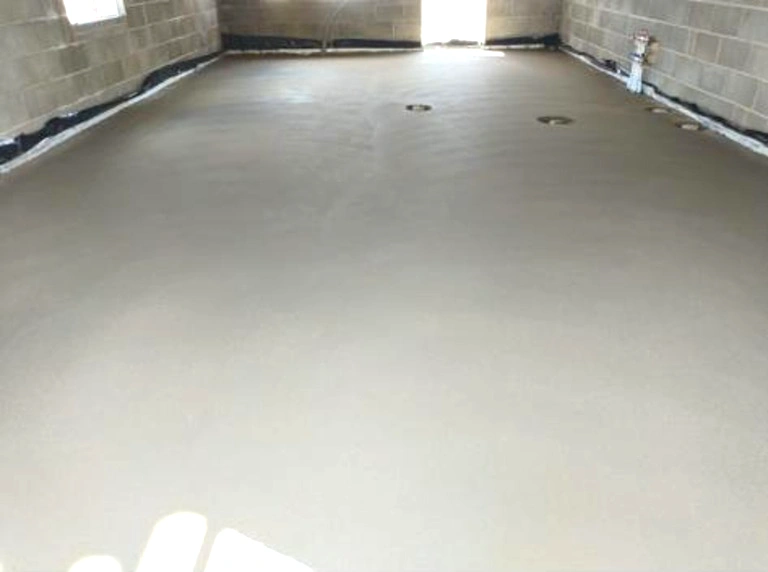
K & B Screeding’s own team, led by director Donatas Bardisevicius. Founded 2019, company 12298780.
See what customers say in our Google reviews and on our testimonials page.
Anhydrite & Flow Screed from Slough to Hitchin
On the map, Hitchin sits north-north-east of Slough, about 32.8 miles from our base in a straight line (postcodes including SG5 and SG4), next to Letchworth (2.9 miles), Stevenage (4.7 miles), Baldock (4.8 miles) and Stotfold (5 miles).
More on anhydrite screed, part of our screeding services.
