
Quarry tiles and boards in older Hitchin houses
A latex screed is two components mixed on site: a cement based powder and a latex liquid that takes the place of water. The result grips more firmly, and tolerates slight movement better, than a compound mixed with water alone. It still goes down thin, typically a few millimetres, and it is a smoothing layer, not a structural one.
Older houses in the town carry a mix of bases. Terraced homes make up 19% of the stock, and the oldest houses, closest to the centre, can sit on timber laid over joists or on concrete with no membrane. A sound, firmly bonded quarry or ceramic tile floor makes a good base once it has been checked, cleaned and primed. Any tile that sounds hollow is lifted and the gap filled before the latex is poured.
Timber is treated with more caution. Latex does not go onto bare floorboards, upstairs or down. The boards are screwed down, and flooring grade plywood is fixed over them at close centres to make a rigid deck; the latex then smooths the plywood joints and screw heads for vinyl or LVT.
Old concrete that has worn uneven, or that carries thin, well bonded adhesive from an earlier floor, can also take latex after priming. On a calcium sulphate screed the laitance comes off first and a primer always goes on. Damp is tested on every ground floor before we start, and loose or contaminated surfaces go through floor preparation first.
Where latex stops working in Hitchin homes
Latex is thin, and that sets its limits. It follows the shape and the behaviour of the floor below, so three conditions rule it out until they are fixed.
Movement comes first. A suspended timber floor with a bounce will crack a thin compound, so loose boards and weak joists are dealt with and the plywood overboarding fixed rigid before any latex goes down.
Damp is the second. Early concrete with no membrane lets moisture through, and latex will not stop it; vinyl laid on top can lift. Where the old floor is damp, the lift, insulate and rescreed approach on our hand-laid screed page is usually the real answer.
The third is level. Wherever the house is, from Bearton to the Poets Estate, a floor that falls several centimetres from one wall to the other is not changed by a few millimetres of latex. A fall that size needs a new screed; shallower hollows can take floor levelling with compound.
Finishes help decide. Sheet vinyl, LVT, safety flooring in a utility room, lino and rubber show every mark beneath them, so these are the floors where latex earns its keep. Carpet asks less, though old tile joints can still show through.
How we price latex screed in Hitchin
A fixed written price within 24 hours, once we know the area and the base. See our floor screeding cost guide.
Who lays your latex screed in Hitchin
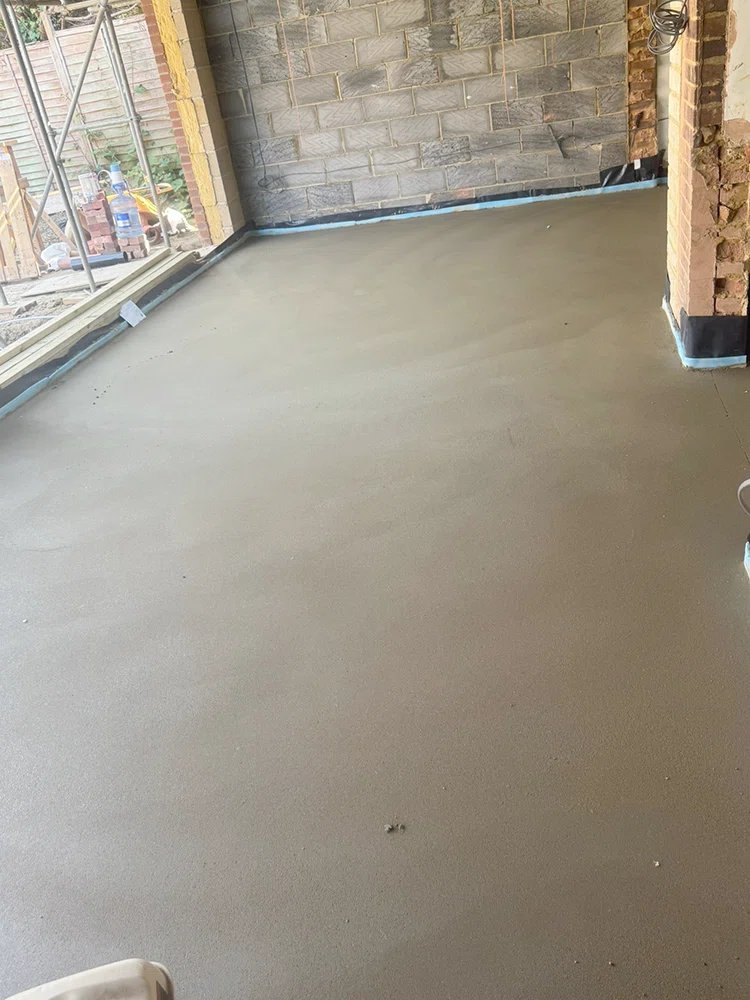
K & B Screeding’s own team, led by director Donatas Bardisevicius. Founded 2019, company 12298780.
See what customers say in our Google reviews and on our testimonials page.
Latex Screed from Slough to Hitchin
On the map, Hitchin sits north-north-east of Slough, about 32.8 miles from our base in a straight line (postcodes including SG5 and SG4), next to Letchworth (2.9 miles), Stevenage (4.7 miles), Baldock (4.8 miles) and Stotfold (5 miles).
More on latex screed, part of our screeding services.
