
Lift, insulate and rescreed near Hitchin town centre
Hitchin has a real stock of older houses. Pre-1919 houses make up around 14% of the town, and those from 1919 to 1944 another 16%. Close to the centre, Victorian and Edwardian homes may sit on timber ground floors hung over a void, or on early concrete laid with no damp proof membrane.
Either kind of floor can be replaced with a solid, insulated one. We take the old floor out and get the ground ready underneath. A membrane goes down, lapped and turned up at the walls, followed by rigid insulation and an edge strip. A floating sand and cement screed, 65mm deep in a house, then gives a dense base for tiles, stone or wood.
The finished height is the hard part. Old thresholds, hearths and door bottoms set the level, so the dig depth is worked back from there. Where there is little depth to play with, and the slab below is sound, a bonded screed of 25 to 40mm can work; our page on bonded screed explains the conditions.
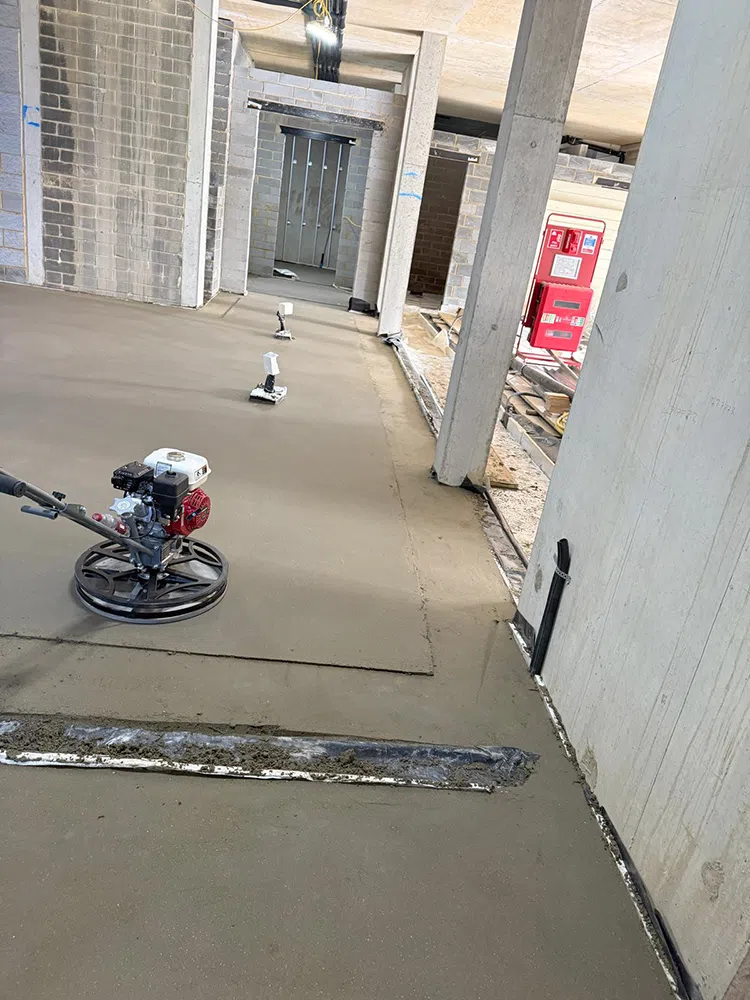
Hand-laid screed is suited to this work because it goes in room by room, in small batches, around chimney breasts, bay windows and narrow halls without any pump. It also gives a cement surface that can take load early, which helps where builders need to keep working in the room.
Where a sound floor is simply out of level, compound may be all it needs; see levelling an uneven Hitchin floor.
Wet rooms, garages and drying times in Hitchin
Some rooms need a cement floor whatever else is in the house. Wet rooms and walk-in showers are screeded to a fall towards the drain, which a flowing screed cannot form, and calcium sulphate does not suit areas that may get wet. Sand and cement is the standard answer.
Converting a garage suits it too. A garage slab tends to sit lower than the rooms next to it, so insulation and fresh screed lift it to the same level. You can see a typical build-up in our guide to screeding a garage floor.
Where a floor will be loaded early, a utility room full of heavy appliances for example, fibres can go into the mix to resist cracking, for an extra £1 to £3 per m². Short on time? A faster drying mix can be used.
What you give up with sand and cement is time. Give it roughly one day for every millimetre of the first 40mm, plus more for the rest, and a 65mm floor holds up most finishes for weeks. Plan the kitchen fitter and the tiler around that date, and keep the room ventilated. The same service is available for houses in Stevenage.
Sand and Cement Screed prices in Hitchin
Sand and cement screed: £18 to £25 per m² supplied and laid (MyJobQuote, August 2026), so £450 to £630 for 25 m². MyJobQuote does not say whether these figures include VAT. See our floor screeding cost guide or screed calculator.
Who lays your sand and cement screed in Hitchin
K & B Screeding’s own team, led by director Donatas Bardisevicius. Founded 2019, company 12298780.
See what customers say in our Google reviews and on our testimonials page.
Sand and Cement Screed from Slough to Hitchin
On the map, Hitchin sits north-north-east of Slough, about 32.8 miles from our base in a straight line (postcodes including SG5 and SG4), next to Letchworth (2.9 miles), Stevenage (4.7 miles), Baldock (4.8 miles) and Stotfold (5 miles).
More on sand & cement screed, part of our screeding services.
