
Older Biggleswade houses and listed buildings like the White Hart
An old solid ground floor usually fails in one of a few ways. It cracks, it sinks in patches, or it has no damp protection at all, so finishes lift and rooms smell damp. The cure is to take the whole slab out, lay insulation and a membrane in its place, and screed over them. Sand and cement tends to make more sense than a pumped mix for a rebuild like this. It is mixed in small batches to suit each room, carried through narrow doorways and compacted and floated to a dense, level finish.
Terraced houses make up 25% of the town's homes, and a narrow hall, a back kitchen and a small bathroom are the kind of layout where hand-laid screed is easier to control than a pumped one.
Listed buildings in the conservation area, such as the White Hart, need a different pace. Conservation-aware floor work is agreed in advance, so what comes out, what stays and what is rebuilt is settled before any tool is lifted.
Depth depends on the construction. Laid floating over insulation, a house needs 65mm of sand and cement, and commercial floors 75mm. Bond it straight to sound concrete and 25 to 40mm can be enough, a method set out on our bonded screed page. Adding fibres to help stop cracks costs roughly £1 to £3 extra per m².
If the floor is sound but only uneven, digging out may be unnecessary, and levelling a Biggleswade floor with compound could be the cheaper route.
Wet rooms, garages and falls in Biggleswade homes
Any Biggleswade room that will see water needs a cement screed. Calcium sulphate products are weakened by lasting moisture, so a walk-in shower, a wet room or a utility floor gets a cement base. Falls towards a drain are formed by hand, with the depth tapering across the room, and that is simpler with a hand-laid mix than a flowing one.
Turning a garage into a room is the other job where this mix earns its keep. Because garage slabs are normally lower than the rest of the house, we build up insulation, membrane and screed until the new floor meets the hall. For the layers in order, read our garage conversion screed guide. A garage kept for cars or a workshop may also need early load, which a cement screed takes better.
Drying is the trade-off. The first 40mm gives up its water at roughly a millimetre a day and the rest more slowly, so a 65mm floor in a Biggleswade garage conversion is several weeks off wood or vinyl. When the build cannot wait that long, a quicker drying cement screed cuts the gap. Sandy is only 3.1 miles up the road, and its hand-laid screed page covers the same work there.
Sand and Cement Screed prices in Biggleswade
Sand and cement screed: £18 to £25 per m² supplied and laid (MyJobQuote, August 2026), so £450 to £630 for 25 m². MyJobQuote does not say whether these figures include VAT. See our floor screeding cost guide or screed calculator.
Who lays your sand and cement screed in Biggleswade
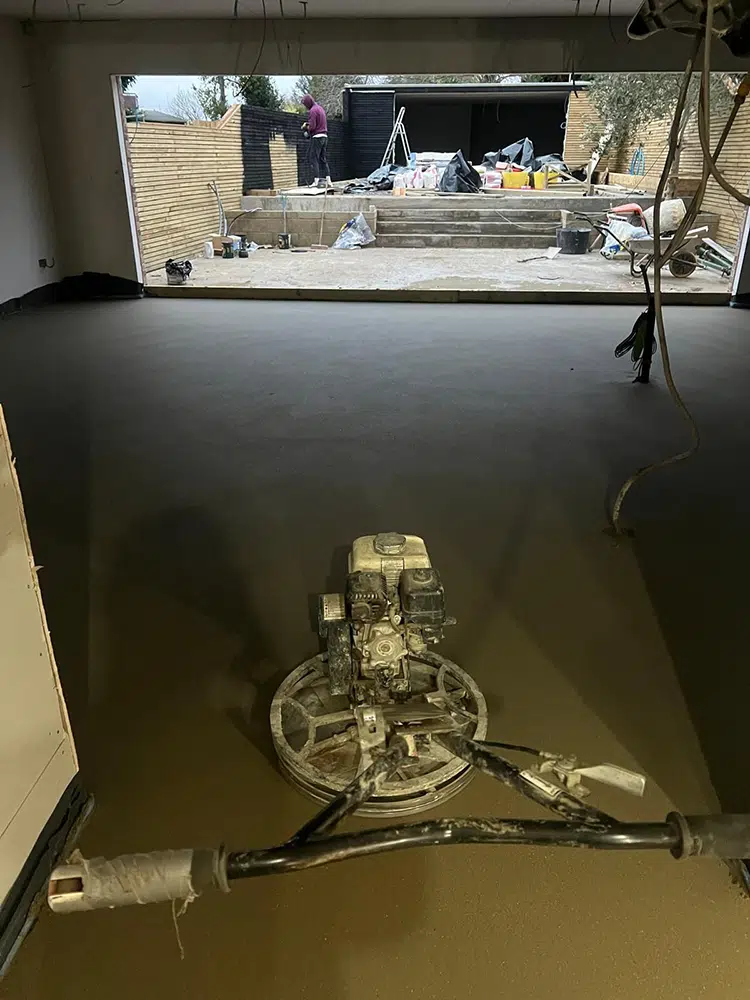
K & B Screeding’s own team, led by director Donatas Bardisevicius. Founded 2019, company 12298780.
See what customers say in our Google reviews and on our testimonials page.
Sand and Cement Screed from Slough to Biggleswade
On the map, Biggleswade sits north-north-east of Slough, about 41.7 miles from our base in a straight line (postcodes including SG18), next to Sandy (3.1 miles), Stotfold (5.1 miles), Baldock (7.4 miles) and Letchworth (7.7 miles).
More on sand & cement screed, part of our screeding services.
