
CA grades on Biggleswade plots and apartment floors
Calcium sulphate screeds are graded with a short code, set out in the standard that covers screed materials. The number after C is compressive strength and the one after F is flexural, both in N/mm2. For houses and flats, you will almost always meet one of three. CA-C20-F4 is for lightly trodden rooms in a house. A Biggleswade flat, house or office will mostly be poured at CA-C25-F5. CA-C30-F6 goes where a floor will be worked harder.
On a new Biggleswade plot, the engineer or developer picks the grade, and that exact grade is what goes down, with no near-equivalent substituted. Now and then a specification names an alpha hemihydrate product instead, normally to get a thinner floor or a quicker dry. Those products follow their own data sheet, so thickness, drying and heat-up are taken from it.
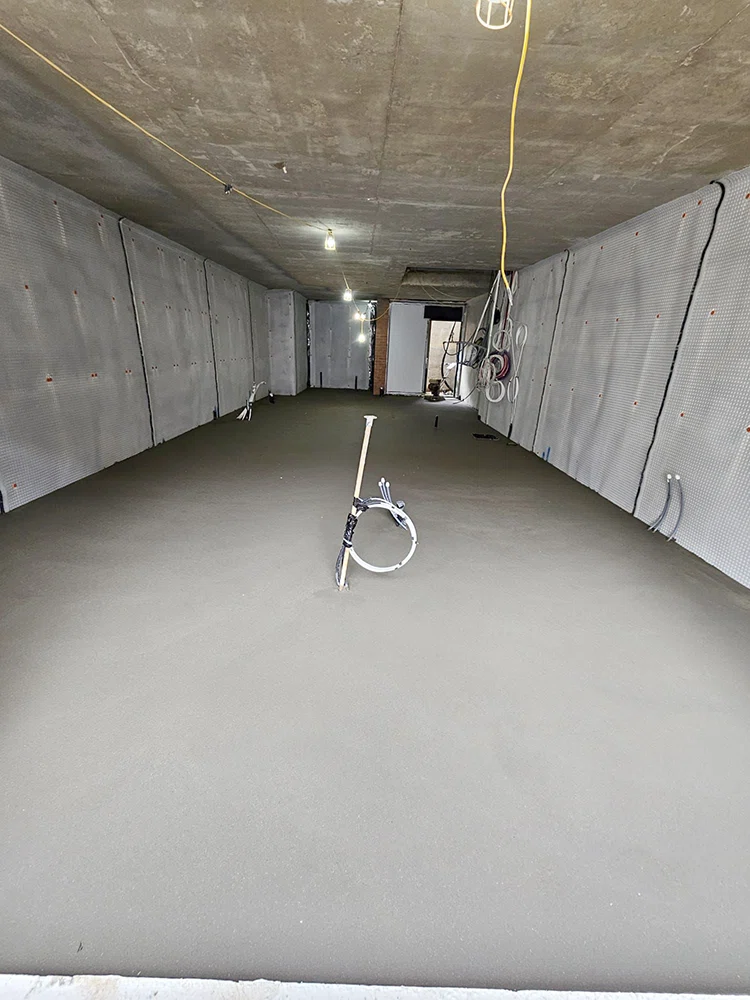
The material itself is the reason it is specified. Since calcium sulphate barely shrinks while setting, wide bays need few joints, and an entire ground floor or flat is poured on one visit. Any joints, at thresholds or where one heating zone meets another, are planned with you before pouring starts.
Purpose-built flats account for 12% of homes in Biggleswade, and apartment floors are a close match for this material: a wide area over insulation, usually with heating, and a finish that must be flat for thin coverings. If you want more on why it behaves this way, our anhydrite screed guide goes into it.
Sanding, priming and testing before Biggleswade floors are finished
Pouring is half the job. While it dries, calcium sulphate throws a thin, weak layer to the surface, known as laitance. Any adhesive or levelling compound laid over it bonds to that weak crust, not the screed below, which is why it gets sanded off before anything else. We then prime with a product designed for calcium sulphate, giving the adhesive a sound surface to hold.
Moisture comes next. Flooring manufacturers often set a tighter moisture limit for calcium sulphate, so a reading that would pass on sand and cement can still be too wet here. We take a hygrometer reading and compare it with the maximum given by whoever makes your chosen floor covering. If the floor is heated, running the system from about 7 days can usually speed the drying.
Any Biggleswade floor at risk of getting wet should not be calcium sulphate. Wet rooms, plant rooms and utilities where a leak is possible need a cement based flowing screed instead, or sand and cement laid by hand. The same approach to grades and testing applies to anhydrite flow screed in St Neots.
Anhydrite & Flow Screed prices in Biggleswade
Liquid flowing screed (which includes anhydrite): £24 to £31 per m² supplied and laid (MyJobQuote, August 2026), so £960 to £1,240 for 40 m². MyJobQuote does not say whether these figures include VAT. See our floor screeding cost guide or screed calculator.
Who lays your anhydrite and flow screed in Biggleswade
K & B Screeding’s own team, led by director Donatas Bardisevicius. Founded 2019, company 12298780.
See what customers say in our Google reviews and on our testimonials page.
Anhydrite & Flow Screed from Slough to Biggleswade
On the map, Biggleswade sits north-north-east of Slough, about 41.7 miles from our base in a straight line (postcodes including SG18), next to Sandy (3.1 miles), Stotfold (5.1 miles), Baldock (7.4 miles) and Letchworth (7.7 miles).
More on anhydrite screed, part of our screeding services.
