
Choosing a CA grade for Kempston flats and houses
A calcium sulphate screed is specified by grade, and the grade tells you its strength. After the C comes its compressive strength and after the F its flexural strength, each given in N/mm2.
At the light end, CA-C20-F4 serves domestic floors that see little traffic. CA-C25-F5 sits in the middle and covers the general run of houses, flats and office space, and CA-C30-F6 is kept for floors that take more punishment. If you are a builder working from a drawing, the grade will be written there, and we supply exactly that grade. If no grade is set, we recommend one to suit the use of the floor, so that it can be checked and agreed with you before the pour.
Alpha hemihydrate products are a faster option. Specifiers reach for them when the programme needs drying sooner or the floor needs to be thinner, and each must be laid to its own data sheet rather than to rules of thumb.
Because it barely shrinks while drying, we can lay it in big bays with hardly any joints. On a Kempston semi knocked through into one open-plan room, or across a floor of flats, that is where it pays off. Joint positions are still set out ahead of pumping, with doorways and the boundaries between heating zones settled first.
10% of homes in Kempston were built between 2000 and 2014, and newer houses like these are the other place the material fits, over insulation and underfloor heating. There is a fuller account of the material in our calcium sulphate screed guide.
Drying, sanding and testing anhydrite in Kempston
Calcium sulphate needs a finishing routine of its own before flooring can go on.
First, the laitance. Setting leaves a soft, crumbly film on top of the screed, and once the floor has dried that film has to be sanded away. Adhesives and primers laid over laitance can fail.
Second, moisture. The acceptable reading a flooring maker gives for calcium sulphate is often lower than the one for cement, so check the result against the correct limit. We normally test with a hygrometer. In a heated extension, running the heating can usually start forcing the drying from about 7 days.
Third, priming. After sanding, and only when dry, it takes a primer formulated for calcium sulphate. Use one especially where a cement based adhesive or levelling compound over anhydrite will follow.
Do not use it in any room that may get wet. Wet rooms get a flowing screed with a cement binder instead, which is pumped in just the same way.
Building over in Milton Keynes? See our Milton Keynes anhydrite screed page.
Anhydrite & Flow Screed prices in Kempston
Liquid flowing screed (which includes anhydrite): £24 to £31 per m² supplied and laid (MyJobQuote, August 2026), so £960 to £1,240 for 40 m². MyJobQuote does not say whether these figures include VAT. See our floor screeding cost guide or screed calculator.
Who lays your anhydrite and flow screed in Kempston
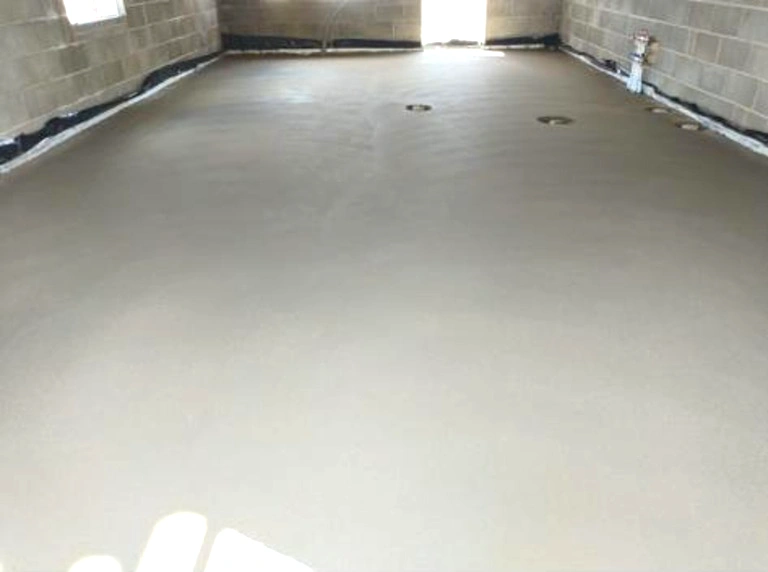
K & B Screeding’s own team, led by director Donatas Bardisevicius. Founded 2019, company 12298780.
See what customers say in our Google reviews and on our testimonials page.
Anhydrite & Flow Screed from Slough to Kempston
As the crow flies, our yard in Slough is about 40.8 miles from Kempston, which lies to the north. Postcodes here include MK42, MK40, MK43 and MK45, and Bedford (2 miles), Flitwick (7.8 miles), Sandy (9.1 miles) and Newport Pagnell (9.6 miles) are close by.
More on anhydrite screed, part of our screeding services.
