
Reading an anhydrite specification for Newport Pagnell plots
Read a specification for calcium sulphate screed and you will find a short code from the European screed materials standard. CA stands for the calcium sulphate binder, the C figure is its strength in compression and the F figure its strength in bending, both given in N/mm2. Most buildings use one of three: CA-C20-F4 where domestic traffic is light, CA-C25-F5 in most houses, flats and offices, and CA-C30-F6 for harder use.
For a plot on a new development, it is the developer's engineer who sets the grade. We pour the specified grade and do not swap it for something cheaper. Occasionally the drawings call for an alpha hemihydrate product, because the site needs quicker drying or a thinner floor. Its minimum depth and drying time are set by that manufacturer's sheet, which is what we follow.
The material has real advantages on housing sites. Because it barely shrinks while setting, an open-plan ground floor or a flat can be poured in big bays with only a handful of joints. Purpose-built flats are 8% of homes in the town today, and any new apartment block would be a natural place for it.
Our own team prepares the full build-up before the pour: insulation, membrane, edge strip and the bay and joint layout, with joints placed at doorways and between heating zones. For wider background, read anhydrite screed explained, and for the delivery side see screed pumping.
Laitance and moisture on Newport Pagnell new builds
When an anhydrite floor is dry enough, it still is not ready for flooring. Curing leaves a fragile skin on top, known as laitance. We sand that skin away and then prime the floor with a primer suited to calcium sulphate. Adhesive laid over laitance grips the crust, not the screed, and tiles or vinyl can later come loose.
Moisture is the next check. Flooring manufacturers frequently demand a drier reading from calcium sulphate than from cement, so a surface that seems dry can still fail. We test with a hygrometer and record the result, so the flooring contractor has a figure to work from rather than a date. If the plot has underfloor heating, force drying can usually start at about 7 days, useful when houses on a development are handed over one after another. The drying and laitance advice for each floor is handed over in writing, so the site manager and the flooring subcontractor are working from the same instructions.
Anhydrite does not belong where water may sit. For a shower room, a wet room or a utility where a leak could happen, use a cement based flowing screed instead, or sand and cement laid by hand with a fall to the drain.
Anhydrite & Flow Screed prices in Newport Pagnell
Liquid flowing screed (which includes anhydrite): £24 to £31 per m² supplied and laid (MyJobQuote, August 2026), so £960 to £1,240 for 40 m². MyJobQuote does not say whether these figures include VAT. See our floor screeding cost guide or screed calculator.
Who lays your anhydrite and flow screed in Newport Pagnell
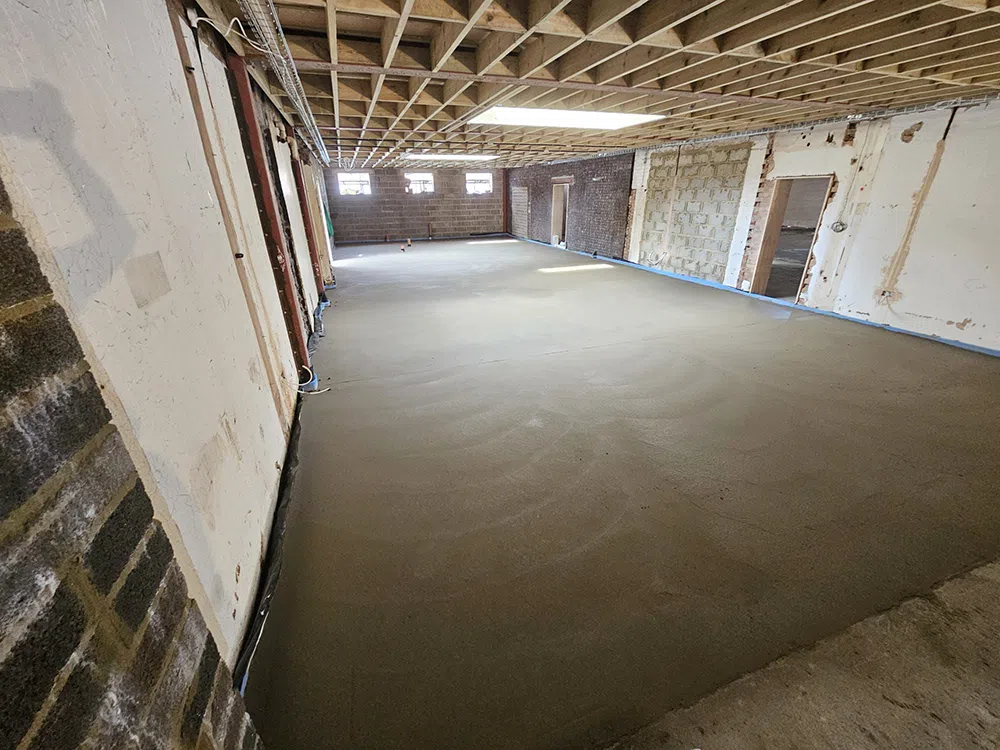
K & B Screeding’s own team, led by director Donatas Bardisevicius. Founded 2019, company 12298780.
See what customers say in our Google reviews and on our testimonials page.
Anhydrite & Flow Screed from Slough to Newport Pagnell
Newport Pagnell is about 38.5 miles north of our Slough base as the crow flies, with postcodes including MK16 and MK14. The nearest towns to it are Milton Keynes (3.3 miles), Bletchley (6.5 miles), Kempston (9.6 miles) and Flitwick (11.3 miles).
More on anhydrite screed, part of our screeding services.