
Reading a Bedford new-build specification: grades and products
On a new-build specification, calcium sulphate screed is written as a code taken from the European standard for screed materials. In that code, C gives the strength in compression and F the strength in bending, each in N/mm2. Housing mostly uses one of three: CA-C20-F4 where traffic is light, CA-C25-F5 for typical houses, flats and offices, and CA-C30-F6 for floors that will work harder.
The developer's engineer chooses the grade for each plot, and we pour exactly that grade, with no swaps or substitutes. Sometimes the drawings call for alpha hemihydrate, usually because the floor must be ready sooner or be thinner. Those come with their own product sheet, and its depths and drying times override the general CA rules.
Unlike cement, calcium sulphate barely shrinks as it cures, so wide bays can go down with hardly any joints, which suits a flat or a big open-plan ground floor. Where a joint is unavoidable, at a door threshold or where heating zones meet, we set out the bays before pouring.
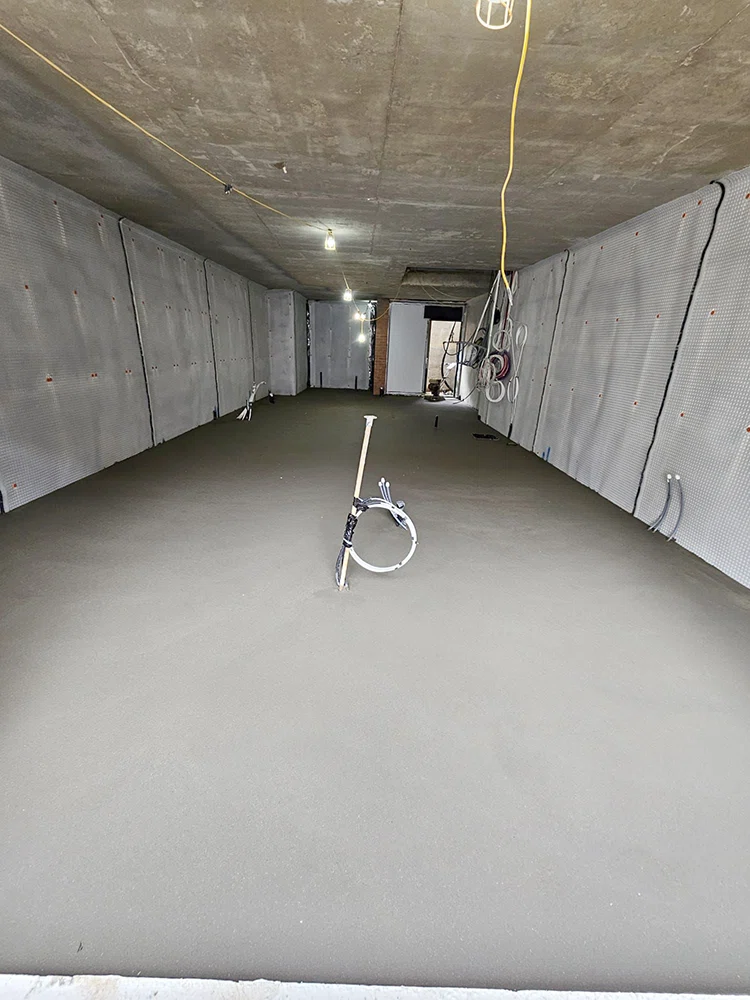
In Bedford, 21% of homes sit in purpose-built blocks of flats, and their floors are exactly this kind of job: a large area poured in one visit over insulation, often with heating. There is more on the material in our anhydrite guide.
Laitance and moisture tests before Bedford floors are finished
Getting calcium sulphate into the house is only half the work. While it dries, the top develops laitance, a thin and fragile skin. Lay flooring adhesive onto that and your tiles or LVT are stuck to a crust, not to the screed, so that skin is sanded off after the screed has dried sufficiently and then primed with a product made to suit calcium sulphate.
Next comes the moisture check. Flooring manufacturers often set a tighter moisture limit on calcium sulphate than on cement, which means a floor dry enough for tiles on sand and cement may still fail here. A hygrometer settles the question, not the calendar. If underfloor heating is fitted, it can usually be run from about day 7 to speed the drying.
Keep calcium sulphate away from anywhere that could stay wet, like a wet room or a utility room floor that could flood from a leak. In those rooms we pour a flowing screed bound with cement, or lay a traditional one. Older Bedford buildings whose base needs attention first are covered by our floor preparation service, and for wet rooms, see sand and cement floors in Bedford.
Anhydrite & Flow Screed prices in Bedford
Liquid flowing screed (which includes anhydrite): £24 to £31 per m² supplied and laid (MyJobQuote, August 2026), so £960 to £1,240 for 40 m². MyJobQuote does not say whether these figures include VAT. See our floor screeding cost guide or screed calculator.
Who lays your anhydrite and flow screed in Bedford
K & B Screeding’s own team, led by director Donatas Bardisevicius. Founded 2019, company 12298780.
See what customers say in our Google reviews and on our testimonials page.
Anhydrite & Flow Screed from Slough to Bedford
Bedford is about 42.5 miles north of our Slough base as the crow flies, with postcodes including MK40, MK41 and MK42. The nearest towns to it are Kempston (2 miles), Sandy (7.7 miles), Flitwick (9.3 miles) and Biggleswade (9.4 miles).
More on anhydrite screed, part of our screeding services.