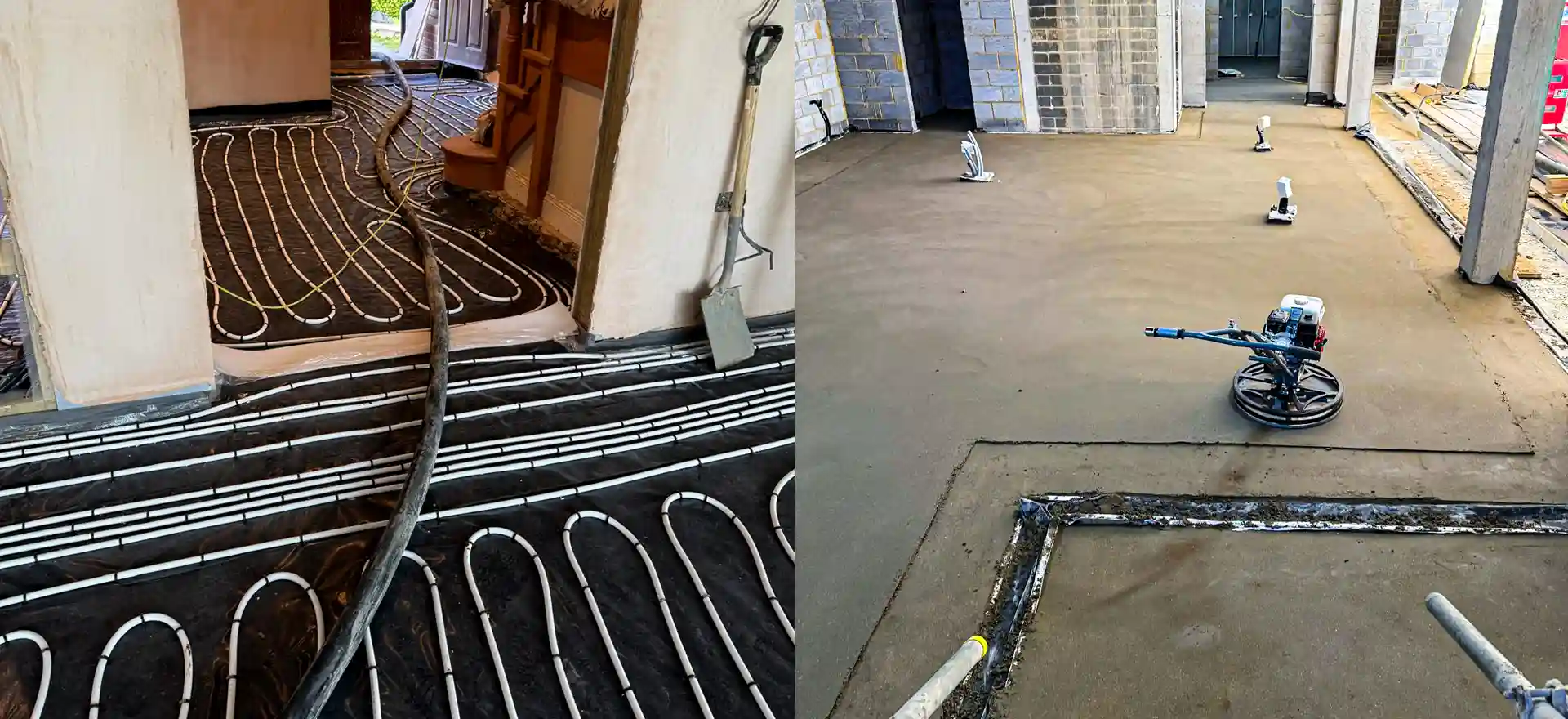
Level floors for Caxton Park and Priory Business Park refits
Commercial refits are where levelling compound does its most visible work. When a unit changes hands at Elms Farm Industrial Estate, including Caxton Park on Caxton Road, or an office is refitted at Priory Business Park on Fraser Road, the new finish often exposes every dip in the old base. Carpet tiles hide a little. LVT, vinyl sheet and large format tiles hide nothing.
Flatness is graded under BS 8204 by laying a 2m straightedge on the floor and measuring the biggest gap: up to 3mm passes SR1, 5mm SR2 and 10mm SR3. Thin sheet flooring often asks for SR1, so a floor that looked fine under the old carpet can fall short once vinyl is chosen.
The compound itself is a thin layer, normally somewhere from 2mm to 10mm, with a few products made for more. First the base is cleaned, then primed with whatever suits it, be that concrete, a cement screed, calcium sulphate or the remains of old adhesive. The wrong primer is the usual reason compound lifts, and on a busy refit it is the step most likely to be rushed.
Warehouse slabs on Hammond Road and similar estates can be too worn for compound alone. In that case the slab is put right first by grinding the concrete and repairing the slab, giving the compound a solid surface to grip.
Joining old floors and extensions in Bedford homes
In a house, the trouble usually shows up at the opening between the original rooms and the extension, as a step or a slope. The new floor is flat; the old one next to it has settled, or was never quite true. Compound evens out the small dips and meets the two, so new flooring can carry straight through with no lip underfoot.
There are limits. Compound only finishes a surface; it carries no structure, and pouring it thick over a floor that really wants replacing tends to end in cracks and lifting. When the old floor sounds hollow, breaks up or is too far out, it needs rescreeding, usually with a new sand and cement floor in Bedford. Where only a thin build-up is needed, latex screed of a few millimetres is another option.
The programme is simpler than for a full screed. Fast drying compounds keep things moving, so the flooring fitter is not left waiting weeks as they might be after a new screed. We are happy to look at a floor and tell you plainly which of the two it needs.
Self levelling screed or compound for a Bedford floor
Searches for self levelling screed in Bedford tend to mix up two different products, and it helps to know which one your floor needs before asking for prices.
The first is a thin self levelling compound. It is poured a few millimetres deep over a floor that is already sound: an old concrete slab, a cement screed or an existing floor with small dips. It flows out to a smooth face so that vinyl, LVT, tiles or engineered boards sit flat. This page is about that work.
The second is a flowing screed, sometimes called liquid screed, covered on our liquid screed page for Bedford. It is a full depth floor in its own right, pumped from about 35mm deep over insulation in a home, often with underfloor heating pipes buried inside. It replaces a missing or failed floor, or forms a new one in an extension.
A simple test separates them. If the floor you have is solid and only needs smoothing, compound is the answer. If there is no floor yet, or the old one is hollow, cracked through or several centimetres out, you need a screed, with compound perhaps added later as the final skim.
At Wixams, where the new homes are built for underfloor heating in liquid screed, the full depth floor is already there. If an owner later chooses LVT and that screed falls short of SR1, compound is the step that closes the gap, primed to suit the screed beneath.
How we price floor levelling in Bedford
A fixed written price within 24 hours, once we know the area and the base. See our self levelling screed cost guide.
Who levels your floor in Bedford
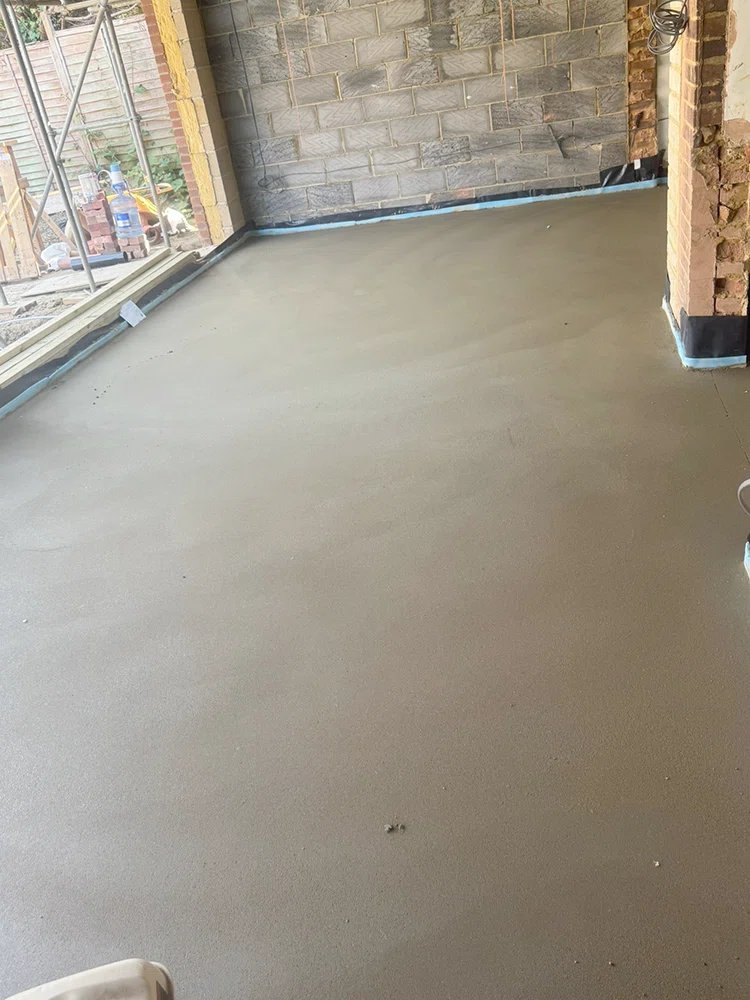
K & B Screeding’s own team, led by director Donatas Bardisevicius. Founded 2019, company 12298780.
See what customers say in our Google reviews and on our testimonials page.
Floor levelling from Slough to Bedford
Bedford is about 42.5 miles north of our Slough base as the crow flies, with postcodes including MK40, MK41 and MK42. The nearest towns to it are Kempston (2 miles), Sandy (7.7 miles), Flitwick (9.3 miles) and Biggleswade (9.4 miles).
More on floor levelling, part of our screeding services. For every screed we lay locally, see floor screeding in Bedford. Not sure whether you need a thin compound or a full flowing screed? See self levelling screed explained.
Further reading: how to level a concrete floor and latex, self levelling compound or screed.