
Levelling post-war St Neots house floors for new finishes
Homes built between 1945 and 1972 are 27% of St Neots, and semi-detached houses are 29%. Houses of that era suit extensions and knock-throughs, and both leave floors that need attention before a modern finish. The old slab may dip towards the walls, hold patches of adhesive from earlier coverings, or sit a few millimetres out from the newer floor in an extension.
Thin finishes show every flaw. Lay a 2m straightedge on the floor: for SR1, which plenty of thin sheet finishes require, the gap beneath must stay within 3mm. The SR2 class lets that gap reach 5mm, and SR3 lets it reach 10mm. Large format tiles and LVT usually need the tighter end.
The process is methodical. We strip off old adhesive and anything loose, mend the cracks, then prime with whatever suits the base, whether that is concrete, sand and cement, calcium sulphate or old tiles. Only then is the compound mixed, poured and spread out to settle flat.
Levelling has limits. A few products are made to go past 10mm, yet using thick compound on a floor that ought to be screeded is asking for cracking and debonding. If a St Neots floor is hollow, damp or far out of level, it needs a new sand and cement screed for older floors or a repair first. For areas only a few millimetres out, latex screed is often the right product.
Refits at Cromwell Road and Little End Road units
Two commercial areas in St Neots stand out. One is the Cromwell Road Industrial Estate, which includes factory and warehouse premises on Marston Road where Marston Business Park is a new development. The other is Little End Road in Eaton Socon, where steel framed warehouse units have concrete floors, mezzanines and trade counters near the A428 and A1.
When a unit changes hands, the offices, trade counter and showroom usually get new flooring, and the slab underneath rarely meets the flatness the new finish needs. Levelling compound brings those areas into line, with fast drying products that keep the fit-out moving. Work can be split into sections, so the trade counter reopens while the offices behind it are still being finished.
The warehouse floor itself needs different treatment. Worn or uneven slabs in older units often need repair, grinding or a high strength topping before new occupiers move in, because a thin compound will not stand up to forklifts. Our concrete floor grinding service is the starting point there.
For refits in neighbouring towns, see floor levelling in Bedford.
How we price floor levelling in St Neots
A fixed written price within 24 hours, once we know the area and the base. See our floor screeding cost guide.
Who levels your floor in St Neots
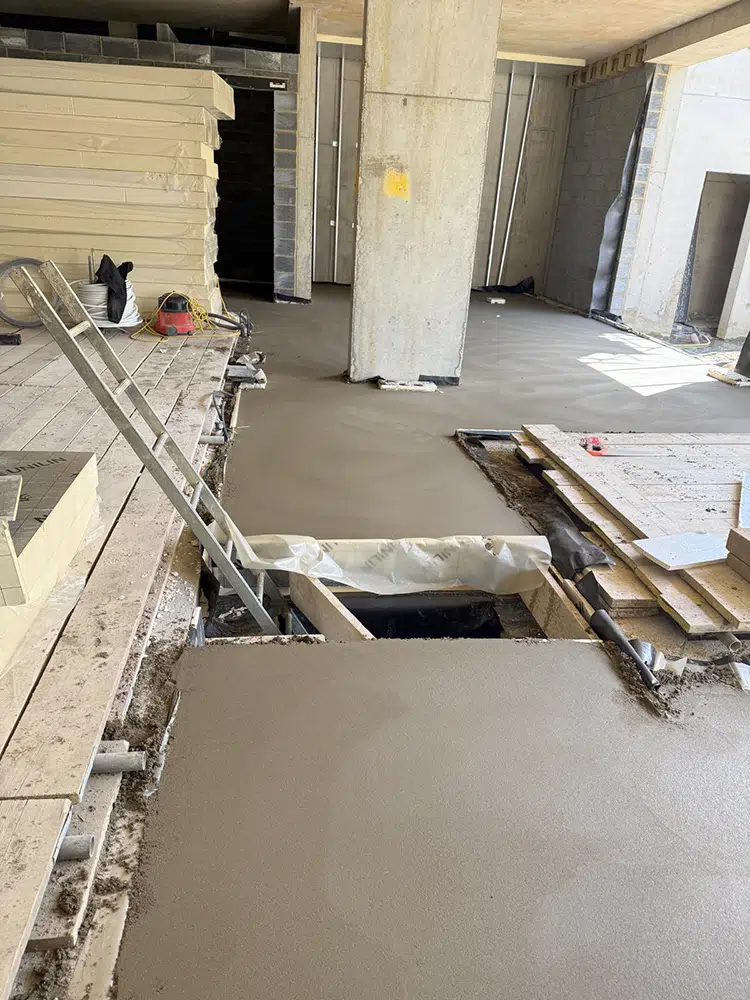
K & B Screeding’s own team, led by director Donatas Bardisevicius. Founded 2019, company 12298780.
See what customers say in our Google reviews and on our testimonials page.
Floor Levelling from Slough to St Neots
As the crow flies, our yard in Slough is about 50.7 miles from St Neots, which lies to the north-north-east. Postcodes here include PE19, and Sandy (6.9 miles), Huntingdon (8 miles), Biggleswade (9.8 miles) and Bedford (10.5 miles) are close by.
More on floor levelling, part of our screeding services. Not sure whether you need a thin compound or a full flowing screed? See self levelling screed explained.