
Latex over old tiles and timber in St Neots
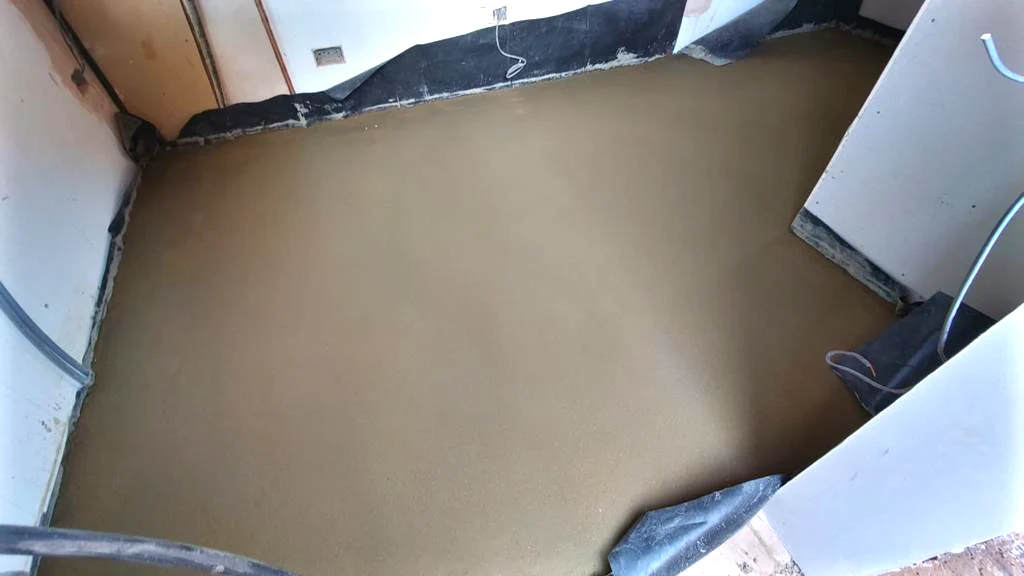
The name sounds technical, but the product is simple. A cement based powder is mixed with a latex liquid in place of water, and the latex gives the cured layer a little flexibility and a very strong grip on the surface below. That grip is why it is chosen for bases where an ordinary compound might let go. Because it goes down so thin, a new kitchen floor gains only a few millimetres, so door thresholds and the plinths under fitted units are rarely a problem.
Older homes in St Neots offer plenty of awkward bases. Homes built before 1919 make up 6% of the town's housing. Older houses are found in the historic core by St Mary's Church, where cottages and larger houses mix, in the late Victorian and Edwardian terraces, and in Eynesbury, which also has early twentieth century council housing. A kitchen in any of them might have firmly stuck quarry tiles, a timber floor or a concrete floor worn uneven over the years.
Each base is handled differently. Ceramic or quarry tiles that are bonded fast can stay put: they are cleaned of grease, primed with a product made for tiles and then covered. Timber is never covered directly. Bare boards move with the seasons and would crack a thin layer, so they are first overboarded with flooring grade plywood, screwed down closely, and the latex goes over the plywood. Old concrete is swept, loose patches are cut out and filled, and the surface is primed before the skim.
Old adhesive can sometimes stay if it is hard, thin and well bonded. Anything soft or flaking is scraped or ground away first, as part of preparing the floor beforehand.
When a St Neots floor needs more than latex
Latex finishes a floor; it does not mend one. Before we price, three questions decide whether it is the right product.
Is the floor dry? Many older solid floors in the terraced streets end up being dug out and relaid over new insulation and a membrane, and for good reason. Put a thin skim over a damp slab and the moisture simply sits under the new vinyl until the adhesive fails. A floor like that is rebuilt, usually in sand and cement laid by hand over a fresh membrane.
Is it firm? Stand in the middle of the room and rock on your heels. If the boards spring, they need extra fixings or replacing before any plywood goes down, otherwise the latex will crack along the board joints.
Is it close to level? Latex smooths small undulations. It cannot lift a floor that drops away by several centimetres from one wall to the other. A room in an old cottage may simply be too far out for a skim; a repair or new screed comes first then, and our screed repairs service can deal with failed patches.
The primer is the last check. If the base is a calcium sulphate screed, its laitance is sanded off and a compatible primer applied before any latex touches it. For general compound work and flatness classes, see our page on levelling St Neots floors.
How we price latex screed in St Neots
A fixed written price within 24 hours, once we know the area and the base. See our floor screeding cost guide.
Who lays your latex screed in St Neots
K & B Screeding’s own team, led by director Donatas Bardisevicius. Founded 2019, company 12298780.
See what customers say in our Google reviews and on our testimonials page.
Latex Screed from Slough to St Neots
As the crow flies, our yard in Slough is about 50.7 miles from St Neots, which lies to the north-north-east. Postcodes here include PE19, and Sandy (6.9 miles), Huntingdon (8 miles), Biggleswade (9.8 miles) and Bedford (10.5 miles) are close by.
More on latex screed, part of our screeding services.