
New homes along Cambridge Road and in older St Neots
Purpose-built flats account for 14% of St Neots homes, and those built since 2015 already make up 11%. Both numbers point towards pumped screed. On a new house or an apartment floor, the screed usually goes down over insulation or underfloor heating across the whole level at once, and a self-levelling material covers that area far faster than hand laying.
The finish is the other reason. A liquid screed flows out to a flat, dense surface, and SR1 or SR2 regularity is readily achievable. Shrinkage is low, so you get far fewer joints than with sand and cement, and that matters in open plan layouts where one length of flooring runs through several rooms.
Depth is shallow compared with a traditional floor. Floating on insulation in a home, it can be as little as about 35mm thick, rising to about 45 to 50mm overall when it has heating pipes to cover. That matters on post-war houses in the town, which suit extensions and knock-throughs where the new floor must sit level with the old.
Liquid screeds come in two broad types. Calcium sulphate types are common in new homes, and cement based flowing screeds are used where the floor may get wet. The grades and testing of the first kind are covered on our anhydrite flow screed page for St Neots.
Being able to cross the floor within a couple of days does not mean it is ready for the fitter. Expect around a day of drying for each millimetre up to 40mm, and a slower rate after that.
Pump access in Eaton Ford, Eynesbury and beyond
The pump has to reach the room. A mixer truck feeds a pump parked outside, and a hose carries the screed through the house to the floor being poured. On a new plot with open access that is easy. Where a house in Eaton Ford, Eynesbury or elsewhere in town has no drive, the truck and pump may have to stand at the roadside, so parking, width and any restrictions should be mentioned when you ask for a price.
Apartments bring their own checks. The hose can run up a stairwell to an upper floor, but the route through communal areas needs protecting and the building's rules for contractors need agreeing in advance. Upper floors also need their edge detailing and any sound insulation layer checked before the pour, since a flowing screed will find every gap.
For 2026, published UK prices for liquid screed sit between £24 and £31 per m². Area, depth and access all move a price within that range. Before you choose, it is worth reading our guide to liquid screed versus sand and cement. The same service is available about 6.9 miles away for liquid screed in Sandy.
Liquid Screed prices in St Neots
Liquid screed: £24 to £31 per m² supplied and laid (MyJobQuote, August 2026), so £960 to £1,240 for 40 m². MyJobQuote does not say whether these figures include VAT. See our floor screeding cost guide or screed calculator.
Who lays your liquid screed in St Neots
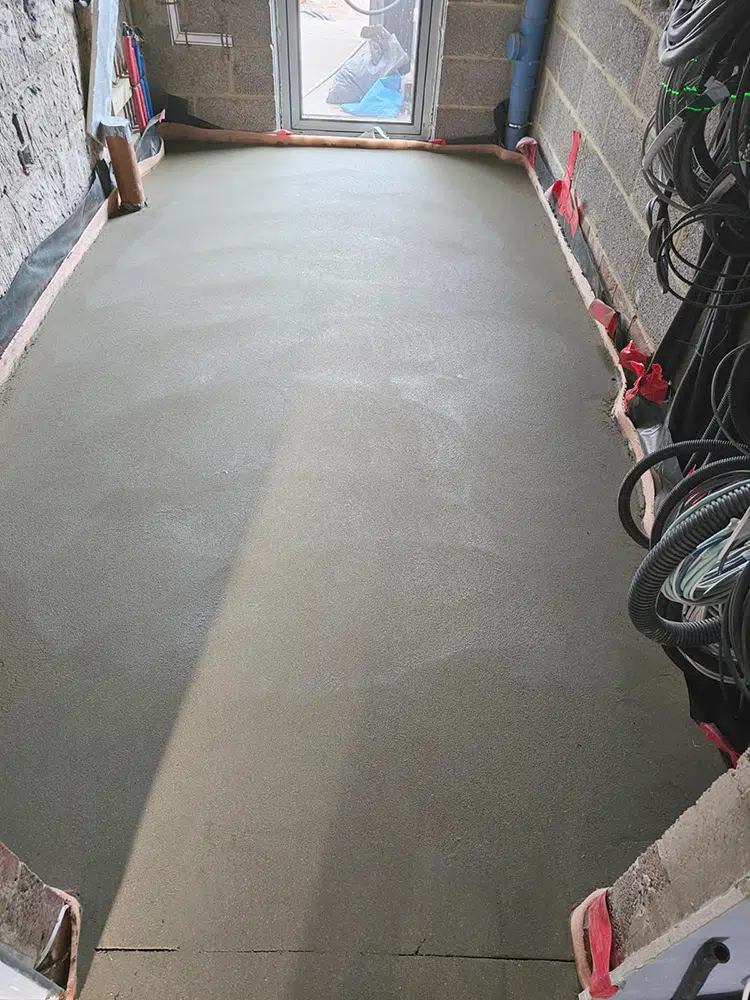
K & B Screeding’s own team, led by director Donatas Bardisevicius. Founded 2019, company 12298780.
See what customers say in our Google reviews and on our testimonials page.
Liquid Screed from Slough to St Neots
As the crow flies, our yard in Slough is about 50.7 miles from St Neots, which lies to the north-north-east. Postcodes here include PE19, and Sandy (6.9 miles), Huntingdon (8 miles), Biggleswade (9.8 miles) and Bedford (10.5 miles) are close by.
More on liquid screed, part of our screeding services.
