
Relaying solid floors in Eynesbury and around St Mary's Church
Terraced houses make up 26% of St Neots homes, and just 6% of all homes were built before 1919. Those older houses sit in particular parts of town. Around the Market Square and St Mary's Church, cottages stand beside larger houses. Late Victorian and Edwardian terraces line the regular streets north and east of the medieval centre. In Eynesbury there are small cottages and terraces alongside early twentieth century council housing.
Older solid floors in these streets often need relaying with a membrane and insulation. Once the old floor is out, the new one is built in layers: a firm base, a damp proof membrane, insulation, and a screed on top. Sand and cement suits that job because each batch is mixed to suit the room, so small rooms, tight doorways and changes in level are all manageable by hand.
Depth follows the method. Laid floating on insulation in a house, it goes down at 65mm. Bonded to concrete that is still sound, it can be just 25 to 40mm. If the floor is being rebuilt, our insulation and membrane work covers the layers underneath.
We tamp it down hard and float it off, leaving a dense, level surface that will take any covering. Drying is slower than with liquid screed: roughly a day for every millimetre up to 40mm, then slower still. If you are relaying the ground floor of an older St Neots house, put those weeks into the plan from the start.
Wet rooms, garages and quick repairs in St Neots
Sand and cement also works where other screeds cannot. A walk-in shower or wet room floor has to fall towards its drain, and working by hand we can form that slope in the screed. It copes with water once tanked, which is why it suits wet areas.
Converting a garage is another job where it earns its keep. Garage floors tend to be lower than the rooms next door, so insulation and screed bring the level up to meet the hall. The build-up is set out layer by layer in our garage conversion floor guide.
UK price data for 2026 has sand and cement at £18 to £25 per m², and fibres for better crack resistance put another £1 to £3 per m² on top. On a small area, hand laying is often the cost effective route because there is no pump to set up.
Where an existing screed has only cracked or broken up in patches, a full relay may not be needed at all, and screed repairs can cut out and replace the damaged section. We check whether the rest of the floor is sound before suggesting either.
Sand and Cement Screed prices in St Neots
Sand and cement screed: £18 to £25 per m² supplied and laid (MyJobQuote, August 2026), so £450 to £630 for 25 m². MyJobQuote does not say whether these figures include VAT. See our floor screeding cost guide or screed calculator.
Who lays your sand and cement screed in St Neots
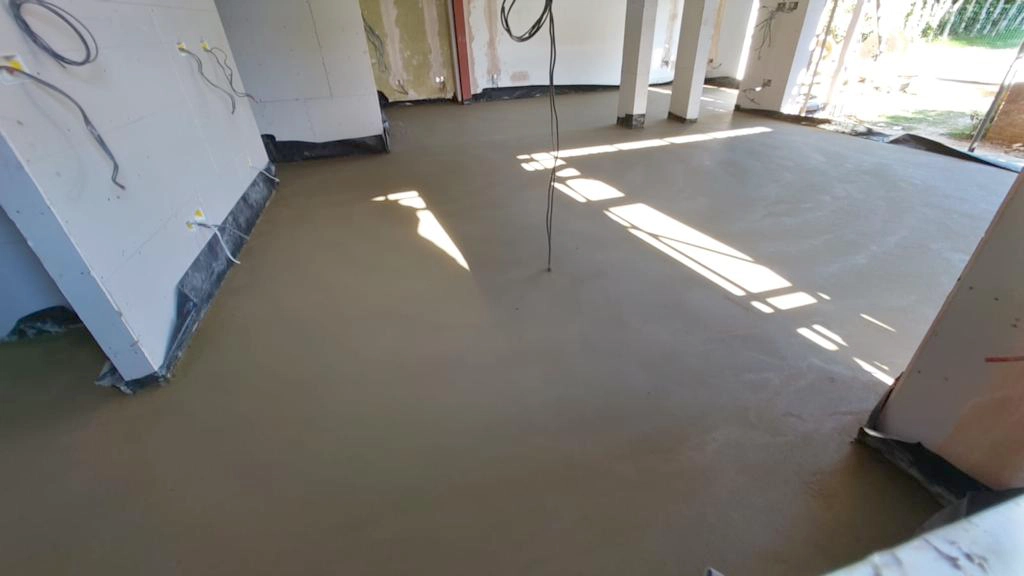
K & B Screeding’s own team, led by director Donatas Bardisevicius. Founded 2019, company 12298780.
See what customers say in our Google reviews and on our testimonials page.
Sand and Cement Screed from Slough to St Neots
As the crow flies, our yard in Slough is about 50.7 miles from St Neots, which lies to the north-north-east. Postcodes here include PE19, and Sandy (6.9 miles), Huntingdon (8 miles), Biggleswade (9.8 miles) and Bedford (10.5 miles) are close by.
More on sand & cement screed, part of our screeding services.
