
Relaying old floors near Church Street, Raunds
The streets around Church Street, Manor Street and Thorpe Street hold the older part of Raunds. Older homes in the centre may have solid floors that are cracked, cold or damp, laid long before insulation and membranes were normal. Patching them rarely lasts.
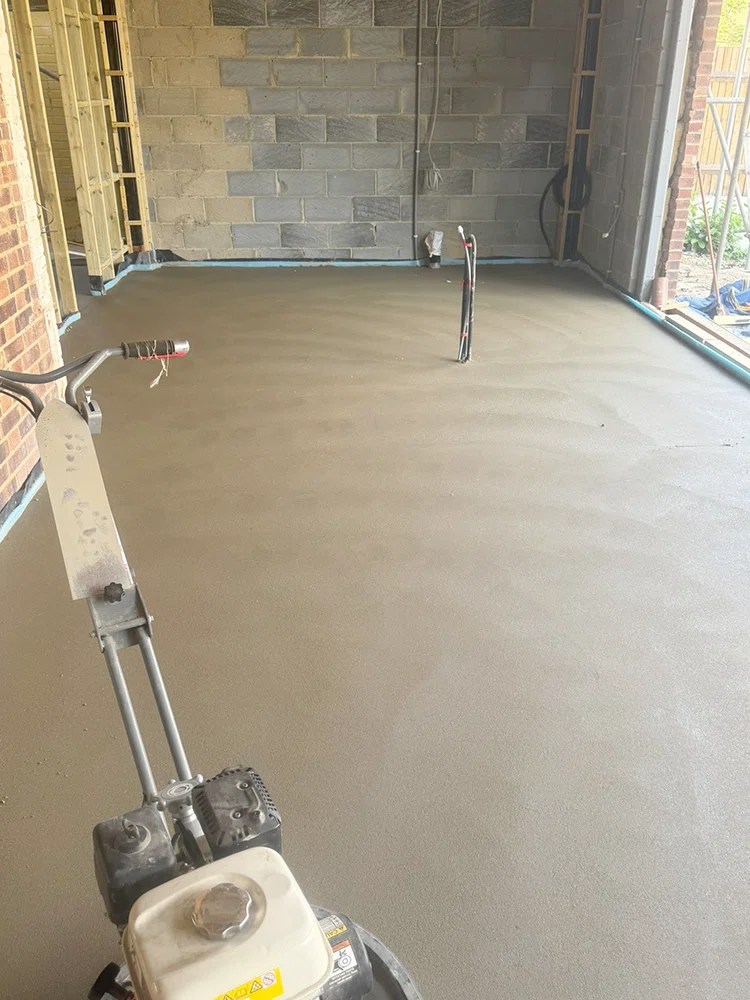
What lasts is digging out to the right depth, then laying a damp proof membrane and insulation boards under a fresh screed. Because the rooms in older houses tend to be smaller, with steps, chimney breasts and awkward doorways, a screed mixed on site and laid by hand is easier to fit around them than a pumped one. On a small area it is cheaper too, since a pump would cost more to set up than it saves.
The depth matters. Over insulation, as a floating layer, the domestic depth is 65mm; commercial space takes 75mm. Bond it straight to sound concrete and 25 to 40mm will do, handy when an old door leaves you little height.
Sand and cement also gives a cement substrate, which some finishes and wet areas need, and it can take load earlier in its life than a calcium sulphate screed. Fibres or a rapid drying additive can be mixed in where the programme or the base calls for them. Membranes and insulation boards under the screed are part of our insulation and membrane work.
Wet rooms, garages and slower drying in Raunds
Some Raunds rooms are better on cement than on calcium sulphate. A walk-in shower or wet room floor has to run down to its drain, and a screed laid by hand can be trowelled to follow that fall. Utility rooms and floors at risk of leaks are safer in sand and cement too.
Garage conversions on later Raunds houses raise a similar question. Usually the old garage floor is lower than the house, so insulation, a membrane and screed go in on top until the level matches the hallway. Our guide to screeding a converted garage goes through each layer, from the old slab up.
Its weak point is drying. Drying runs at about a day a millimetre through the first 40mm, then slows, so a 65mm floor is weeks rather than days from a passing moisture test. Good ventilation helps and a rapid drying mix can shorten the wait. If the room is large and open with no wet areas, pumped liquid screed for larger Raunds floors may suit it better.
Sand and Cement Screed prices in Raunds
Sand and cement screed: £18 to £25 per m² supplied and laid (MyJobQuote, August 2026), so £450 to £630 for 25 m². MyJobQuote does not say whether these figures include VAT. See our floor screeding cost guide or screed calculator.
Who lays your sand and cement screed in Raunds
K & B Screeding’s own team, led by director Donatas Bardisevicius. Founded 2019, company 12298780.
See what customers say in our Google reviews and on our testimonials page.
Sand and Cement Screed from Slough to Raunds
As the crow flies, our yard in Slough is about 56.4 miles from Raunds, which lies to the north. Postcodes here include NN9, and Rushden (4.6 miles), Burton Latimer (6.2 miles), Wellingborough (7.3 miles) and Kettering (9 miles) are close by.
More on sand & cement screed, part of our screeding services.