
Relaying floors in Kettering's shoe-era terraces
Kettering's terraces were built for workers in the boot and shoe trade, and a century or more later their ground floors are often the weak point in a renovation. Some have an old solid floor, cracked and without proper damp protection. Others have suspended timber that has rotted.
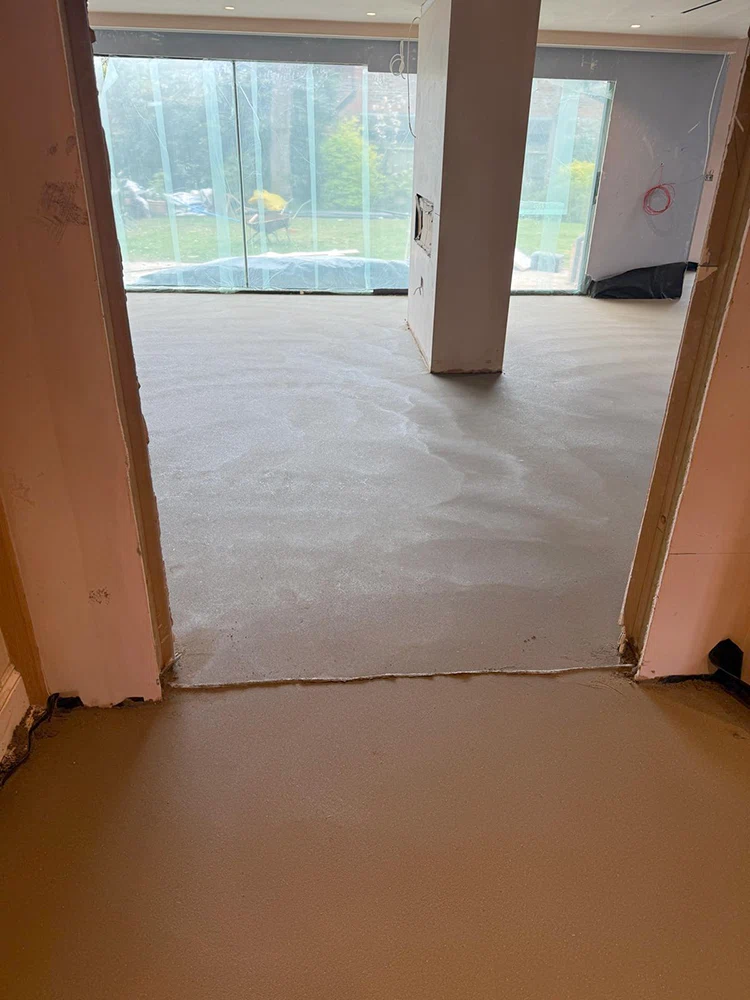
Either way, the repair follows the same pattern. Out comes the old floor, the ground below is taken down far enough for the new layers, and back go a damp proof membrane, rigid insulation and a floating screed. House screeds of this kind go down at 65mm, and the excavation has to leave room for that on top of the insulation.
Terraces make up 24% of Kettering's homes, and their rooms are what make hand-laid screed practical. Narrow front rooms, chimney breasts, alcoves and a back kitchen reached through one door all suit a small team working with screed rails, compaction by hand and a float. The new floor has to meet the front door threshold, the hearth and the bottom stair, and a hand-laid screed can be set to those levels room by room.
Drying takes longer than with a pumped screed, at roughly a day for each millimetre up to 40mm and slower again past that. A quicker drying sand and cement mix cuts the wait when a terrace renovation is on a deadline, and our guide to how long screed takes to dry helps you time the flooring.
Garages, wet rooms and heavy floors around Kettering
Garage conversions are common on the town's post-war and later semis, and a garage floor almost always needs raising. The slab sits lower than the house, so the job is insulation, a membrane and a screed brought up to the hallway level. The sequence of trades is set out in our guide to garage conversion floors.
Wet rooms and level-access showers are sand and cement territory too. Cement based screed tolerates water, and we form the falls to the drain within the screed, so the tiler follows a true slope rather than building one up in adhesive.
If the concrete below is solid and just wants a new top, 25 to 40mm of bonded screed can go straight onto the prepared slab. That costs £12 to £18 (trade2base, June 2026) a square metre on 2026 published rates, compared with £18 to £25 for an ordinary sand and cement floor. It only works if the base is clean and sound, so preparation comes first.
For heavier floors, such as a workshop or a small commercial unit, fibres or a higher strength sand and cement mix add resistance to cracking and wear. That is still a screed rather than a structural slab, and power floated concrete slabs are outside what we lay.
Sand and Cement Screed prices in Kettering
Sand and cement screed: £18 to £25 per m² supplied and laid (MyJobQuote, August 2026), so £450 to £630 for 25 m². MyJobQuote does not say whether these figures include VAT. See our floor screeding cost guide or screed calculator.
Who lays your sand and cement screed in Kettering
K & B Screeding’s own team, led by director Donatas Bardisevicius. Founded 2019, company 12298780.
See what customers say in our Google reviews and on our testimonials page.
Sand and Cement Screed from Slough to Kettering
As the crow flies, our yard in Slough is about 60.1 miles from Kettering, which lies to the north. Postcodes here include NN16, NN15 and NN14, and Burton Latimer (3.3 miles), Desborough (4.9 miles), Corby (6.2 miles) and Wellingborough (6.9 miles) are close by.
More on sand & cement screed, part of our screeding services.
