
Rebuilding old solid floors in Desborough's older houses
An old solid floor that has failed usually announces itself. Tiles crack along a line, the floor sounds hollow in places, the skirting shows a tide mark or the middle of the room has dropped. Patching the surface rarely lasts, because the problem sits below it.
A repair that holds means taking the old floor out, digging deep enough to fit the new build-up, then putting it back layer by layer: damp proof membrane first, rigid insulation over it, and a floating screed to finish. A domestic floating screed in sand and cement is laid at 65mm, which is why the digging has to go deep enough before anything else happens.
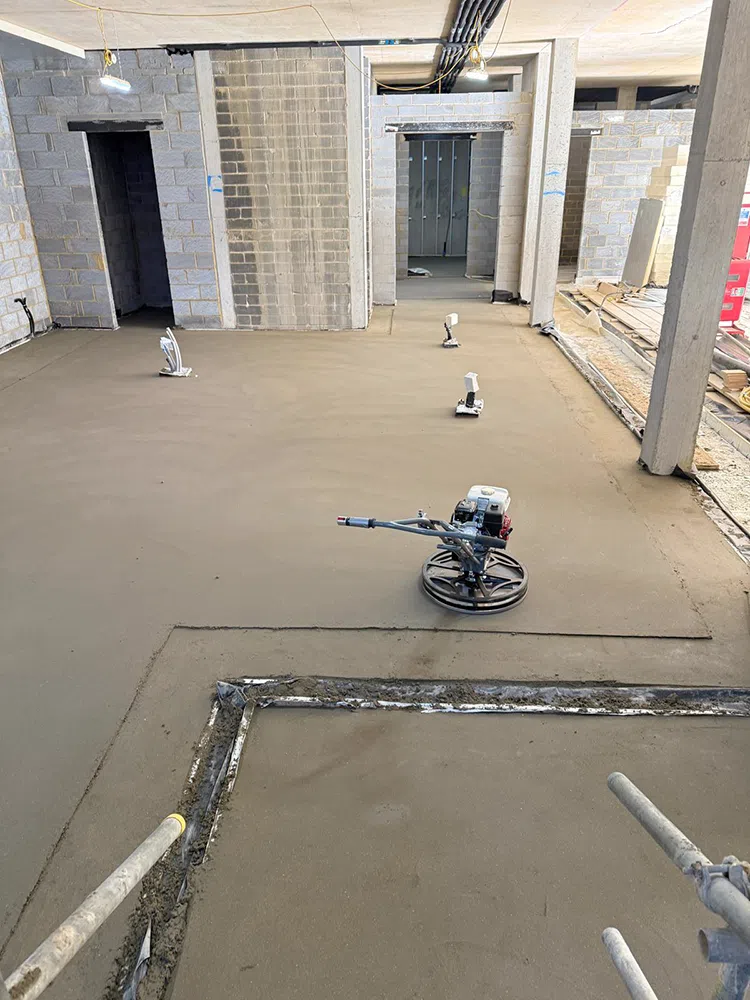
Hand-laid screed suits this work in older houses and in the town's terraces, which make up 19% of its homes. Rooms are often narrow, doorways tight, and the finished floor has to meet existing thresholds, hearths and the bottom stair exactly. The screed is mixed to suit each area, placed between levelled screed rails, compacted by hand and finished with a float, so the team can work around chimney breasts and alcoves without a pump in the street.
Expect a longer wait for drying than with liquid screed. The usual guide is a day for each millimetre up to 40mm, slowing beyond that, so a 65mm floor sits for weeks before it is worth testing for moisture. Where time is short, a quick drying sand and cement mix or a comparison with pumped liquid screed in Desborough is worth a look.
Wet rooms, garages and bonded screeds in Desborough
Because its binder is cement, this screed puts up with water where a calcium sulphate floor would not. That makes it the natural base for a wet room or level-access shower, where the floor must fall to a drain. We form the falls in the screed itself, giving the tiler a true surface to follow rather than trying to build the slope in adhesive.
Garage conversions are another common use on family houses. The garage slab usually sits below the house floor, so the job is to add insulation and a membrane and screed up to meet the hallway. The levels and the sequence of trades are covered step by step in our guide to screeding a converted garage.
Not every floor needs the full 65mm. If the concrete underneath is solid and just wants a fresh top, we can bond 25 to 40mm of screed directly to the prepared slab using a bonding agent. That route depends on the base being clean, sound and free of contamination, which is where floor preparation such as shot blasting comes in.
For heavier use, such as a workshop or a garage kept as a garage, fibres or a higher strength mix can be added. Expect fibres to put roughly £1 to £3 a square metre on the price.
Sand and Cement Screed prices in Desborough
Sand and cement screed: £18 to £25 per m² supplied and laid (MyJobQuote, August 2026), so £450 to £630 for 25 m². MyJobQuote does not say whether these figures include VAT. See our floor screeding cost guide or screed calculator.
Who lays your sand and cement screed in Desborough
K & B Screeding’s own team, led by director Donatas Bardisevicius. Founded 2019, company 12298780.
See what customers say in our Google reviews and on our testimonials page.
Sand and Cement Screed from Slough to Desborough
Desborough is about 63.3 miles north of our Slough base as the crow flies, with postcodes including NN14. The nearest towns to it are Kettering (4.9 miles), Market Harborough (5 miles), Corby (6 miles) and Burton Latimer (8.1 miles).
More on sand & cement screed, part of our screeding services.
