
Rebuilding solid floors in older Market Harborough houses
Houses of that era were often built with a solid ground floor laid straight on the earth or on thin concrete. Over a century or more those floors crack, settle or lose whatever damp protection they had. Patch repairs on floors like this tend to fail, so we normally take the old floor out and rebuild it from the base up. A rebuilt floor goes down in layers: a compacted base, a damp proof membrane, rigid insulation, a separating layer and then the screed. Floating over insulation, a house floor in sand and cement goes down at around 65mm. If the old concrete beneath is solid and the screed is bonded straight onto it, 25 to 40mm can be enough. Hand laying suits these houses. Rooms are smaller, walls are rarely square and doorways are narrow, and a screeder with a straightedge can work into corners and hold levels to an existing hallway or step. It can also be built up in stages where the old base is well out of level. Terraced houses, which make up 20% of the town's homes, are a good example, since there is often no easy route for a pump hose to reach the back room. The mix can be adjusted to the job. Fibres in the mix help stop cracking, and rapid drying additives bring the flooring date forward. For an older floor that needs extra strength, look at fibre reinforced screed.
Garage conversions, wet rooms and falls in Market Harborough
The council-built homes of the Bowden Fields Estate lend themselves to garage conversions and extensions, and sand and cement screed is well suited to both. A garage slab usually sits lower than the house floor, so the new floor has to make up that height with insulation and screed while meeting the building regulations. Our guide to screeding a garage floor shows the layers and usual depths. Wet rooms are the other reason to choose a cement screed. For a walk-in shower the floor has to slope to the drain, and our screeders form that slope by hand with a cement mix. A calcium sulphate floor is the wrong choice anywhere that might stay wet, which is why cement screed goes under the tanking and tiles. What you give up is speed. This mix dries more slowly than most liquid floors, about 1 day per mm to 40mm and slower beyond, so a 65mm Bowden Fields extension floor needs a long wait before moisture-sensitive flooring. If the programme is tight, a faster drying sand and cement mix cuts that wait. Sometimes the existing floor is solid and only uneven, and then levelling it may do instead of a new screed.
Sand and Cement Screed prices in Market Harborough
Sand and cement screed: £18 to £25 per m² supplied and laid (MyJobQuote, August 2026), so £450 to £630 for 25 m². MyJobQuote does not say whether these figures include VAT. See our floor screeding cost guide or screed calculator.
Who lays your sand and cement screed in Market Harborough
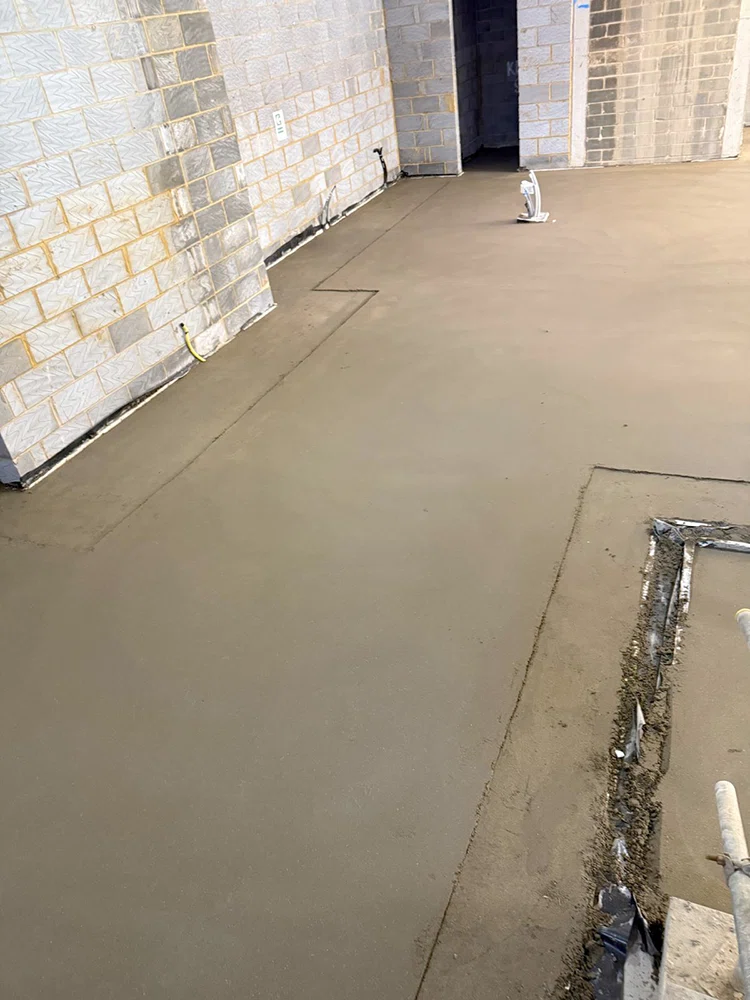
K & B Screeding’s own team, led by director Donatas Bardisevicius. Founded 2019, company 12298780.
See what customers say in our Google reviews and on our testimonials page.
Sand and Cement Screed from Slough to Market Harborough
Market Harborough is about 66.6 miles north of our Slough base as the crow flies, with postcodes including LE16. The nearest towns to it are Desborough (5 miles), Corby (9.4 miles), Kettering (9.9 miles) and Lutterworth (11.8 miles).
More on sand & cement screed, part of our screeding services.
