
Relaying terrace floors near the Earl Shilton Conservation Area
The conservation area around the old A47 keeps the look of the town's framework knitting and shoe making past: red brick terraces, late Victorian factories and a rare group of framework knitters' cottages. Inside the terraces, the ground floors are often solid and laid without any damp protection, and that is where floor trouble tends to start. Damp edges, loose tiles and a cold, musty floor are the signs.
Patching such a floor rarely lasts. The reliable repair is to lift it, dig down to make room for the new build-up, and relay it properly: a damp proof membrane, rigid insulation, a separating layer and a floating sand and cement screed, normally 65mm in a house. For depths across every method, read how thick a screed needs to be.
Homes built before 1919 make up 11% of Earl Shilton's housing, and homes of that age, with small rooms, narrow halls and steps, suit a screed that is mixed on site and compacted by hand. It can be taken round corners and through doorways, and its level adjusted room by room.
Where the finished height is fixed by a door or step and only a thin layer will fit, a bonded screed over sound concrete at 25 to 40mm may work instead. Lifting the old floor and preparing the ground beneath it is part of the same job, priced in one figure.
Garages, wet rooms and falls in Earl Shilton
Garage conversions on the post-war semis are a natural use for sand and cement. Garage slabs usually slope and finish lower than the house, so insulation and a membrane go down first, then screed deep enough to come flush with the hall. A small, enclosed area like that is quick to lay by hand, with no pump needed. The garage floor conversion guide covers the build-up.
Wet rooms are the other clear case. A level-access shower needs a fall to the drain, shaped by hand, and a cement base that tolerates moisture. A calcium sulphate floor has no place in that room.
Terraced houses make up 19% of homes in the town, and a bathroom or utility room at the back of a terrace is a typical place where this applies.
What you pay for that flexibility is waiting. Allow around 40 days for the first 40mm, and longer for anything deeper. If the builder cannot wait that long, a quicker drying sand and cement mix trims the time, and fibres, at an extra £1 to £3 per m², help keep cracks at bay.
Sand and Cement Screed prices in Earl Shilton
Sand and cement screed: £18 to £25 per m² supplied and laid (MyJobQuote, August 2026), so £450 to £630 for 25 m². MyJobQuote does not say whether these figures include VAT. See our floor screeding cost guide or screed calculator.
Who lays your sand and cement screed in Earl Shilton
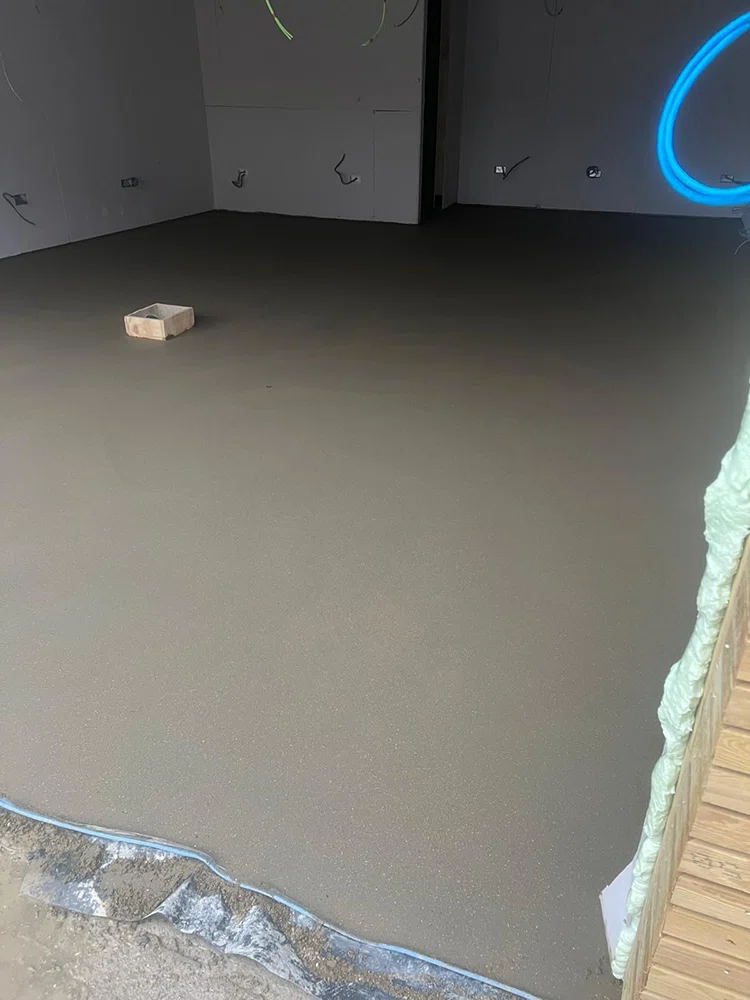
K & B Screeding’s own team, led by director Donatas Bardisevicius. Founded 2019, company 12298780.
See what customers say in our Google reviews and on our testimonials page.
Sand and Cement Screed from Slough to Earl Shilton
As the crow flies, our yard in Slough is about 77.6 miles from Earl Shilton, which lies to the north-north-west. Postcodes here include LE9, and Hinckley (3.4 miles), Nuneaton (7.4 miles), Leicester (8.7 miles) and Bedworth (9.4 miles) are close by.
More on sand & cement screed, part of our screeding services.
