
Rebuilding tired solid floors in older Hinckley houses
An old solid floor usually gives itself away. It may be cracked across a room, sunk near a wall, cold underfoot or damp at the edges, and new flooring laid straight on top tends to lift or stain. Patches tend to fail again, so the job that lasts is to lift the floor and build it back up layer by layer.
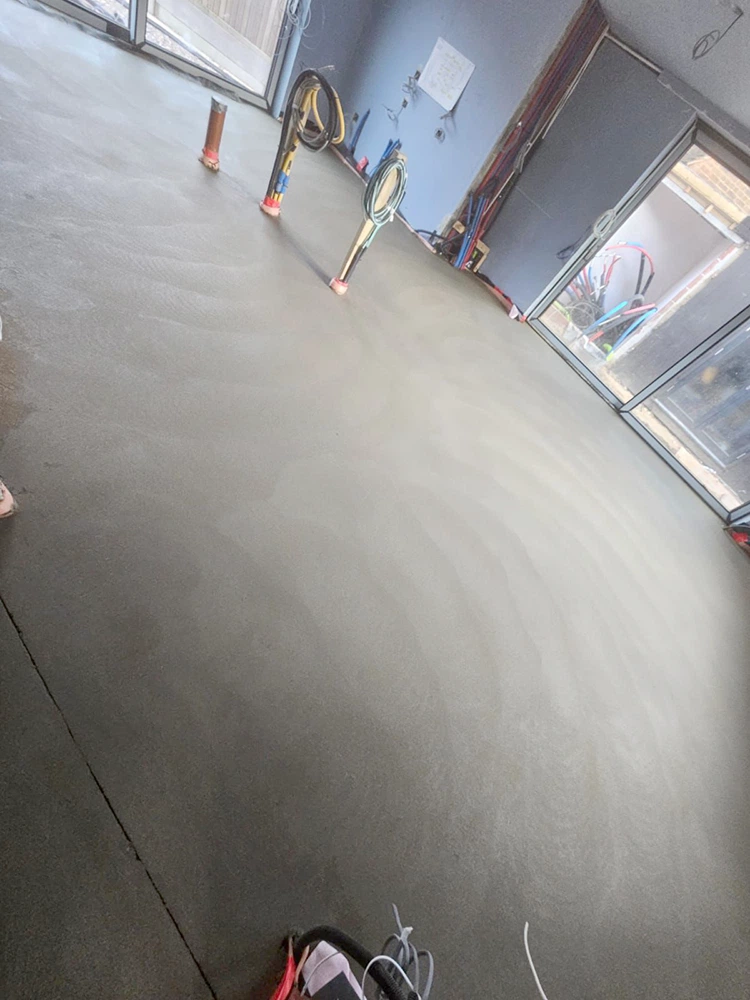
The job starts with breaking out the old slab and screed to a sound base, which our floor preparation work covers. Rigid insulation boards are laid on that base, with a damp proof membrane over them turned up the walls, and the screed goes on last. Laid as a floating floor in a house, sand and cement is about 65mm thick, so the dig must leave room for that plus the insulation if the new floor is to sit level with the existing thresholds.
It is the right material here because each batch is mixed on site for its area and packed down by hand. It copes with narrow hallways, stepped rooms and doorways that a pumped screed would struggle to contain. It also sets up as a cement substrate, which some floor finishes and adhesives prefer.
Where the floor is being kept and only the top is failing, a thinner bonded screed at 25 to 40mm, fixed to the slab below, may be enough. Our screed thickness guide sets out which depth fits which build-up, and we will say which applies once we know what is under your floor.
Garages, wet rooms and falls in Hinckley homes
A few rooms in any Hinckley house are better on cement screed, whatever goes in elsewhere. In a wet room the shower floor must slope to the drain; those falls are shaped by hand in sand and cement, which copes with water where calcium sulphate does not. Utility rooms and bathrooms with a tiled floor follow the same logic.
Garage conversions are a common reason to screed in a semi or detached house, and they bring their own questions: the old garage slab is usually lower than the house floor, may have no membrane and often slopes to the door. Our guide to screeding a converted garage shows how insulation and screed raise that step to meet the house.
Drying speed is what you give up by choosing sand and cement. Each millimetre takes around a day to dry out over the first 40mm, and deeper screed slower again, so a 65mm floor needs a good while longer than liquid screed before timber or vinyl can go on. Where the build has no slack in it, a faster drying cement screed cuts the wait, and fibres for crack resistance add £1 to £3 per m² on published 2026 figures.
Sand and Cement Screed prices in Hinckley
Sand and cement screed: £18 to £25 per m² supplied and laid (MyJobQuote, August 2026), so £450 to £630 for 25 m². MyJobQuote does not say whether these figures include VAT. See our floor screeding cost guide or screed calculator.
Who lays your sand and cement screed in Hinckley
K & B Screeding’s own team, led by director Donatas Bardisevicius. Founded 2019, company 12298780.
See what customers say in our Google reviews and on our testimonials page.
Sand and Cement Screed from Slough to Hinckley
As the crow flies, our yard in Slough is about 76.3 miles from Hinckley, which lies to the north-north-west. Postcodes here include LE10, and Earl Shilton (3.4 miles), Nuneaton (4.2 miles), Bedworth (6 miles) and Lutterworth (9.5 miles) are close by.
More on sand & cement screed, part of our screeding services.