
Rebuilding floors near the High Street and Abbey Fields
An old solid floor without a membrane can look fine until something goes on top of it. Seal it under vinyl or LVT and damp that once escaped through the surface collects under the new finish, lifting tiles or staining boards. Older properties near Kenilworth's High Street conservation area and around Abbey Fields can have floors like this.
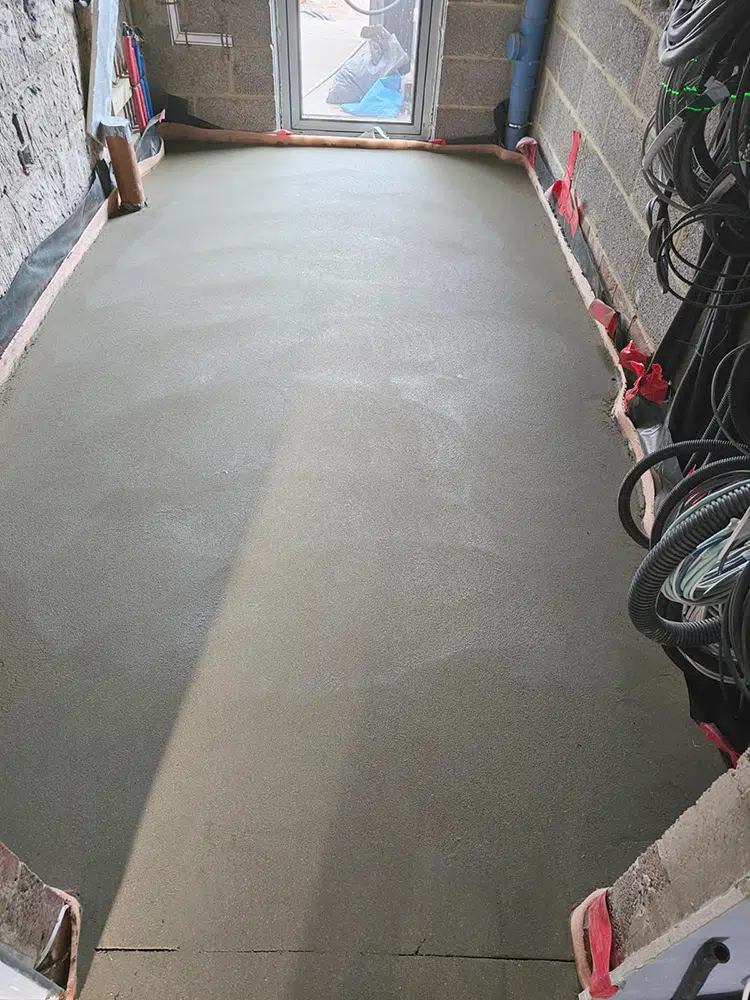
The lasting fix is a rebuild. We break up the old slab and excavate to the depth the new layers need. A damp proof membrane goes in, lapped and turned up at the walls, then insulation, then a new screed. In older rooms with alcoves, uneven walls and thresholds that cannot move, a hand-laid sand and cement screed gives precise control over levels, and it can be mixed in small batches room by room.
Kenilworth has a pre-1919 share of 11%. Houses of that age may also have suspended timber floors in some rooms, which raises questions about ventilation before any solid floor replaces them.
Depth is fixed by the build-up. Over insulation, a house floor wants about 65mm of sand and cement, and a shop or office about 75mm. Straight onto sound concrete, with no insulation between, a bonded layer just 25 to 40mm thick will do. The membrane and insulation can be supplied through our insulation and membranes service, so one team handles the whole floor.
Kenilworth wet rooms, garages and falls to drains
Water that would damage calcium sulphate does a cement screed no harm, so walk-in showers and wet rooms are laid in sand and cement. The slope down to the drain is shaped into the screed as we lay it. That gives the tiler a true, even slope rather than one built up in adhesive.
Garage conversions suit it as well. Most garage bases are lower than the rooms next door, and many fall towards the garage door. Converting it into a room means a membrane, insulation and a screed brought up level with the hall, and sand and cement handles that small enclosed space with no pump needed.
It is also the material to choose where a floor needs a cement substrate for the finish above, or must carry load earlier than a calcium sulphate screed allows. Fibres or rapid drying additives can be mixed in on site.
The drawback is drying time. A 65mm floor needs weeks: around one day per millimetre through the first 40mm, with the rest drying more slowly still. Our screeding cost guide compares methods, and the same service runs in Royal Leamington Spa.
Sand and Cement Screed prices in Kenilworth
Sand and cement screed: £18 to £25 per m² supplied and laid (MyJobQuote, August 2026), so £450 to £630 for 25 m². MyJobQuote does not say whether these figures include VAT. See our floor screeding cost guide or screed calculator.
Who lays your sand and cement screed in Kenilworth
K & B Screeding’s own team, led by director Donatas Bardisevicius. Founded 2019, company 12298780.
See what customers say in our Google reviews and on our testimonials page.
Sand and Cement Screed from Slough to Kenilworth
As the crow flies, our yard in Slough is about 68.8 miles from Kenilworth, which lies to the north-west. Postcodes here include CV8, and Royal Leamington Spa (3.9 miles), Warwick (4.1 miles), Coventry (5.4 miles) and Solihull (9.7 miles) are close by.
More on sand & cement screed, part of our screeding services.
