
Replacing cold kitchen floors in Bedworth homes
Many 1950s and 1960s kitchens in Bedworth sit on a concrete floor laid with little or no insulation. It feels cold underfoot, and fitting a new kitchen over it locks the problem in for another twenty years. The better route is to break out the old floor, dig to the right depth, lay insulation and a damp proof membrane, then screed back to the finished level.
This is home ground for a hand-laid mix. The kitchen is often the only room being done, so the mix is made up on site in the quantity needed and laid to exact levels against existing door thresholds. Laid over insulation in a house, it needs to be about 65mm deep. Thinner than that, it tends to crack.
Older houses add their own questions. 9% of Bedworth's homes were built before 1919 and 12% between the wars, and houses of those ages may have a suspended timber floor in some rooms. Swapping timber for a solid screeded floor changes ventilation and levels, so talk it through first.
Where the new screed goes straight onto a sound slab rather than over insulation, a bonded screed of 25 to 40mm is possible. A fibre reinforced mix adds crack resistance on floors that will carry more weight. We can bring the membrane and insulation as part of the same job. As a guide, published 2026 rates for hand-laid sand and cement run £18 to £25 per m², and fibres put another £1 to £3 on that.
Garage conversions and wet rooms around Bedworth
Turning the garage of a Bedworth semi into a room nearly always involves a new floor. The old base tends to be lower than the house, often falls towards the up-and-over door, and has nothing underneath to keep the cold out. Making it a room means adding a membrane and insulation, then screeding up until it meets the hallway with no step. How those levels are calculated is in our garage conversion floor guide.
A wet room is the second place where nothing else really works. Calcium sulphate screeds do not tolerate repeated wetting, but a cement screed does. The slope to the drain is built into the screed, which gives the tiler an accurate fall to work to. The same screed suits utility rooms and downstairs cloakrooms where splashes are likely.
The main drawback is drying. Expect a 65mm floor to take weeks before it is dry right through: about a day for each of the first 40 millimetres, then slower. When the kitchen fitter is already booked, our fast drying sand and cement shortens the gap. A fibre or rapid drying additive can be mixed in on site, which is one of the advantages of a screed made up by hand. Projects over in Coventry follow the same approach.
Sand and Cement Screed prices in Bedworth
Sand and cement screed: £18 to £25 per m² supplied and laid (MyJobQuote, August 2026), so £450 to £630 for 25 m². MyJobQuote does not say whether these figures include VAT. See our floor screeding cost guide or screed calculator.
Who lays your sand and cement screed in Bedworth
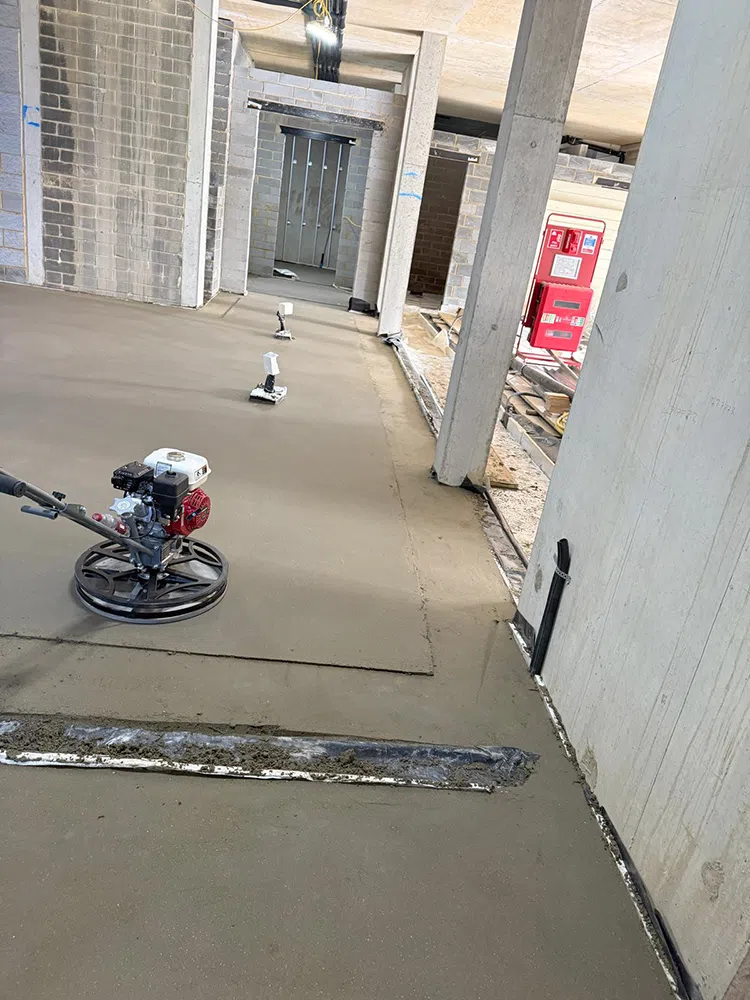
K & B Screeding’s own team, led by director Donatas Bardisevicius. Founded 2019, company 12298780.
See what customers say in our Google reviews and on our testimonials page.
Sand and Cement Screed from Slough to Bedworth
Bedworth is about 74.3 miles north-north-west of our Slough base as the crow flies, with postcodes including CV12 and CV7. The nearest towns to it are Nuneaton (3 miles), Coventry (5.1 miles), Hinckley (6 miles) and Earl Shilton (9.4 miles).
More on sand & cement screed, part of our screeding services.
