
Calcium sulphate grades for Bedworth new build plots
Drawings name a calcium sulphate screed with a code, CA-C25-F5 being a typical one. CA means calcium sulphate. Under the British and European standard, the figure after C is its compressive strength and the figure after F its flexural strength, both in N/mm2.
Three grades cover nearly every job. The lightest, CA-C20-F4, is for house floors with little traffic. A family home, a flat or an office would normally get CA-C25-F5, and CA-C30-F6 goes where wear will be heavier. Alpha hemihydrate screeds are a separate case, used when drying time or depth is the priority, and their own data sheet sets the thickness and drying rules.
Because it hardly shrinks, a calcium sulphate floor in a block of flats can be poured in big bays with little jointing. We set out the joints in advance, placing them at doorways and wherever the building's structure calls for one. With 11% of Bedworth's homes in purpose-built blocks, apartment floors are part of the local mix, and the same planning applies to a block as to a row of plots.
There is one firm limit. Calcium sulphate does not tolerate repeated wetting, so it is not used where the floor may get wet, such as a utility room drain or a shower without proper tanking. In those spots we would pour a cement based flowing screed instead, or use sand and cement laid by hand where a wet room needs falls. Our anhydrite explainer digs into how the material behaves.
Sanding and testing anhydrite floors in Bedworth
Before any covering goes onto a calcium sulphate floor, two things must be done.
Laitance comes first. A fragile film rises to the surface while the screed sets. Tile adhesive or LVT adhesive laid over it bonds to that skin rather than the screed, and the finish can lift. When the floor has dried sufficiently, we sand that film off, take up the dust and apply a calcium sulphate primer. That sanding and priming is part of our preparation work before flooring.
Moisture comes second. Flooring makers often allow a calcium sulphate base less moisture than a cement one, so aim for the figure printed on your chosen floor's data sheet. A hygrometer test confirms it. With heating pipes in the floor, warming it from about 7 days can speed the drying up.
Skipping either step is the usual reason a calcium sulphate floor fails under its finish. Both are written into the handover notes we leave, so the flooring fitter knows what has been done and what still needs doing before adhesive goes down. For a project in Rugby, see anhydrite flow screed in Rugby.
Anhydrite & Flow Screed prices in Bedworth
Liquid flowing screed (which includes anhydrite): £24 to £31 per m² supplied and laid (MyJobQuote, August 2026), so £960 to £1,240 for 40 m². MyJobQuote does not say whether these figures include VAT. See our floor screeding cost guide or screed calculator.
Who lays your anhydrite and flow screed in Bedworth
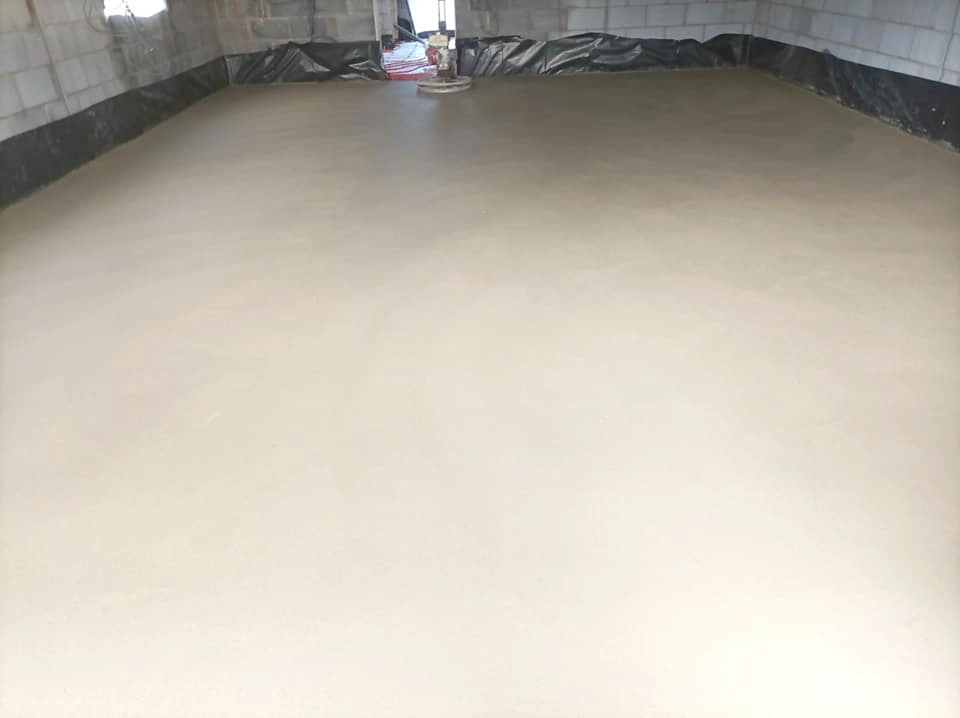
K & B Screeding’s own team, led by director Donatas Bardisevicius. Founded 2019, company 12298780.
See what customers say in our Google reviews and on our testimonials page.
Anhydrite & Flow Screed from Slough to Bedworth
Bedworth is about 74.3 miles north-north-west of our Slough base as the crow flies, with postcodes including CV12 and CV7. The nearest towns to it are Nuneaton (3 miles), Coventry (5.1 miles), Hinckley (6 miles) and Earl Shilton (9.4 miles).
More on anhydrite screed, part of our screeding services.
