
Grades and products on East of Lutterworth plots
Calcium sulphate screed, which many call anhydrite, is ordered by grade, not by brand. Take CA-C25-F5: CA is calcium sulphate, and the figures after C and F give compressive and flexural strength in N/mm2.
CA-C20-F4 is the domestic grade, for floors with light traffic. The middle grade, CA-C25-F5, covers the bulk of homes, apartments and offices. Where use is heavier, CA-C30-F6 is the one. On a housing plot, the grade is the designer's choice, and we pour that grade without swapping it.
Alpha hemihydrate products are the alternative when faster drying or reduced depth matters. Their thickness and drying time follow each product's own data sheet.
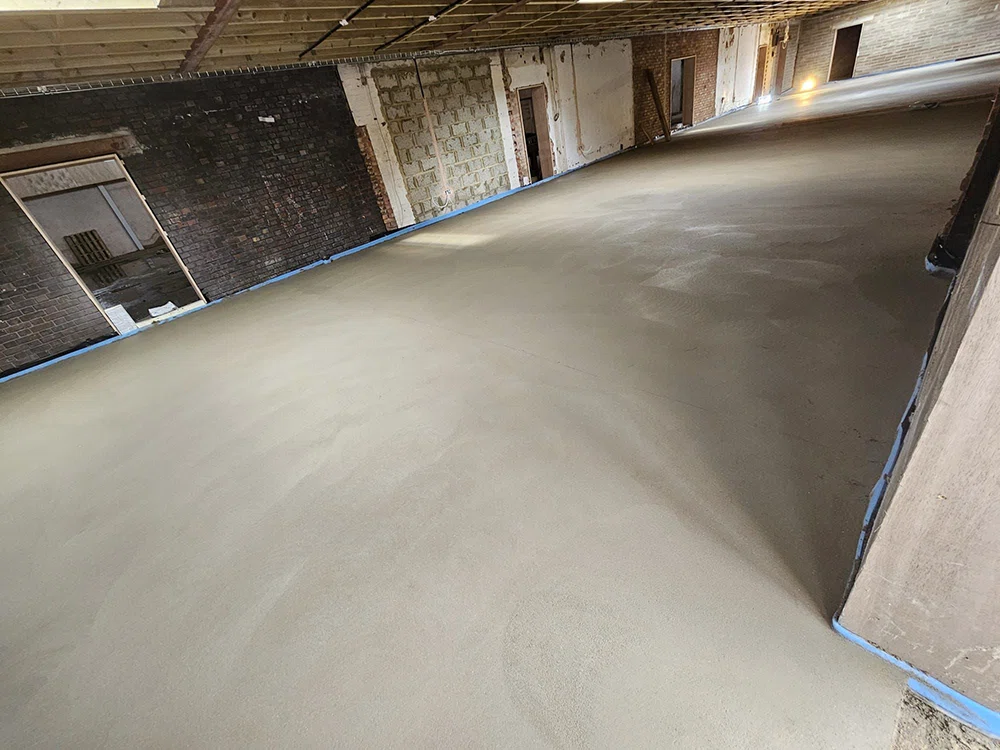
On new build sites its main advantage is that it shrinks very little. That allows large bays with few joints across open-plan ground floors, and it keeps the floor flat and stable over insulation and underfloor heating. Before the pour we draw up where bays and joints go, putting the joints at doorways and heating zones.
Purpose-built blocks make up 7% of Lutterworth's homes, and apartment floors suit calcium sulphate for the same reasons: long corridors and open living areas poured in broad bays, with a stable base over insulation and heating pipes. There is a plainer guide to the material in anhydrite screed explained, and pumped floors in general are on our Lutterworth liquid screed page.
Laitance, moisture and primers before Lutterworth floors go down
Calcium sulphate screed needs finishing work after the pour. Laitance, a weak skin, forms on the surface while it cures and has to be sanded off after the floor has dried. Adhesives and levelling compounds bond poorly to laitance, and floor coverings laid over it can lift.
Moisture is the next check. A calcium sulphate floor often has to reach a drier reading than cement before the flooring maker will accept it, so we test against that maker's figure rather than judging by eye. Heated floors can usually be force dried from about 7 days, which speeds things up, but the test still comes before the covering.
Priming comes last. The calcium sulphate needs a compatible primer before any adhesive or compound with a cement base goes on. Where a smoother surface is needed for LVT or sheet vinyl, our floor levelling service uses products suited to the screed.
This material is not the right choice for areas that may get wet. Wet rooms and spaces like them take a flowing screed with a cement binder, or traditional sand and cement, instead. Every pour finishes with written guidance from us on drying and laitance, so the flooring contractor knows the steps.
Anhydrite & Flow Screed prices in Lutterworth
Liquid flowing screed (which includes anhydrite): £24 to £31 per m² supplied and laid (MyJobQuote, August 2026), so £960 to £1,240 for 40 m². MyJobQuote does not say whether these figures include VAT. See our floor screeding cost guide or screed calculator.
Who lays your anhydrite and flow screed in Lutterworth
K & B Screeding’s own team, led by director Donatas Bardisevicius. Founded 2019, company 12298780.
See what customers say in our Google reviews and on our testimonials page.
Anhydrite & Flow Screed from Slough to Lutterworth
As the crow flies, our yard in Slough is about 68 miles from Lutterworth, which lies to the north-north-west. Postcodes here include LE17, and Rugby (6.3 miles), Hinckley (9.5 miles), Earl Shilton (9.7 miles) and Bedworth (11.6 miles) are close by.
More on anhydrite screed, part of our screeding services.
