
Knock-throughs on Greenacres and other Lutterworth estates
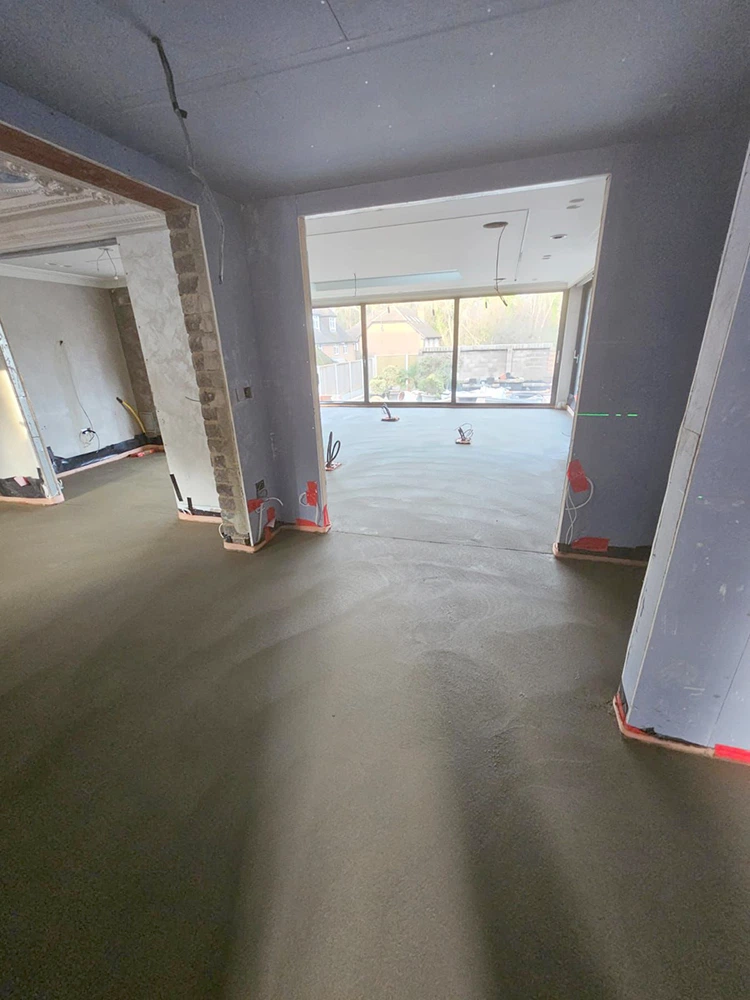
Established estates such as Greenacres are typical places for kitchen knock-throughs and rear extensions. Knock two rooms together and the floor underneath rarely matches. One half might be old quarry tiles, the other worn concrete under a layer of vinyl glue, with a strip of patched screed where a wall used to stand. Sheet vinyl or LVT laid over that shows every edge.
Latex screed is how those mixed surfaces become one. The powder is cement based, and it is blended with a latex liquid rather than water, then spread thinly over a primed base. Each part of the floor is prepared on its own terms first. Firmly bonded tiles are cleaned and keyed, and any hollow ones are taken out and filled. Thin, hard adhesive may be primed over, while soft or heavy residue comes off, often with our diamond grinding to clear the base. Any lip where an old wall line or the extension slab sits higher is taken down at the same stage.
Timber needs a different start. Bare boards are never coated directly. They are fixed down and overboarded with flooring grade plywood screwed at close centres, and the latex goes over the ply.
Flats make up 8% of Lutterworth's homes, and where an upstairs flat has a timber floor the same route applies.
Once the latex has cured, the room can take sheet vinyl, LVT, lino, rubber, safety flooring or carpet. Where a floor needs more than a thin smoothing coat, our page on deeper floor levelling explains the alternatives.
George Street floors and when latex must wait
Many of the older buildings in the town's historic core, near George Street and Leicester Road, stand on solid floors that predate the routine use of damp proof membranes. That matters for latex, because a few millimetres of compound does nothing to stop moisture. Spread over a damp slab, it simply traps the damp under the new floor covering, which can then lift, smell or blister. The lasting fix in those buildings is to dig the floor out and lay a new sand and cement floor with a membrane, and only then think about a smoothing layer.
Two other faults rule latex out for now. A timber floor that bounces will crack any thin topping, so the structure has to be stiffened first. A floor that is badly out of level, falling or dipping by much more than a few millimetres, needs a deeper compound or a new screed instead.
Newer homes north of the town raise a different point. If a floor there was laid in calcium sulphate liquid screed, the surface laitance must be sanded off and a compatible primer applied before latex goes on. Without that, the latex grips a weak skin and can come away.
Cracked or broken screed is a job for screed repairs before any topping. The same latex service runs in nearby towns, including latex screed in Rugby.
How we price latex screed in Lutterworth
A fixed written price within 24 hours, once we know the area and the base. See our floor screeding cost guide.
Who lays your latex screed in Lutterworth
K & B Screeding’s own team, led by director Donatas Bardisevicius. Founded 2019, company 12298780.
See what customers say in our Google reviews and on our testimonials page.
Latex Screed from Slough to Lutterworth
As the crow flies, our yard in Slough is about 68 miles from Lutterworth, which lies to the north-north-west. Postcodes here include LE17, and Rugby (6.3 miles), Hinckley (9.5 miles), Earl Shilton (9.7 miles) and Bedworth (11.6 miles) are close by.
More on latex screed, part of our screeding services.