
Latex over tiles and old adhesive in Daventry refits
With most Daventry houses built in the overspill era or since, the slab under a kitchen or bathroom is rarely the problem. The trouble is the surface. Semi-detached houses make up 32% of the town's homes, and in houses of that age a refit often uncovers ceramic tiles laid by an earlier owner, a scatter of old adhesive, or a pattern of filled chases where pipes and cables were moved. None of that suits thin vinyl or LVT, which shows every edge and ridge beneath it.
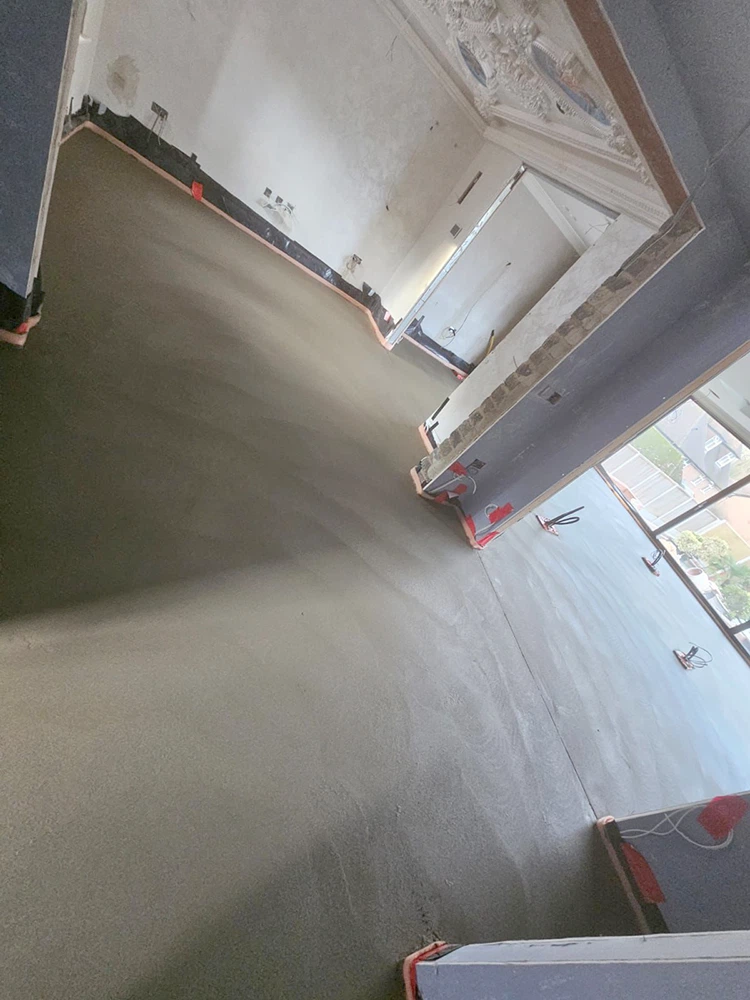
Latex deals with that kind of surface. It is supplied as a cement based powder and a latex liquid that replaces the usual water. Mixed, it runs out thin, bonds well to dense surfaces like glazed tile and sets with a little give, so a base made of different materials stays crack free under the new floor.
The base must earn the latex. Tiles are tapped across the whole room, and hollow or loose ones come up. Adhesive stays only when it is thin, hard and well bonded. Thick or soft residue comes off, and where scraping will not shift it, grinding the slab back clears it. Gaps and chases are filled first.
Conservatory conversions, a typical project in places like Southbrook and Ashby Fields, can raise the same question. If the old floor is staying and is solid, latex may be the right top layer once the new room is weathertight and the base is dry.
Primers and damp checks for Daventry latex floors
Each base takes its own primer. Glazed tiles need one that grips a surface with no suction. Concrete takes one that slows how quickly it draws water out of the mix, and plywood one suited to timber. At Monksmoor Park and other recent phases, extensions often have a liquid screed over heating pipes. Where that screed is calcium sulphate, the soft skin on top is always sanded away first, then a primer made for calcium sulphate goes on before the latex.
A moisture check comes before mixing. Latex is not a damp barrier, and a floor holding moisture will push a thin layer off. In an extension, that means waiting for the screed to dry and confirming it with a reading.
Timber is handled with care. Latex never goes onto bare boards: the boards are fixed, springy sections dealt with, and flooring grade plywood screwed down across the room as the base. A floor that still moves is not ready.
If the floor is well out of level across the room, latex is the wrong layer; deeper levelling compound or a new liquid screed comes first. For homes towards Rugby, see latex screed in Rugby.
How we price latex screed in Daventry
A fixed written price within 24 hours, once we know the area and the base. See our floor screeding cost guide.
Who lays your latex screed in Daventry
K & B Screeding’s own team, led by director Donatas Bardisevicius. Founded 2019, company 12298780.
See what customers say in our Google reviews and on our testimonials page.
Latex Screed from Slough to Daventry
As the crow flies, our yard in Slough is about 54.8 miles from Daventry, which lies to the north-north-west. Postcodes here include NN11, and Rugby (9 miles), Northampton (11.3 miles), Towcester (11.4 miles) and Lutterworth (13.7 miles) are close by.
More on latex screed, part of our screeding services.