
Wet rooms and garage floors in Daventry homes
The first reason to choose sand and cement is water. Calcium sulphate cannot be left wet, so a walk-in shower, wet room or utility with a leaking washing machine needs a cement floor. We trowel the slope to the drain straight into the screed, and the tiler then works on a firm surface that already falls the right way.
The second is the garage. A garage conversion needs its floor brought up to the hallway height, built in layers of membrane, insulation boards and screed. The guide to screeding garage conversions sets out the typical build-up. Over insulation in a house, this kind of screed goes down 65mm thick, which has to be allowed for when the depth is worked out from the house floor level.
Third, small and awkward rooms. Terraced houses make up 26% of Daventry's homes, and where the only way in is through the front door, a screed that arrives as sand and cement and goes in by barrow avoids the need for a hose run. A pump is hard to justify for a cloakroom or a porch.
Finally, early load. Where a floor needs a cement substrate or has to take traffic sooner, additives help: fibres improve crack resistance and rapid drying additives cut the waiting time. The choices are set out under fast drying sand and cement screed, and MyJobQuote's 2026 figures price that faster mix at £20 to £28 a square metre.
Bonded or floating screed over Daventry concrete slabs
Because most Daventry homes date from the overspill era or later, the ground floor is usually a concrete slab in reasonable order. That opens a choice between two ways of laying screed on it.
Bonding means gluing the new layer to a clean, solid slab, and it can then be as thin as 25 to 40mm. It suits a room where there is little height to play with and no insulation is being added. The slab must be clean and properly prepared, or the bond fails, and bonded screed explains how that preparation is done.
Floating means it rests loose over boards or a membrane sheet, which calls for 65mm in a house and 75mm in commercial premises. It is the usual route when insulation is being added, as in an extension or a garage conversion, and it lets the floor move independently of the slab.
It takes longer to dry than a pumped floor, and with heating pipes inside, the system stays off for three weeks, 21 days at the least. For a heated extension, read the Daventry underfloor heating screed page first.
Sand and Cement Screed prices in Daventry
Sand and cement screed: £18 to £25 per m² supplied and laid (MyJobQuote, August 2026), so £450 to £630 for 25 m². MyJobQuote does not say whether these figures include VAT. See our floor screeding cost guide or screed calculator.
Who lays your sand and cement screed in Daventry
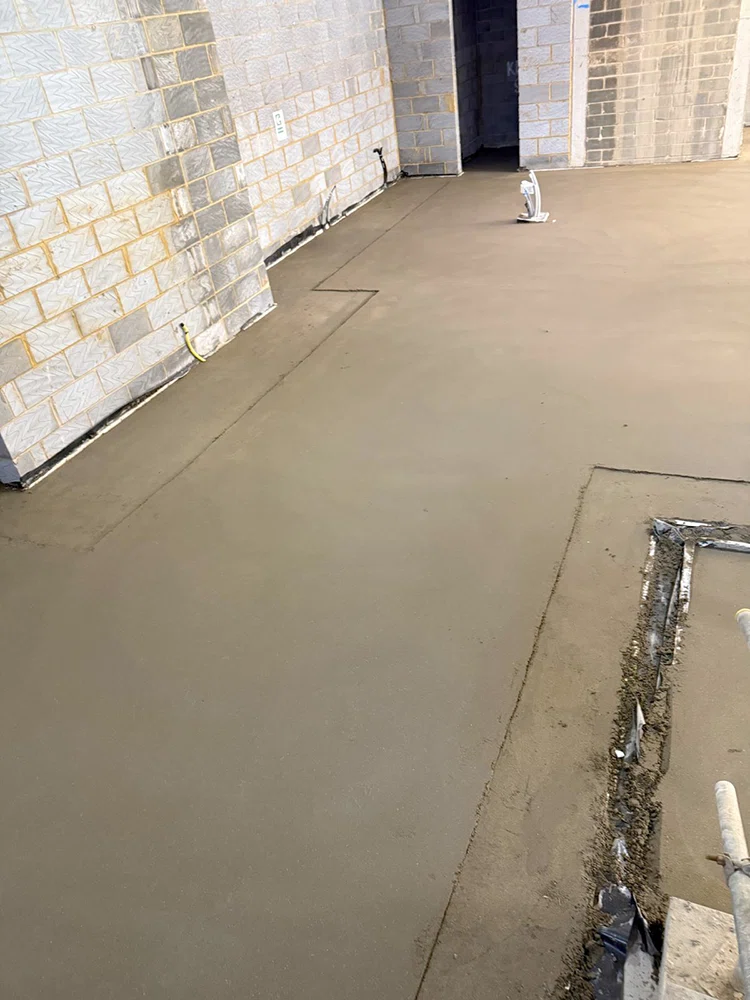
K & B Screeding’s own team, led by director Donatas Bardisevicius. Founded 2019, company 12298780.
See what customers say in our Google reviews and on our testimonials page.
Sand and Cement Screed from Slough to Daventry
As the crow flies, our yard in Slough is about 54.8 miles from Daventry, which lies to the north-north-west. Postcodes here include NN11, and Rugby (9 miles), Northampton (11.3 miles), Towcester (11.4 miles) and Lutterworth (13.7 miles) are close by.
More on sand & cement screed, part of our screeding services.