
Relaying old floors along Watling Street
Towcester was a stagecoach stop between London and Holyhead, when over twenty inns lined the main street, and the older buildings along Watling Street East and Watling Street West date from long before modern floors. Only 7% of Towcester homes were built before 1919, a small share, but floors of that age take the most care.
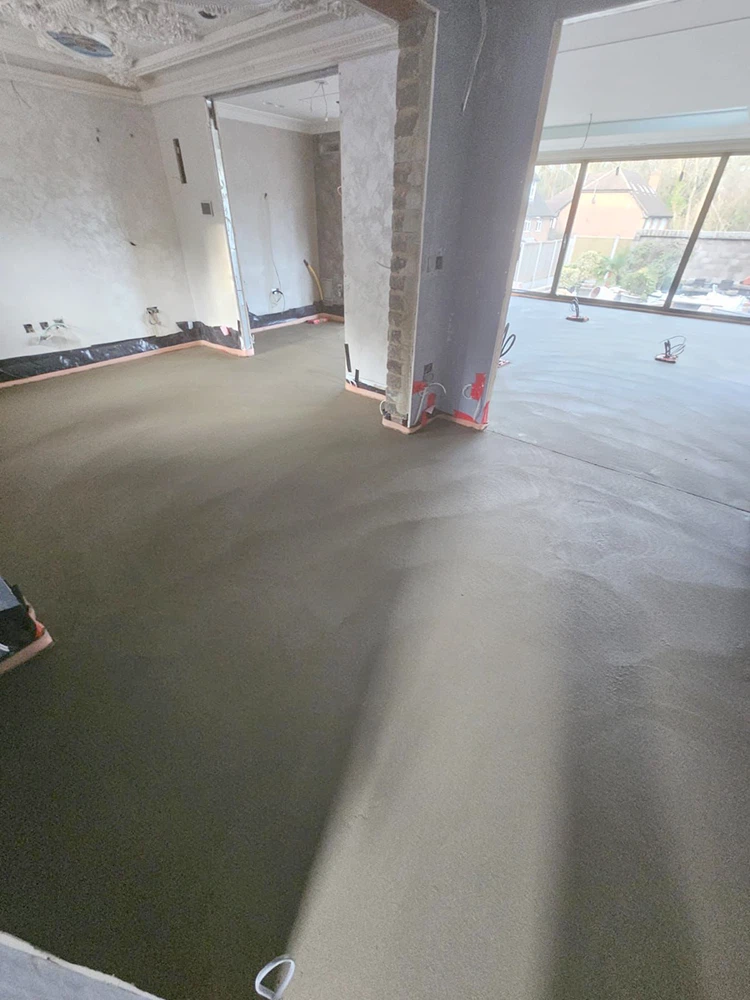
An old solid floor in one of these buildings may be uneven and cold, with no insulation beneath it. It is lifted, the ground is prepared, and a membrane and insulation go down before a new screed brings it back to a level base. Floating on insulation, it goes in at 65mm in a home, or 75mm where the use is commercial, a shop or a pub for instance.
The same applies in conversions such as Gilbert Scott Court, in the former Union Workhouse, where old solid floors often need the same lifting and relaying. Where door and stair heights are fixed, the depth is planned before any floor is broken out.
This is the kind of job a hand-laid screed handles well. It is mixed on site to suit each room, taken through doorways by barrow, and finished around steps, hearths and old walls. Where the screed can be bonded to a sound existing base, it can be 25 to 40mm, which helps under fixed door heights; our bonded screed page explains that option.
Wet rooms, garages and Towcester extensions
Anywhere water may reach should get a sand and cement screed. Walk-in showers and wet rooms have to fall towards a drain, and those falls are shaped by hand. Utility rooms and cloakrooms also suit a cement screed better than a calcium sulphate one.
Garage conversions are much the same. In most garages the slab sits below the house floor, and we lift it to the hallway with insulation and screed. The layers and depths are set out in our guide to garage floor screed.
Extensions bring their own rule: whatever is laid must finish flush with the original floor, to the millimetre. Hand-laid screed can be finished precisely to a datum, which helps where the extension is small or broken up into several rooms. For a large, open extension, pumped liquid screed in Towcester is usually faster.
The trade off is drying. Allow about one day of drying for each millimetre up to 40mm, then longer per millimetre, and a 65mm screed is several weeks away from taking a floor finish. Fast drying mixes and fibres can be added where the programme or the base needs them.
Sand and Cement Screed prices in Towcester
Sand and cement screed: £18 to £25 per m² supplied and laid (MyJobQuote, August 2026), so £450 to £630 for 25 m². MyJobQuote does not say whether these figures include VAT. See our floor screeding cost guide or screed calculator.
Who lays your sand and cement screed in Towcester
K & B Screeding’s own team, led by director Donatas Bardisevicius. Founded 2019, company 12298780.
See what customers say in our Google reviews and on our testimonials page.
Sand and Cement Screed from Slough to Towcester
On the map, Towcester sits north-north-west of Slough, about 44 miles from our base in a straight line (postcodes including NN12), next to Northampton (8.3 miles), Buckingham (9 miles), Brackley (9.5 miles) and Daventry (11.4 miles).
More on sand & cement screed, part of our screeding services.
