
Relaying floors in Northampton's shoe factory terraces
Many of Northampton's terraces were built for shoe factory workers, and 14% of the town's homes date from before 1919. More than a century on, the ground floor is often where a renovation starts. Old solid floors crack, sink or lose whatever damp protection they had, and patching the surface only hides the problem for a while.
The durable repair is to take the floor up, dig to a depth that allows for the new layers, and rebuild: damp proof membrane, rigid insulation and a floating screed on top. A domestic floating sand and cement screed is laid at 65mm, and the finished floor has to meet the front threshold, the hearth and the stair exactly.
That is where hand-laid screed makes sense in a terrace. The rooms are narrow and broken up by chimney breasts, and access is often through a single front door. A small team can mix to suit each area, set screed rails to the right level and compact and float the screed by hand, working around every obstacle without a mixer truck in the street.
Expect it to take longer to dry than a pumped floor, at about a day for each millimetre up to 40mm and more slowly past that. Where the programme is tight, a quick drying screed helps, and a fibre reinforced mix reduces the risk of cracking on a floating floor.
Conversions, wet rooms and bonded floors in Northampton
Across the development corporation's housing in the south, from Briar Hill and Camp Hill to East and West Hunsbury, extensions and conversions are a constant. Where a conversion involves a garage, the floor is almost always too low. Raising it to meet the hall takes insulation, a membrane and new screed on top, and the order those go in is set out in our guide to converting a garage floor.
Being bound with cement, this screed copes with water, so it is what we put under wet rooms and level-access showers. The slope down to the waste is built into the screed as we lay it, which leaves the tiler a true fall to work to.
If the slab underneath is solid and simply wants a fresh top, 25 to 40mm of screed can be bonded to it using a bonding agent. Published 2026 figures give £12 to £18 per m² (trade2base, June 2026) for bonded work, while a standard sand and cement screed runs at £18 to £25 per m². None of that works unless the concrete is clean and solid to start with.
If you are weighing this against a pumped floor for a larger extension, compare it with liquid screed in Northampton.
Sand and Cement Screed prices in Northampton
Sand and cement screed: £18 to £25 per m² supplied and laid (MyJobQuote, August 2026), so £450 to £630 for 25 m². MyJobQuote does not say whether these figures include VAT. See our floor screeding cost guide or screed calculator.
Who lays your sand and cement screed in Northampton
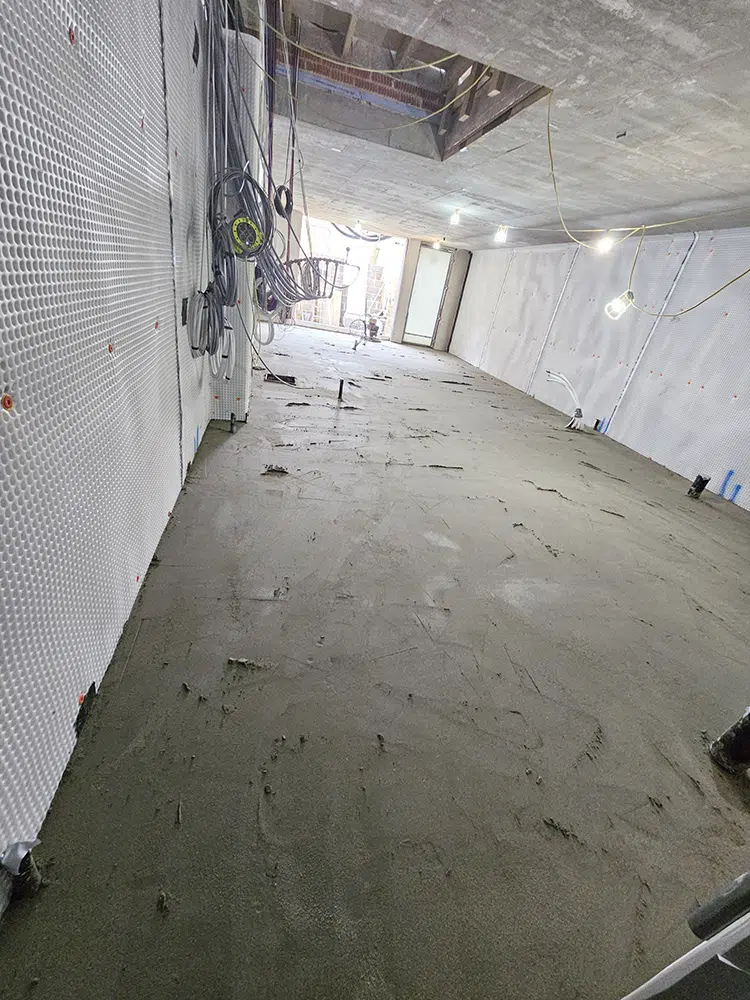
K & B Screeding’s own team, led by director Donatas Bardisevicius. Founded 2019, company 12298780.
See what customers say in our Google reviews and on our testimonials page.
Sand and Cement Screed from Slough to Northampton
Northampton is about 49.9 miles north-north-west of our Slough base as the crow flies, with postcodes including NN1, NN3, NN4 and NN2. The nearest towns to it are Towcester (8.3 miles), Wellingborough (9.7 miles), Daventry (11.3 miles) and Burton Latimer (12.6 miles).
More on sand & cement screed, part of our screeding services.
